 The Bitcoin Beacon
A hawkish Fed chair can talk tough on inflation. With a federal debt past $37 trillion to refinance, the math argues he blinks — and that math is bitcoin’s whole case.
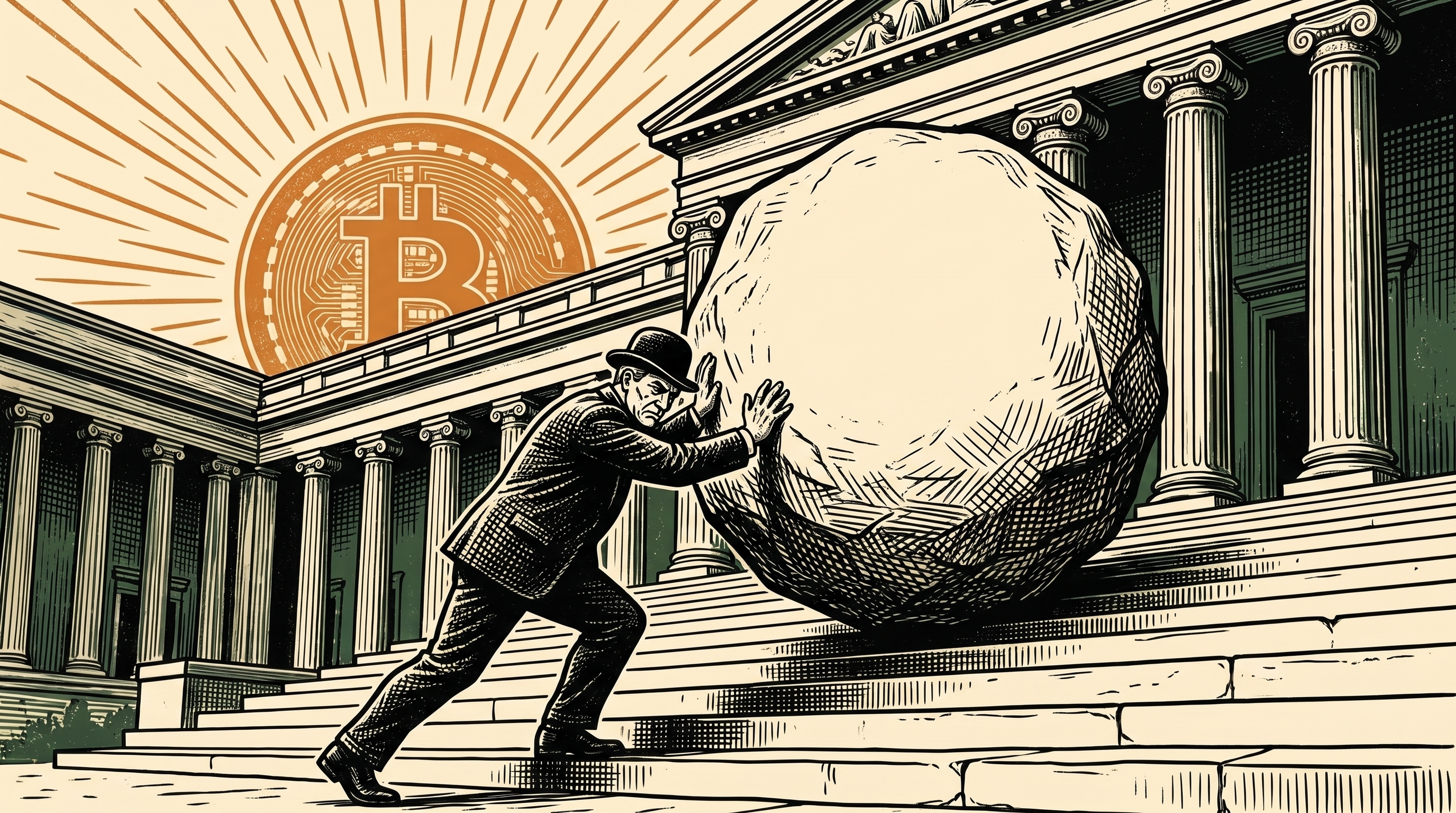
THE TAKE — Kevin Warsh spent his first Jackson Hole as Fed chair sounding like a man who intends to raise interest rates. Markets believe him: the odds of a September hike jumped from near zero to roughly 60% on his words alone. Take him at face value, and the Fed is about to defend the dollar’s value against stubborn inflation. Look at the government behind him, and the resolve looks a lot more fragile.
The problem is arithmetic. The United States carries a federal debt now well past $37 trillion, with more than a trillion dollars a year going to interest alone. Every quarter-point Warsh adds makes that pile more expensive to roll over. A central bank that hikes into a debt load this size is not just cooling the economy; it is raising the government’s own borrowing bill toward levels that crowd out everything else.
Economists call it fiscal dominance: the point where a government’s debt is so large that monetary policy bends to serve the budget rather than the currency. A fully independent Fed hikes until inflation breaks. A cornered one discovers reasons to stop — financial stability, a wobbling labor market, a Treasury that needs cheap money — long before the job is done.
That tension is already visible. A hawkish Fed chair and a Treasury that wants low yields to fund deficits are on a collision course, and analysts have noted the two may end up openly at odds. Warsh can talk tough. The question is whether the political and fiscal system will let him act tough for more than a meeting or two.
Strip away the noise and bitcoin’s thesis is a single wager: that when defending the currency collides with funding the state, the state wins, and the currency is quietly debased to make the debt bearable. Not through a dramatic default, but through years of inflation running a step ahead of interest rates — the slow tax that shrinks what a dollar buys while the debt stays nominally the same.
Bitcoin does not need the Fed to fail. It needs the Fed to face a choice between the currency and the debt — and history says which one loses.
Against that backdrop, a supply that no chair can expand looks less like a gimmick and more like a hedge. Twenty-one million coins, an issuance schedule that ignores elections and deficits, no board that can vote to print more. Bitcoin’s pitch is not that it yields; it is that it cannot be inflated by anyone under pressure to inflate.
The bearish read deserves airing. Warsh may well hold the line; a credible hike would prove fiscal dominance is a theory, not a law, and a resolutely hawkish Fed could drag bitcoin down hard in the short run, as it has before. Debt-crisis predictions are also famously early — the US has carried “unsustainable” debt for decades without a reckoning, and betting on the printing press has bankrupted plenty of people who were right about the destination and wrong about the timing.
But the direction of travel is hard to miss. Each cycle, the debt is larger and the room to fight inflation is smaller. Warsh may win this round. The trend still argues that the money gets softer over time — and that is the case bitcoin was built to express.
Free. Five minutes. No hype.
Subscribe free