 The Bitcoin Beacon
America’s two biggest miners spent the first half of 2026 as net sellers, cashing out coins to chase data-center contracts — a sign of how brutal post-halving economics have become.
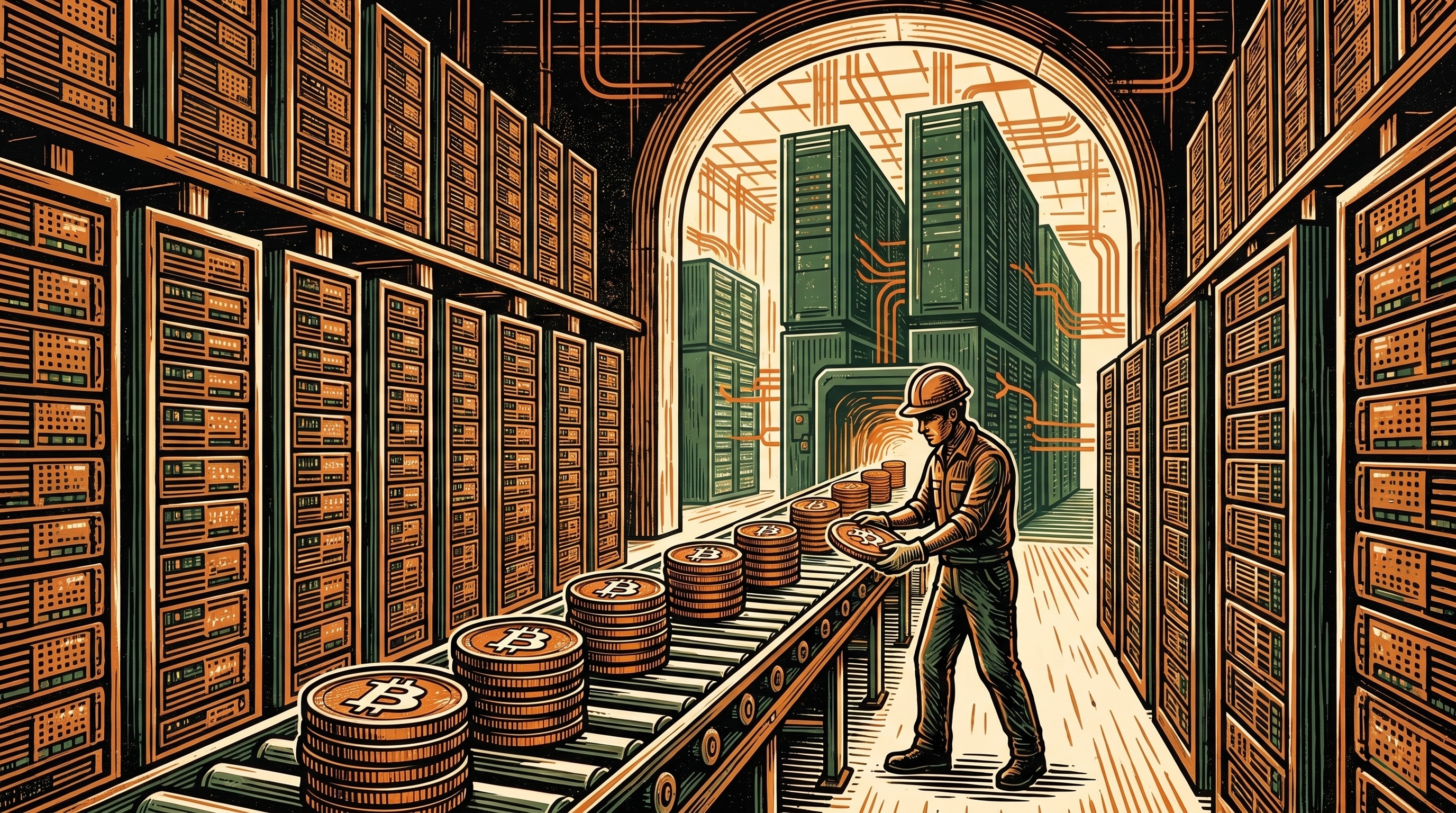
The two largest publicly traded bitcoin miners in the United States spent the first half of 2026 doing the thing miners spent years swearing off: selling their bitcoin. Marathon Digital sold 23,093 BTC and Riot Platforms sold 9,665 — 32,758 coins between them — to cover costs and, increasingly, to fund a pivot away from mining altogether.
Post-halving, the block subsidy that pays miners is half what it was, and the network has never been harder to mine. Bitcoin’s hashrate sits near a record 927 exahash, and difficulty is set to climb again around September 5. More machines chasing fewer coins means each unit of hashpower earns less: “hashprice,” the daily revenue per unit of computing, is around $40 per petahash — a level at which higher-cost operators mine at a loss. Riot reported producing bitcoin in the second quarter at an all-in cost, including depreciation, of roughly $90,000 a coin — above where bitcoin has traded for much of the period.
When it costs more to mine a coin than the coin is worth, a miner has two choices: sell reserves to pay the power bill, or find something more lucrative to do with its power and buildings. The biggest miners are doing both.
The something is artificial intelligence. Renting a data center’s power and racks to AI companies pays far better than mining — by industry estimates, $1.3 million to $1.65 million per megawatt-year for GPU hosting versus roughly $0.8 million to $1.0 million for bitcoin mining. Riot has signed a 191-megawatt lease with the AI firm Anthropic that it says could generate billions over its life; rival IREN took a $639 million writedown on mining hardware to fulfill a $9.7 billion cloud-hosting contract with Microsoft; and Dan Loeb’s hedge fund Third Point disclosed a stake in Core Scientific, another miner-turned-AI-host. The bitcoin sales are, in part, seed capital for the exit.
When a coin costs $90,000 to mine and sells for $78,000, the rational miner stops mining. America’s biggest are doing exactly that.
This is good news for the companies and an open question for the network. Bitcoin’s security is paid for by miners spending real money to guess hashes; if the most efficient, best-capitalized operators redirect their megawatts to AI, hashpower may increasingly come from cheaper, less visible sources — often subsidized state grids abroad. The counterargument is that this is how the market is supposed to work: high-cost miners exit, difficulty adjusts down, survivors mine more cheaply, and the network re-balances. Difficulty already fell across parts of the first half as weaker miners capitulated.
Miners have been declared dead after every halving and have adapted every time. Selling reserves in a lean patch is not a crisis; it is the business. But 2026 marks a shift in kind, not just degree: for the first time, the largest miners are treating bitcoin mining as the lower-value use of their infrastructure. The rigs still hum. What they compute may increasingly not be bitcoin.
Why it matters: the companies that secure bitcoin are quietly deciding it’s worth more to mine intelligence than money — and the network’s security budget is the thing to watch.
H1 2026 sale totals (Marathon 23,093 BTC; Riot 9,665 BTC) and cost/hashprice figures are as reported by the outlets cited and the companies’ filings; the ~927 EH/s hashrate and difficulty timing were read live from mempool.space on Sept 1. Informational only — not financial advice.
Free. Five minutes. No hype.
Subscribe free