 The Bitcoin Beacon
Europol helped crack a wallet whose keys were lost for years; the state has now shifted about $40 million in forfeited coins to an exchange — part of a 1,500-bitcoin haul this year.
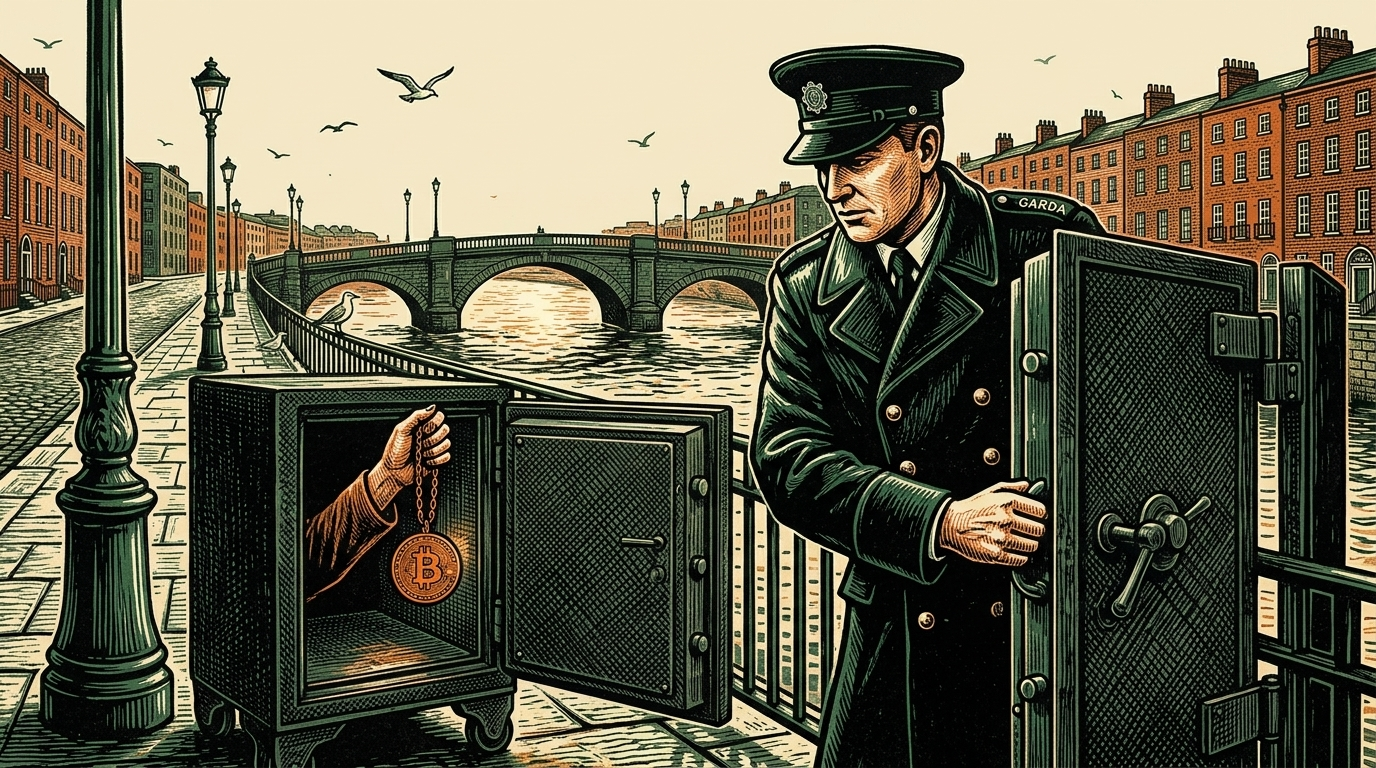
DUBLIN — Ireland’s Criminal Assets Bureau has moved roughly 500 bitcoin, worth about $39.6 million, from a wallet that sat frozen for years to an account at Coinbase Prime. The coins trace to Clifton Collins, a convicted drug dealer whose fortune became one of the most-watched forfeiture cases in the country’s history — largely because, for a time, nobody could open the wallets that held it.
Collins bought the bitcoin in 2016 and scattered the keys, at one point famously hiding a code on a scrap of paper. When authorities moved to seize the proceeds of his crimes, they hit a wall the digital age had not prepared them for: the coins were legally forfeit but technically unreachable, because the private keys were lost. For years the state held a claim it could not execute.
That changed in early 2026. Irish authorities said access began returning in March, after Europol’s European Cybercrime Centre supplied what officials called “highly complex technical expertise and decryption resources” to open one of the wallets. This week’s transfer of 500 BTC to Coinbase Prime is the latest movement of those recovered funds.
Recovered assets in the Collins case now total around 2,000 BTC, worth roughly $155 million. Across all its cases in 2026, the Bureau has taken hold of about 1,500 BTC, some $92 million. Routing the coins to Coinbase Prime — an institutional venue built for large, orderly sales — is the standard prelude to liquidation, which would put the proceeds toward the Irish exchequer.
Self-custody makes bitcoin unconfiscatable — until the keys can be obtained. Then the state sells on an exchange like anyone else.
It is tempting to read “authorities cracked a bitcoin wallet” as a crack in bitcoin itself. It is the opposite. What failed was Collins’s key management, not the network’s cryptography; Europol did not break the math, it recovered a badly kept secret. The same property that let a criminal believe his stash was untouchable is what lets a diligent saver protect a lifetime of work — and what punishes anyone, lawful or not, who loses control of their keys.
For the market, the more prosaic point is supply. Sovereign seizures that end in exchange sales are a small but real source of coins hitting the market at the state’s discretion — a category of flow that barely existed a decade ago and now shows up on the ledger in eight-figure blocks.
Why it matters: bitcoin can be forfeited and sold by a government, but only once the keys are in hand — the whole ballgame, for a saver or a state, is who controls them.
The ~500 BTC (~$39.6M) transfer to Coinbase Prime, the Clifton Collins forfeiture, the lost-keys history, the March 2026 access recovery with Europol EC3 assistance, the ~2,000 BTC total in the Collins case (~$155M) and the ~1,500 BTC 2026 CAB total (~$92M) are per the reporting above. Dollar values are approximate and move with the bitcoin price. Informational only — not financial advice.
Free. Five minutes. No hype.
Subscribe free