 The Bitcoin Beacon
Drones, scanners and 3,000 raids: how Malaysia decided that mining bitcoin on stolen electricity is a crime to prosecute, not an industry to court.
KUALA LUMPUR — Most countries that court bitcoin miners lead with a tariff. Malaysia leads with a raid. Between 2022 and May 2026, Malaysian authorities confiscated 75,578 cryptocurrency mining machines across 3,049 operations nationwide, making 629 arrests — a campaign against not the mining of bitcoin but the stealing of the electricity to do it.
The numbers behind the crackdown are large. Over five years, roughly 14,000 illicit mining sites have been uncovered, and the national utility, Tenaga Nasional Berhad, puts its losses from power theft at about 4.57 billion ringgit — on the order of $1.1 billion. Power theft tied to mining has risen roughly 300% since 2018.
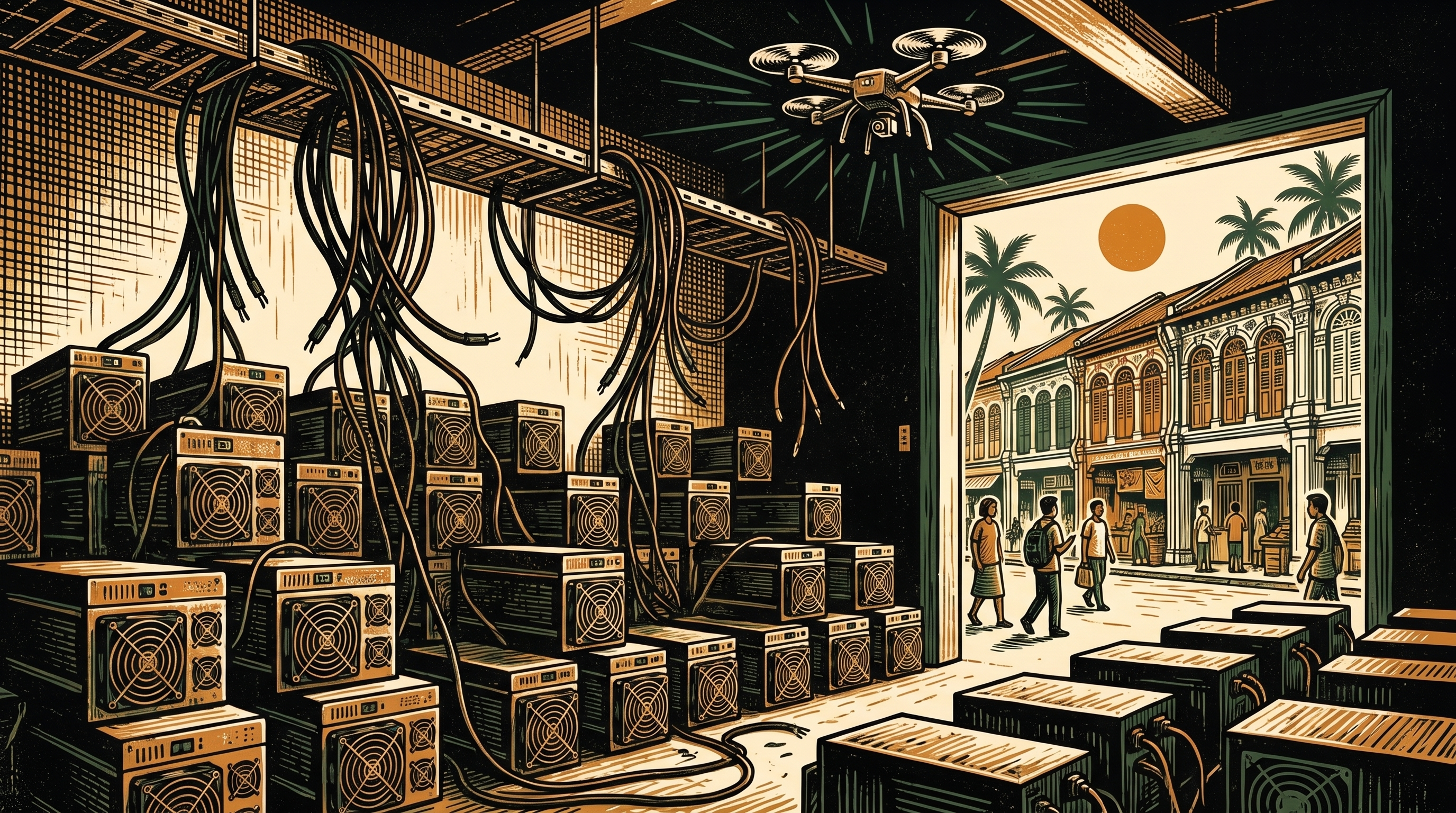
A mining rig runs hot and draws power around the clock, which is exactly what makes it findable. Police, TNB and local councils now run joint operations that use drones to spot heat signatures from above and handheld scanners to trace irregular consumption on the ground. The targets are premises that bypassed their meters or tapped illegal connections — a recent raid in Tronoh seized 73 machines and arrested two men on stolen-electricity charges.
None of this is about bitcoin’s legality. Owning and mining bitcoin is not the crime; siphoning subsidized grid power to do it is. In a country where retail electricity is priced below its market cost, a hidden rig is effectively a subsidy quietly redirected into hash.
Owning bitcoin is not the crime. Siphoning subsidized grid power to mine it is.
Malaysia is the flip side of the countries the Beacon usually covers on this beat. Bhutan mines with sovereign hydropower; Ethiopia sells surplus dam output to licensed miners; Paraguay and Texas court operators with contracts for stranded energy. In each, mining is a way to monetise power that would otherwise be wasted — a buyer of last resort for the grid.
Where power is scarce and subsidized rather than surplus and priced, the same machines become parasites. A rig that is an economic-development tool in Thimphu is a theft case in Ipoh. The deciding variable isn’t the hardware or the hashprice; it’s whether the miner is paying for what it burns.
The steelman for Malaysia is straightforward. Stolen power is a real cost, borne by paying households and a utility already under strain; drone-led enforcement is a rational response to a measurable loss. This is not a war on bitcoin; it is a war on theft that happens to be committed with mining rigs.
What enforcement can’t do is make the incentive disappear. As long as retail power is cheaper than the cost of producing it, hidden mining pays — and crackdowns push it to move, hide better, or wait. The durable fix is a pricing one: tariffs that reflect the real cost of electricity, so that mining either pays its way or goes elsewhere. Until then, Malaysia is left counting seized rigs.
Why it matters: bitcoin mining follows the true price of power — and where that price is hidden by subsidy, mining turns from an energy buyer into a crime to police.
Figures — 75,578 machines / 3,049 operations / 629 arrests (2022–May 2026), ~14,000 sites and 13,827 premises, RM4.57 billion (~$1.1 billion) in TNB losses, and the ~300% rise since 2018 — are cumulative totals per the reporting above; the Tronoh seizure of 73 rigs is a recent individual case. Informational only — not financial advice.
Free. Five minutes. No hype.
Subscribe free