 The Bitcoin Beacon
A Reuters investigation lays out how Tether’s Uruguayan mine went dark — and why, in the Global South, the deciding variable isn’t the price of bitcoin but the reliability of a government contract.
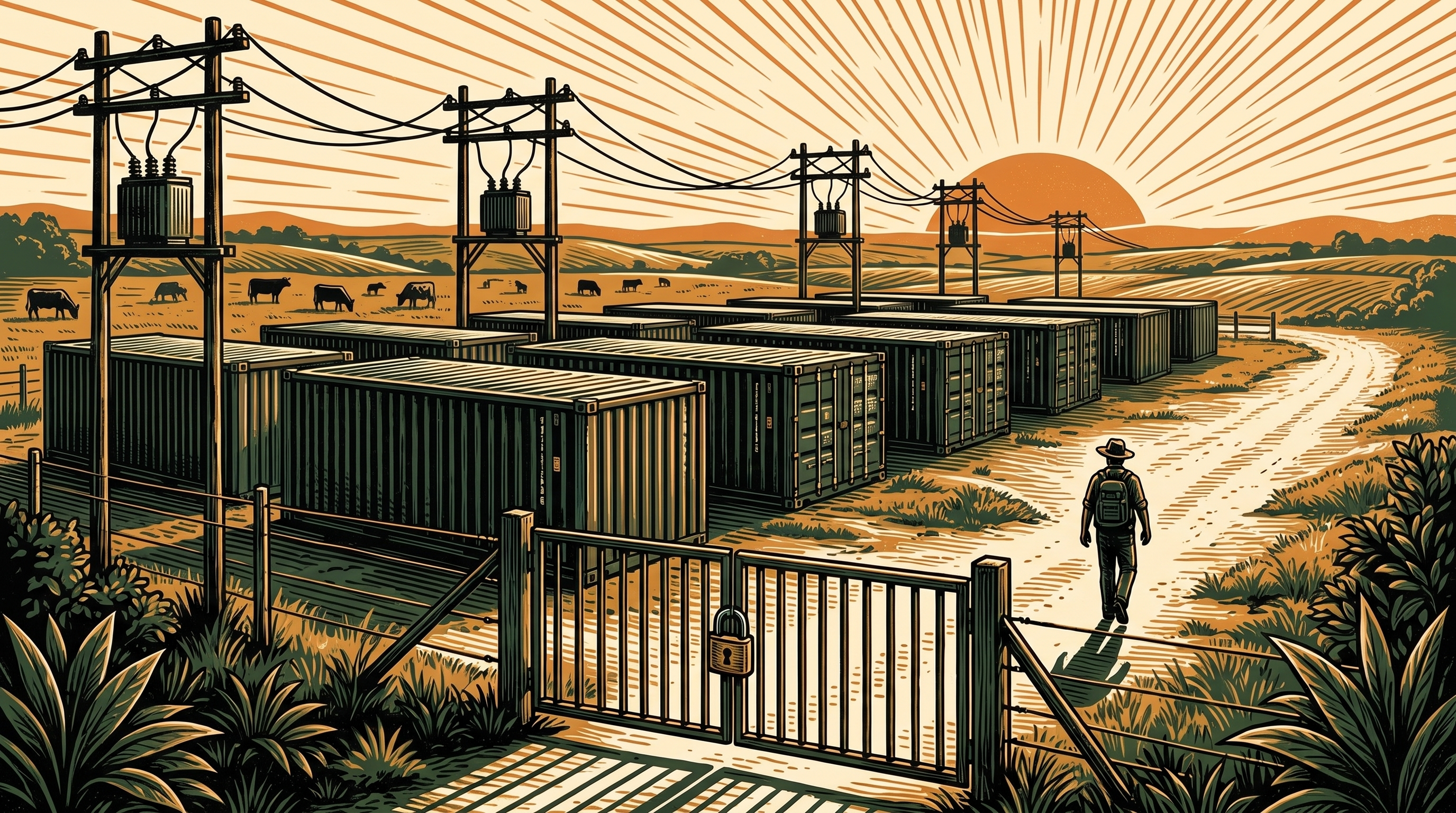
MONTEVIDEO — The collapse of Tether’s roughly $120 million bitcoin-mining venture in Uruguay, laid out in a Reuters investigation this week, reads less like a mining story than a lesson in sovereign risk. The two sites went dark not because bitcoin fell or the machines failed, but because the miner and the state fell out over a contract.
At the center is a disagreement any first-year lawyer would recognize. Tether’s local entity, Microfin, and the state power utility, UTE, read the same number two different ways: Tether treated the contracted power figure as a floor it could raise later; UTE treated it as a hard cap. The gap opened by November 2024 and never closed.
As the dispute dragged, Microfin stopped paying its electricity bills, running up close to $5 million in arrears. In June it told UTE it intended to terminate the contracts. With the revised deal unsigned and the invoices unpaid, UTE cut power to the sites on July 25, 2025. The shutdown erased 30 of the roughly 38 local jobs the project had created.
Politics sharpened the standoff. The left-leaning government of President Yamandú Orsi, which took office in March 2025, appointed new UTE directors who took a harder line on the terms Tether wanted. What might have been a quiet renegotiation under one administration became a clean break under the next.
Bitcoin miners chase cheap, stranded power, and emerging markets with surplus hydro or gas are the obvious destinations. But the Uruguay episode is a reminder that the deciding number often isn’t the hashprice or the tariff — it’s the durability of the contract behind the meter. A mine is a heavy, immovable bet on a counterparty that can change its mind, its leadership, or its reading of a clause.
That is why operators keep paying a premium for boring jurisdictions. The stability of a Texas or a Paraguay-with-a-signed-ANDE-deal is itself a yield: predictable power beats cheap power that can be switched off in a political turn. Uruguay follows a run of Global-South mining stories — Paraguay’s consolidation, Ethiopia’s permit freeze — where the grid, not the market, set the outcome.
Tether has not abandoned the model; it has moved it. The company is redirecting its bitcoin-mining ambitions toward Brazil, where it already backs energy and mining ventures. Whether the next host proves steadier than the last is the open question — and the one every sovereign-hosted miner is now forced to price.
Why it matters: for bitcoin mining in the developing world, the power contract is the trade — and a government that can pull the plug is the risk no hashprice model captures.
Figures — the ~$120M project size, ~$5M arrears, the July 25, 2025 power cut and 30-of-38 job losses — are per the Reuters investigation and the reporting above. Tether is a stablecoin issuer; this piece covers its bitcoin-mining operation, not its stablecoin. Informational only — not financial advice.
Free. Five minutes. No hype.
Subscribe free