 The Bitcoin Beacon
Public miners cut their bitcoin production 13% in six months as they lease power and data centers to artificial-intelligence tenants — and Wall Street has stopped applauding the switch.
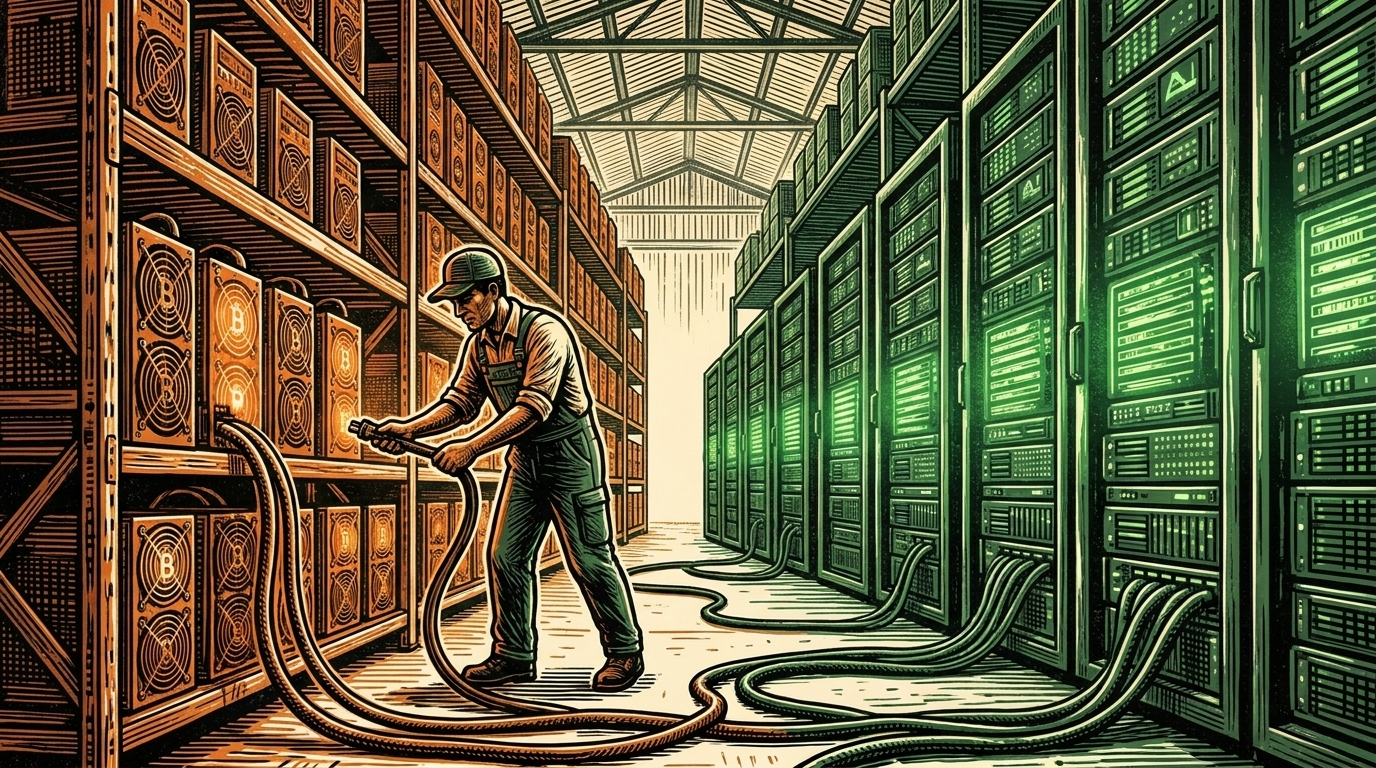
The machines that secure Bitcoin are being switched off to make room for the machines that run artificial intelligence. New data from BlocksBridge Consulting shows the realized hashrate of a cohort of public bitcoin miners fell from 368.3 exahashes per second in the fourth quarter of 2025 to 319 EH/s in the second quarter of 2026 — a 13.4% drop — as operators redirected power and data-center space toward AI and high-performance computing.
Strip out one company and the retreat looks starker. Excluding Bitdeer, the cohort’s realized hashrate fell 21.2% over the six months, from 324.6 to 255.9 EH/s. Bitdeer went the other way, expanding its realized hashrate 44% to 63 EH/s and partly masking how fast everyone else was pulling back. For comparison, the Bitcoin network’s average hashrate fell about 10.6% over the same window — meaning public miners shed capacity faster than the network as a whole.
The clearest picture of the shift is on Core Scientific’s income statement. In the second quarter the company earned $136.7 million from colocation — renting data-center capacity to tenants — against just $27.5 million from mining bitcoin. Hosting supplied 83% of quarterly sales, up from 67% in the first quarter. The bitcoin rigs have become the sideline; the real estate and the power contracts are the business.
The pivot is being forced by brutal mining economics. MARA Holdings reported second-quarter revenue down 27% to $174.9 million and a net loss of $611.3 million, or $1.60 a share. CleanSpark, reporting its fiscal third quarter, posted $138.0 million in revenue — a 30.5% decline — and a $239.8 million net loss, though it has already signed a $6.6 billion, 20-year AI hosting lease at its Sandersville site. MARA, by contrast, has yet to land its first commercial AI contract despite chasing the same customers.
For two years, announcing an AI deal was a reliable way to move a miner’s share price. That reflex is fading. BlocksBridge, through its Blocksbridge Consulting arm, examined 25 AI and HPC transactions announced by bitcoin miners between June 2024 and August 2026 and found that the average same-day stock gain on announcement fell from roughly 24% for the early deals to about 10% for the most recent ones. Wall Street has learned to tell a signed, funded lease from a press release, and to discount the difference.
The bull case is real: AI hosting throws off steadier, higher-margin revenue than mining, and it can keep miners solvent through a stretch of low hashprice that has made minting new coins a money-loser. Efficient private operators can move in to claim the hashrate the public companies abandon, keeping the network humming. But that is also the open question. Bitcoin’s security rests on how much computing power defends it and how widely that power is spread. If the largest, most visible miners keep decamping for AI, the job of securing the ledger falls to fewer, quieter hands — a trade the market is only beginning to price.
Why it matters: the same infrastructure can mine bitcoin or host AI, and for now AI pays more — quietly reshaping who secures the network.
Hashrate figures are BlocksBridge Consulting estimates of realized (not nameplate) hashrate for a cohort of publicly traded miners; earnings figures are as reported by the companies for Q2 / fiscal Q3 2026. Informational only — not financial advice.
Free. Five minutes. No hype.
Subscribe free