 The Bitcoin Beacon
Motiv reaches 750 families a week across 15 Peruvian towns, teaching bitcoin as a plain payment tool. What began as a shoe drive is now one of the world’s busiest circular economies.
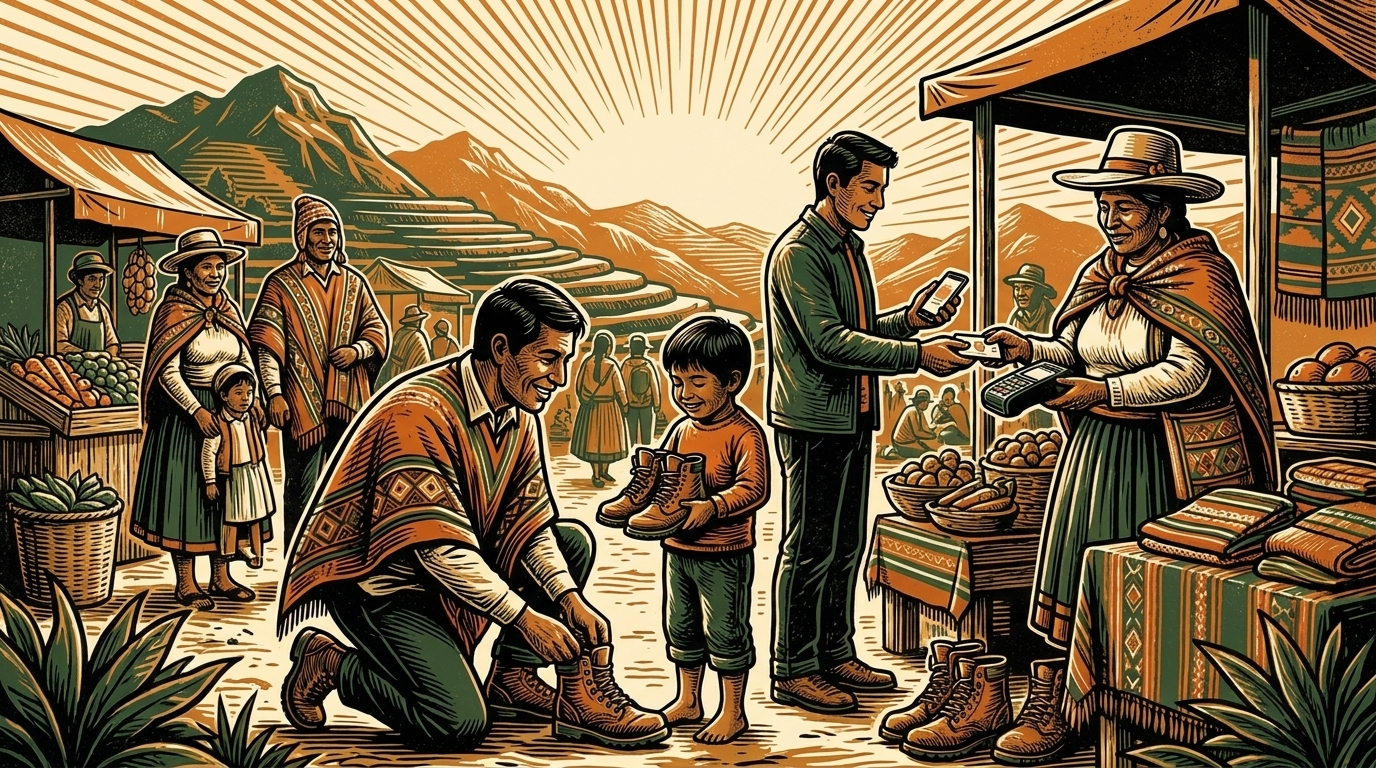
The program that now moves bitcoin through fifteen Peruvian towns started with a pair of shoes. In 2019, in a highland village outside Cusco, volunteers from a small charity called Motiv knelt to wash children’s feet and fit them with sturdy boots — the kind of footwear that, in the rough Andes, decides whether a child can walk the distance to school. Six years later Motiv reaches more than 750 families every week, and the boots are still part of it. So is bitcoin.
The nonprofit, co-founded by retired U.S. serviceman Rich Swisher and Romanian expat Valentin Popescu, teaches bitcoin six days a week across fifteen locations, with hubs in Lima, Cusco and the coastal town of Huanchaco and satellites reaching into Tarapoto and Iquitos. Its events in 2025 drew more than 6,000 people and produced, by Popescu’s count, between 25,000 and 30,000 individual bitcoin transactions — a soccer tournament called the Copa Bitcoin, a Christmas drive, and a rolling calendar of fairs and classes. The entry wallet is Blink. The lesson is deliberately unglamorous: bitcoin as a way to get paid, not a bet to get rich.
The pivot was an accident of the pandemic. In 2020, with the shoe budget already raised, Popescu asked donors to redirect it to food as COVID lockdowns gutted village incomes. Earmarked donations don’t bend that way, and the donors declined. One offer came with a condition: a bitcoin holder would fund the food and supplies, but everything had to be bought in bitcoin.
That forced Motiv to find merchants who would accept it. The first was a kiosk owner; the second, a shoemaker named Olger who had lost his wife and his job in the pandemic and kept his trade alive by teaching others to make shoes. Motiv began keeping a list of vendors and walking them through how bitcoin worked — not as an investment, but as a tool they could switch on and use. In a country repeatedly burned by financial scams, the pitch that landed was the modest one.
Peru is fertile ground. Chainalysis put the country’s crypto transaction value at roughly $28 billion in 2025, part of a Latin American surge driven by remittances, inflation and cheap smartphones. The nation also carries a strange piece of bitcoin history: in early 2011, a Peruvian merchant selling alpaca-wool socks was among the first anywhere to take bitcoin for a real-world good, exporting them to U.S. buyers who paid in coin.
Motiv’s model is a circular economy — the same closed-loop idea pioneered at El Salvador’s Bitcoin Beach, where bitcoin earned locally is spent locally rather than cashed out. A shopper receives sats, a nearby merchant accepts them, and the coin recirculates instead of leaking back into the banking system that never served these towns in the first place. Motiv runs one of the larger nodes of My First Bitcoin’s education program, the curriculum born in El Salvador, and leans on the same wallets — Blink chief among them — that anchor Central America’s grassroots scene.
The honest caveat is dependency. Motiv is a 50-person operation plus volunteers, seeded by foreign donors and a bitcoin benefactor; the transactions it counts are, in part, transactions it subsidizes. A circular economy that leans on outside funding has not yet proven it can spin on its own, and the number that matters — how much trade continues when the grants stop — is not one Motiv can yet show. Popescu’s answer is to build local leaders rather than perform foreign charity. “Being a leader isn’t talking,” he told Bitcoin Magazine of the villages Motiv works in. “It’s serving.”
What Motiv has proven is narrower and still real: that bitcoin can be introduced to people the formal system ignores without a token sale, a price chart, or a promise of riches — introduced as plumbing, and used. The shoes get the charity in the door. The bitcoin is how the money moves once it’s there.
Why it matters: the adoption that lasts rarely arrives by decree — it arrives when a merchant takes a coin because the person in front of them is holding one.
Figures (750 families weekly, 15 locations, 6,000+ reached in 2025, 25,000–30,000 transactions) are as reported by Motiv co-founder Valentin Popescu to Bitcoin Magazine, February 2026; Motiv is donor- and grant-funded, so transaction counts reflect subsidized activity. Informational only — not financial advice.
Free. Five minutes. No hype.
Subscribe free