 The Bitcoin Beacon
Putin signed the law this month and the central bank has cleared bitcoin for licensed exchanges — but ordinary Russians can buy only about $3,700 of it a year.
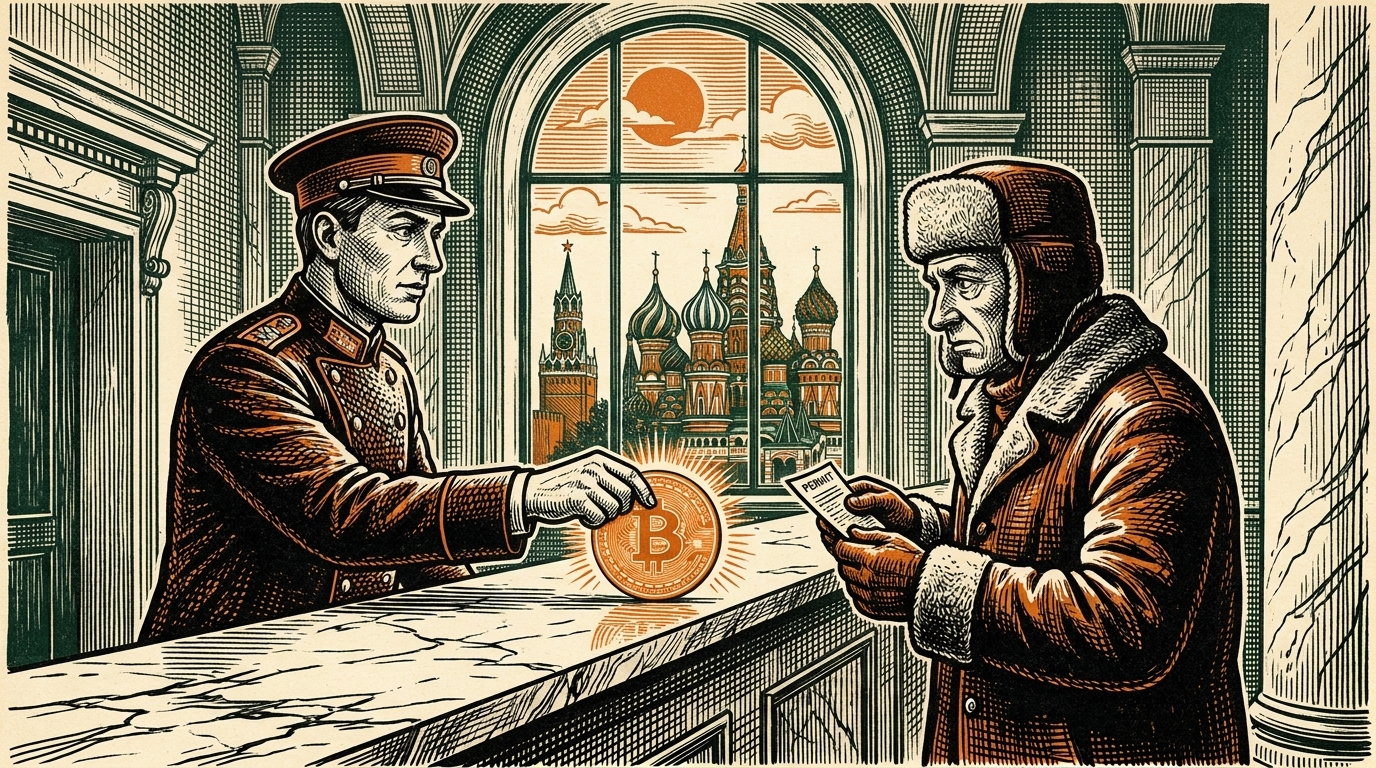
Russia has spent a decade treating bitcoin as a threat to be contained. This month it changed the verb from “ban” to “license.” On August 4, President Vladimir Putin signed legislation legalizing regulated cryptocurrency trading under the supervision of the Bank of Russia. A week later, on August 11, the central bank published its first list of assets approved for trading on licensed domestic exchanges: bitcoin, ether and the dollar-pegged stablecoin Tether. Notably absent was XRP, which failed the bank’s screening.
The selection criteria tell you what the Bank of Russia was optimizing for. To qualify, an asset needed a price history of at least five years on foreign platforms, plus high liquidity and market capitalization. Bitcoin, the oldest and deepest of the three, is the anchor of the list — the asset the framework is really built around. What Russia has done is not endorse a speculative frontier; it has admitted the most established digital asset in the world into a supervised marketplace on the state’s own terms.
Those terms are strict. Under the rules, non-qualified investors — which is to say ordinary Russian citizens — may hold no more than 300,000 rubles, roughly $3,600 to $3,700, worth of these assets per intermediary in a year. Before making a single trade, they must pass a test and formally acknowledge the risks. Qualified investors, a category defined by wealth and experience, can buy without limit. The core provisions take effect September 1, 2026; the separate rules governing issuance and circulation follow a year later, on September 1, 2027.
The cap is the whole design in one number. It is high enough to let households dabble and low enough to keep bitcoin from becoming a mass vehicle for capital flight. A citizen who wanted to move real savings out of the ruble and into a censorship-resistant asset cannot do it at scale through this front door. The state has built a window, not an exit.
The timing is not incidental. Russia has spent three years cut off from large parts of the Western financial system, hunting for settlement rails that do not route through dollar clearing. A regulated, onshore bitcoin market gives the state something a black market never could: visibility. Liquidity that trades on licensed venues can be monitored, taxed, and — if the Kremlin chooses — drawn on. Analysts have read the framework as one piece of a broader effort to assemble crypto liquidity the state can use for cross-border trade and to seed a parallel reserve outside the reach of sanctions.
That interpretation goes beyond anything the Bank of Russia has said out loud, and it should be held loosely. But the shape of the policy fits it. You do not impose a five-year track-record test and a household spending cap if your goal is to unleash retail trading. You do it if your goal is a controlled, legible market that the state can supervise and, eventually, harness.
Russia’s move lands in a week thick with governments deciding what bitcoin is allowed to be. South Korea is pushing foreign exchanges out of its app stores while letting its banks buy the domestic ones. Brazil is preparing a 24-hour hold on large withdrawals. Each is a different mechanism aimed at the same end: pull bitcoin activity onshore, into channels the state can watch and shape.
What makes bitcoin valuable to a citizen — that it can leave the system — is precisely what governments are now busy fencing in. Russia’s version is among the most explicit. It legalizes the asset and, in the same stroke, caps how much of it an ordinary person can hold and requires them to ask permission first. For the Kremlin, that is not a contradiction. It is the point.
The reversal is stark against Russia’s recent history. As late as 2020, officials floated criminal penalties for transacting in bitcoin, and the central bank spent years arguing for an outright prohibition on trading and mining. That hard line broke under sanctions. In 2024, Moscow legalized industrial bitcoin mining and began experimenting with crypto for cross-border settlement, quietly conceding that a technology it could not stop was better regulated than banned. This month’s law is the retail bookend to that shift: having legitimized the production and the plumbing, the state is now licensing the marketplace.
What has not changed is the instinct for control. The 300,000-ruble ceiling, the mandatory test, the five-year track-record screen and the demand that trading happen only on licensed venues are all instruments of visibility. Russia is not building a free market in bitcoin; it is building a monitored one, sized for households and wired so the state can watch the flows. The Bank of Russia gets a legible market it can tax and, if it chooses, tap; ordinary Russians get a small, supervised window onto an asset the government spent a decade telling them to fear.
A decade after Russian officials floated criminal penalties for using bitcoin, the state has legalized it. The lesson is not that Russia has embraced sound money. It is that a large, sanctioned government has concluded bitcoin is easier to manage inside the tent than outside it — and has written rules to make sure that, for its citizens, the tent stays small.
Why it matters: the fight over bitcoin is no longer legal-versus-illegal. It is over the terms — and the terms are where a state decides whether bitcoin stays an exit or becomes just another supervised asset.
Ruble figures convert at roughly 82 to the dollar as of mid-August 2026; the ~$3,600–$3,700 retail cap is an approximation of the 300,000-ruble limit. Reports that Russia intends bitcoin trading to help build a parallel reserve and ease sanctioned cross-border settlement reflect analyst interpretation, not an explicit stated aim of the Bank of Russia. Informational only — not financial advice.
Free. Five minutes. No hype.
Subscribe free