 The Bitcoin Beacon
The kingdom that mined a billion-dollar bitcoin stash has sold roughly 70% of it — and the proceeds are pouring into a new city on its southern border.
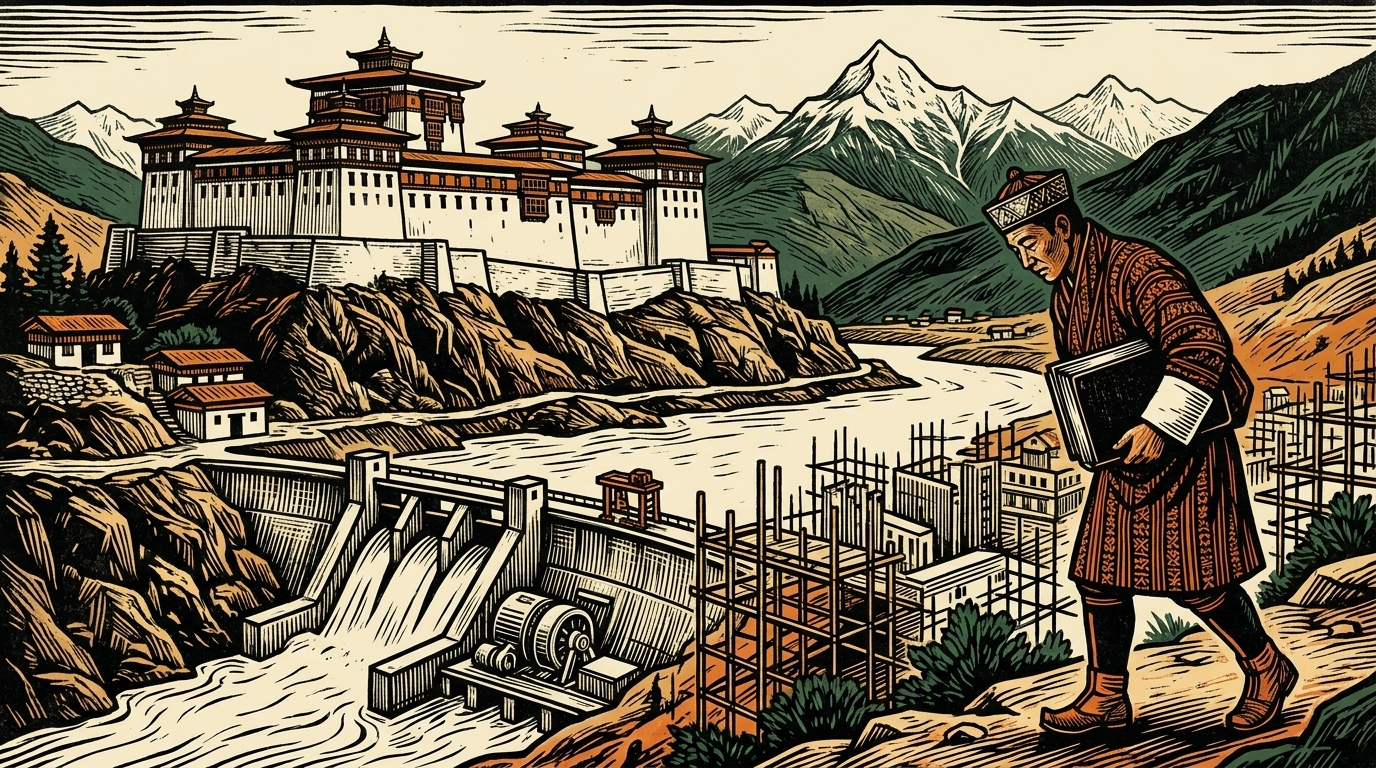
On August 7, the Royal Government of Bhutan moved another 434.87 bitcoin — about $27.93 million — out of its treasury. The transfer ended a month-long pause and extended a pattern that has turned one of the world’s most improbable sovereign bitcoin holders into one of its most reliable sellers. The Himalayan kingdom did not buy this bitcoin. It mined it, with hydropower, and now it is spending the proceeds on concrete and roads.
The scale of the drawdown is the story. Bhutan’s crypto reserve, managed through the state investment arm Druk Holding and Investments, held more than 13,000 BTC in October 2024 — a stack worth north of $1 billion at the time. Today the remaining holdings sit somewhere between 3,000 and 4,000 coins, according to on-chain trackers cited by Crypto Briefing. Roughly 70% of the reserve has been sold in under two years, with cumulative 2026 outflows estimated at $200 million to $240 million. For a country whose GDP is around $3 billion, that is not a rounding error.
The mechanics have been deliberate. Rather than dumping coins on an exchange order book, Druk Holding has routed sales over the counter, in batches usually sized between $5 million and $10 million, directed to market makers and exchange deposit addresses. That is why bitcoin’s price has barely flinched at each Bhutanese transfer. This month’s $27.93 million move was larger than the usual clip, but it followed the same playbook: measured, institutional, and timed to a budget rather than to a chart.
Where is the money going? The proceeds are widely understood to be financing Gelephu Mindfulness City, an ambitious special economic zone on Bhutan’s southern border with India. The project is the kingdom’s bet on diversifying an economy that leans heavily on hydropower exports and high-value tourism, and it carries the personal backing of the monarchy. In that framing, the bitcoin was never meant to be a monument. It was a war chest, and the war is development.
A reserve you draw down is only sustainable if something replenishes it. Bhutan’s does not. The state mining operations that built the stack — powered by the cheap, abundant hydroelectricity coming off the country’s Himalayan rivers — have reportedly slowed or stopped entirely. Analysts tracking the wallets note that mining inflows exceeding $100,000 have not appeared in more than a year. That leaves Druk Holding managing a depleting asset with no production pipeline to offset the sales.
It also changes what the drawdown means. A sovereign wealth fund selling an appreciated asset to fund infrastructure is ordinary treasury management. But a country selling the last of a resource it can no longer produce is closer to spending down an endowment. Each coin that leaves is one Bhutan cannot cheaply mine back, especially with global mining margins compressed and the hydropower increasingly worth more as exported electricity than as hashes.
Bhutan and El Salvador are usually mentioned in the same breath as the two small states that went early on bitcoin. They are, in fact, testing opposite theses. El Salvador buys bitcoin on the open market and refuses to sell, treating it as a permanent reserve and a national branding exercise. Bhutan mined its coins for near-nothing and is liquidating them on a schedule to pay for a city. One treats bitcoin as digital gold to be hoarded; the other treats it as a transitional asset to be harvested and deployed.
For other resource-rich governments — the ones with stranded hydro, gas, or geothermal energy eyeing state mining — Bhutan’s version may be the more tempting template. It does not require conviction that bitcoin will appreciate forever, only that you can mine it cheaply today and turn it into something tangible tomorrow. That is a lower bar than El Salvador’s, and a more politically defensible one when a finance ministry has to justify the position to voters or lenders.
Bhutan’s quiet selling has not moved markets, and it will not. Its significance is conceptual. The country proved a state could mine a billion-dollar bitcoin position out of its rivers; now it is proving a state can spend one down without drama. The lesson for anyone romanticizing sovereign reserves is unsentimental: a bitcoin reserve is a choice a government has to keep making, every quarter, against every other claim on the budget. Bhutan has decided that a city today is worth more than the coins tomorrow.
Why it matters: the first country to mine its own bitcoin reserve is now the clearest proof that a sovereign stack is only as permanent as the next budget cycle.
Holdings figures are estimates from on-chain wallet trackers (remaining reserve put at 3,000–4,000 BTC) as reported August 7–11, 2026; Bhutan does not publish its bitcoin balance. The link between sales and Gelephu Mindfulness City is widely reported but not officially confirmed by Druk Holding and Investments. Informational only — not financial advice.
Free. Five minutes. No hype.
Subscribe free