 The Bitcoin Beacon
Two of the world’s poorer countries are selling surplus dam electricity to bitcoin miners — and earning hard currency their exports rarely deliver.
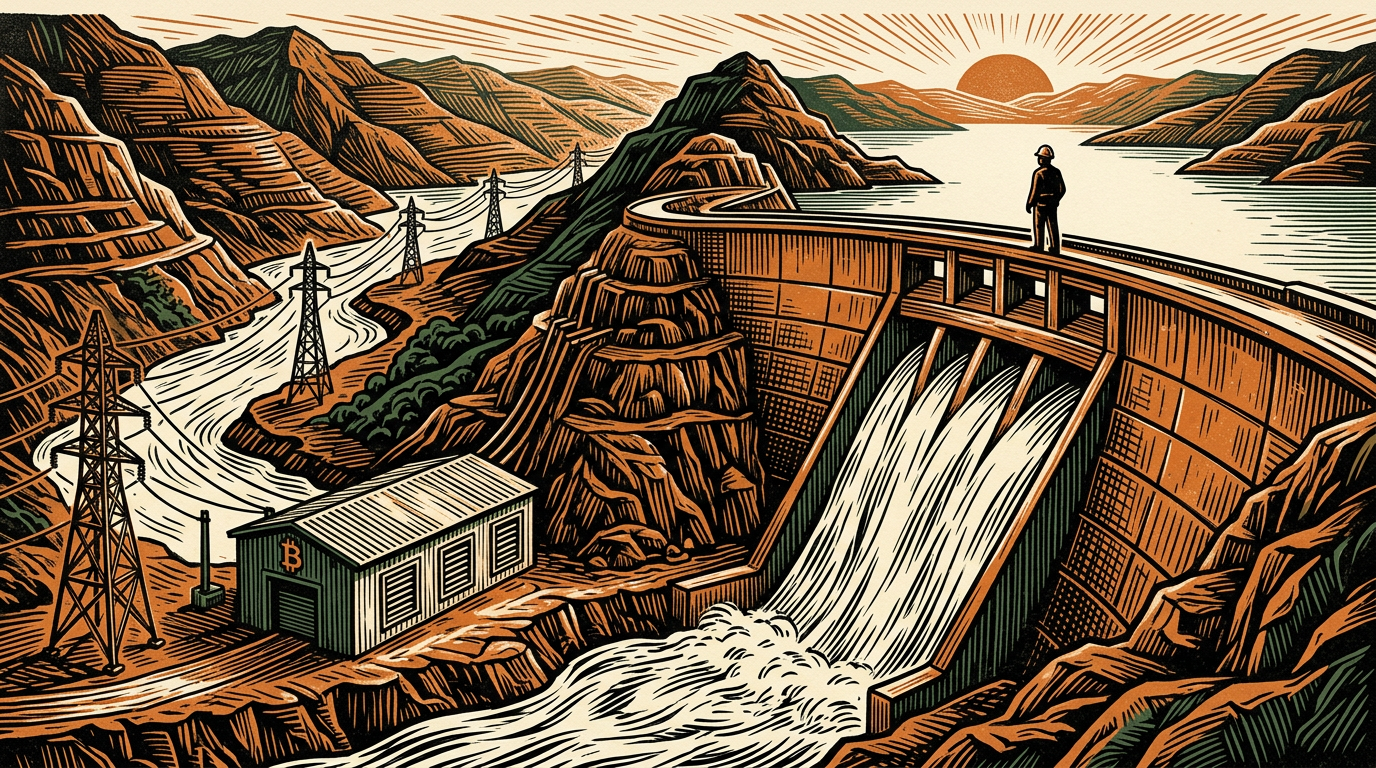
The Grand Ethiopian Renaissance Dam was built to light a nation. For now, some of its power is minting bitcoin instead. Ethiopia — a country where roughly half the population still lacks reliable electricity — has quietly become one of the world’s fastest-growing hosts for bitcoin mining, selling surplus hydropower to operators who pay in dollars.
Ethiopian Electric Power has signed supply deals with miners drawing an estimated 600 megawatts across roughly two dozen sites. State-linked figures and industry trackers put the take at around $55 million in a single recent year — real foreign currency for a government that rations it.
The logic is the one that drew miners to Texas and Kazakhstan, inverted for a developing grid. Ethiopia generates far more hydro capacity than its economy can yet absorb; the transmission lines that would carry that power to homes and factories lag the dams that produce it. Selling the excess to a buyer who can plug in beside the turbine turns stranded electricity into export earnings.
That buyer is unusually mobile. A bitcoin miner is a shipping container of machines that can sit at the dam, consume power the grid cannot deliver elsewhere, and wire hard currency back to the treasury — no port, no cargo ship, no commodity price to haggle over.
Paraguay has run the experiment longer. The Itaipú Dam, one of the largest hydro plants on Earth, makes far more electricity than a country of seven million can use; for decades it sold the surplus to Brazil at fixed rates. Bitcoin miners now bid for it at home. Industrial power in Paraguay runs near $0.033 per kilowatt-hour — among the cheapest anywhere — and hosted mining capacity has grown an estimated 54% year over year.
The Canadian miner Bitfarms alone has secured contracts for up to 150 megawatts of Paraguayan hydropower, and dozens of operators cluster around Itaipú’s output.
Cheap power invites second-guessing. Both governments have floated tariff increases that could compress margins by 2027, and mining’s appetite draws the obvious objection: power sold to machines is power not sold to households. The counter, on a grid with more generation than transmission, is that the two rarely compete in the same place at the same time — the miner takes what the wire cannot yet carry.
There is a reverse risk, too. A state that leans on mining revenue has an incentive to keep the machines running even as domestic demand rises — a tension Ethiopia will feel as it connects more of its own citizens to the grid.
Set it beside Bhutan, the Himalayan kingdom that used hydropower to mine a bitcoin stack once valued above $700 million. The Bhutan model accumulates coins on the sovereign balance sheet. The Ethiopia–Paraguay model is simpler and more immediate: sell the power, collect the dollars, and let someone else hold the bitcoin. For a treasury short on foreign reserves, the second is far easier to spend.
Why it matters: for states that struggle to earn dollars, a dam plus a shipping container is starting to beat a cash crop.
Ethiopia’s ~600 MW and ~$55M figures are as reported by industry trackers and state-linked sources and are estimates that vary; Paraguay capacity growth and pricing per the cited research.
Free. Five minutes. No hype.
Subscribe free