 The Bitcoin Beacon
Bitcoin Ekasi pays its township staff entirely in satoshis. Now it is on a pan-African tour, one node in a federation of 37 circular economies stitching Africa’s grassroots bitcoin map together.
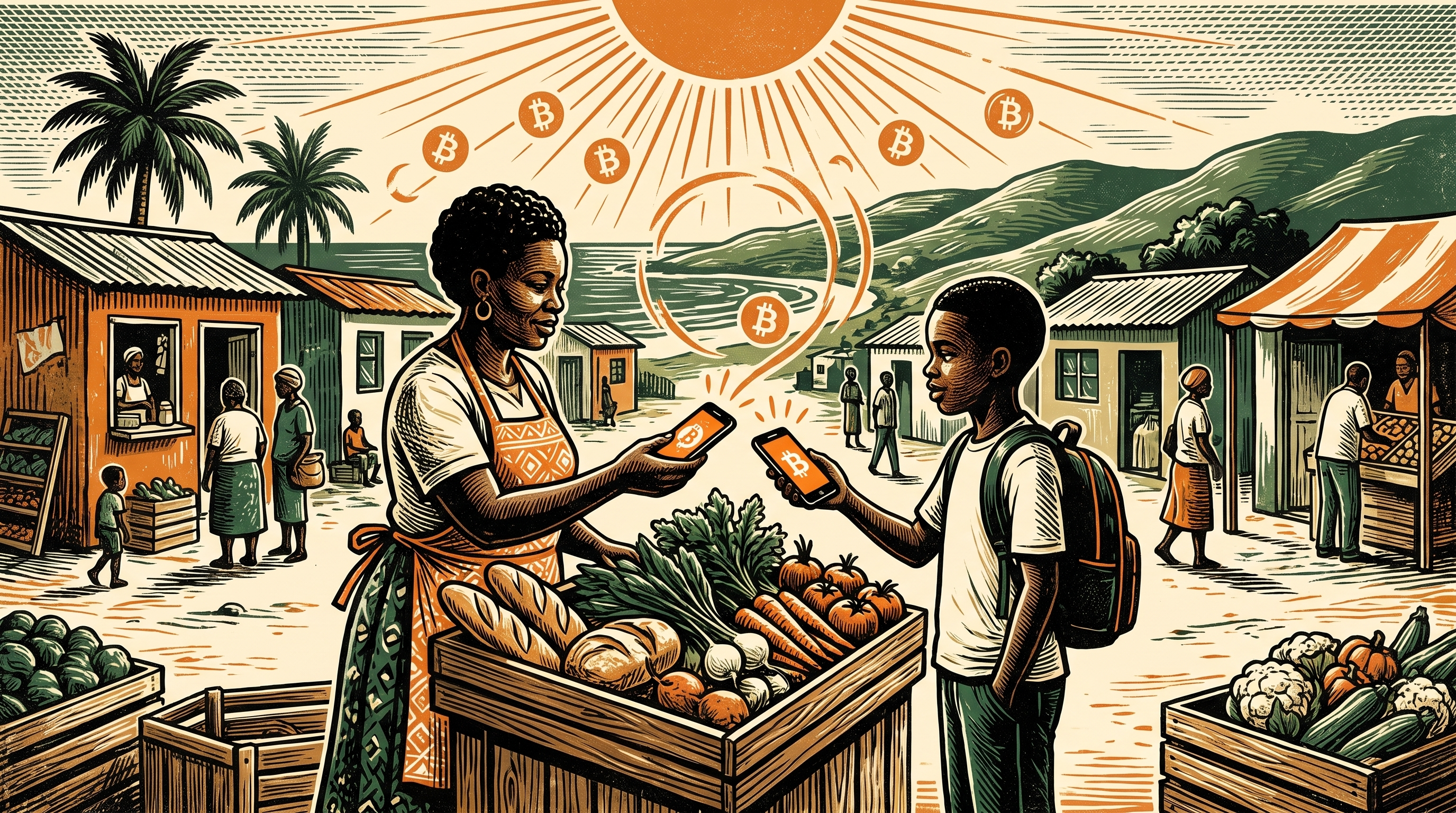
In the township of Kwanonqaba, above the holiday town of Mossel Bay on South Africa’s Garden Route, a surf coach finishes an afternoon session with a class of children, checks a phone, and finds his wages waiting — not in rand, but in satoshis. On the walk home he stops at a spaza shop, scans a QR code, and pays for bread and airtime in the same bitcoin he was paid in. No bank sits between the coach, his employer, and the shopkeeper. The money was earned locally, spent locally, and never left the neighbourhood.
That loop is the entire idea behind Bitcoin Ekasi, a project launched in 2021 and modelled on Bitcoin Beach in El Zonte, El Salvador. It pays its staff — surf instructors, cleaners, coordinators — entirely in bitcoin, and has spent four years persuading the shops those workers use to accept it. The goal was never a speculative punt on price. It was to build a small, self-contained economy where bitcoin functions as ordinary money.
This month Bitcoin Ekasi put that model on the road, announcing a Pan-African Bitcoin Tour for 2026: a travelling programme to visit and connect the continent’s other circular-economy communities and show, on the ground, how a village pays wages in sats and recirculates them through local merchants. The framing is deliberate. Organisers describe adoption as a lived economic loop — earn, spend, re-spend — rather than aid dropped in from outside and cashed straight out.
That distinction is the argument. The project’s founder told The Block there is a “fundamental clash” between bitcoin’s grassroots ethos and the institutionalisation now sweeping the asset in New York and Frankfurt. A circular economy is the opposite of a treasury: the point is not to lock coins in a vault but to keep them moving between people who live on the same few streets.
Ekasi is no longer alone. The Federation of Bitcoin Circular Economies now registers more than 37 active community projects across at least a dozen African countries — among them Zambia’s Bitcoin Campus and a project at Victoria Falls, and Malawi’s Women of Satoshi Cooperative. At a Bitcoin Circular Economies Summit in January 2026, organisers counted 26 projects and roughly 700 merchants accepting daily bitcoin payments, with presenters from Ghana, South Africa, Uganda, Zambia, Mozambique, Kenya, Nigeria, Burundi and Tanzania.
The connective tissue underneath is quiet but essential. Machankura lets people send and receive bitcoin over the Lightning Network using nothing but a basic feature phone and a USSD code — no smartphone, no data plan — and now operates across Côte d’Ivoire, South Africa, Kenya, Ghana, Malawi, Zambia, Nigeria, Namibia, Tanzania and Uganda. In places where the smartphone is not universal, that is the difference between a demo and a functioning economy.
The honest limits are worth stating. These economies are small and often donor-seeded; a surf club funded by outside bitcoiners is not yet a self-sustaining market. Paying salaries in bitcoin exposes workers to its volatility — a coin worth a week’s groceries on payday can buy less by Friday — and many merchants convert to rand the moment a sale clears, which keeps them out of price risk but thins the “circular” part of the loop. Scaling from a township of a few thousand to a national economy is unproven, and headline merchant counts say nothing about how much volume actually flows.
None of that erases what has been built. In a region where remittance fees run high and bank branches run thin, a system where a coach is paid and a shopkeeper is settled without an intermediary is a real alternative, not a slogan. The tour is a bet that the model travels — that what worked on one hillside above Mossel Bay can be taught, village by village, across a continent.
Why it matters: adoption that sticks is not measured in coins bought and held, but in wages paid and groceries bought — and that is happening in more African towns than a year ago.
Merchant and project counts are as reported by the Federation of Bitcoin Circular Economies and summit organisers and are not independently audited. The founder’s “fundamental clash” remark is quoted from The Block. Nothing here is financial advice.
Free. Five minutes. No hype.
Subscribe free