 The Bitcoin Beacon
A new open-source layer moves value between Kenya’s M-PESA and South Sudan’s MTN MoMo over bitcoin — no routing fees, and no company holding the funds off the continent.
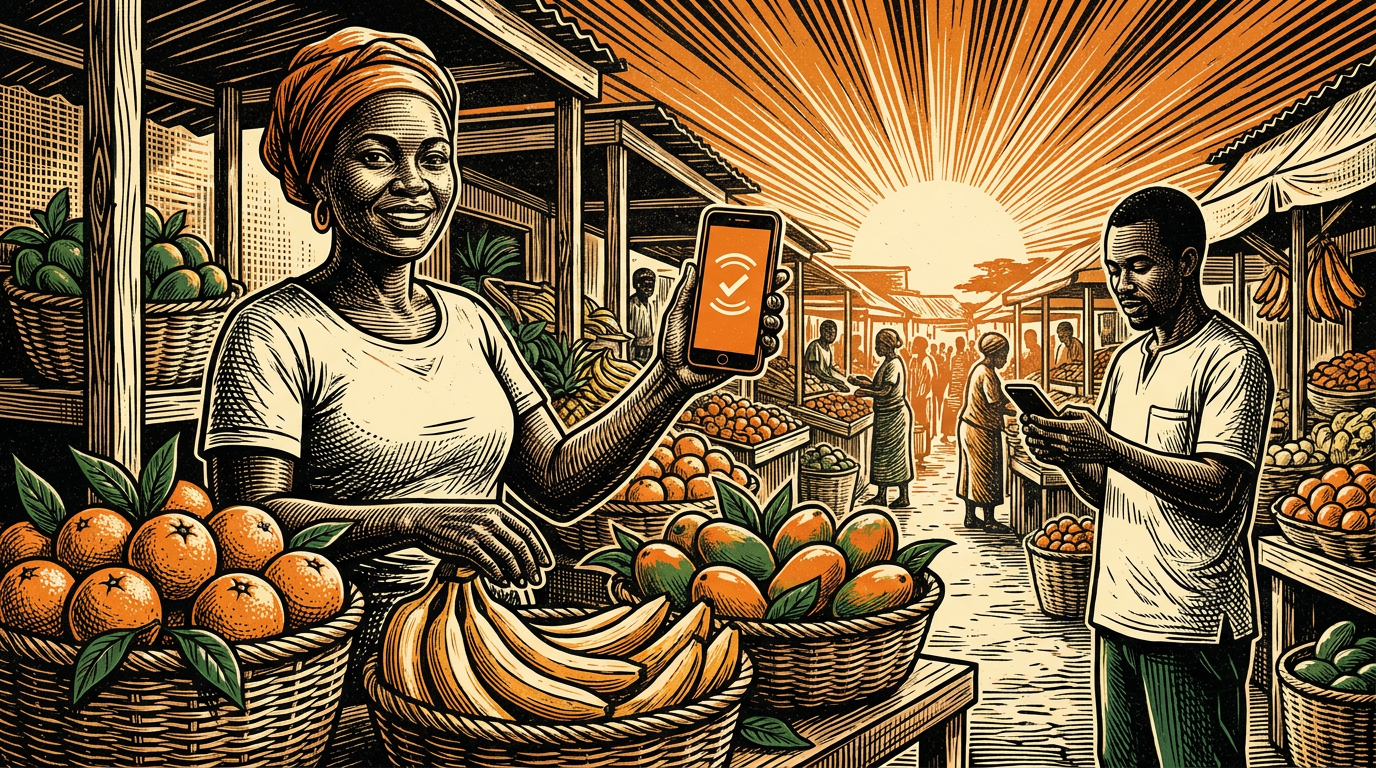
The most interesting thing to happen to African payments this year did not come from a bank or a central bank. It came out of a hackathon in Nairobi, where a small group of developers spent two weeks rebuilding the plumbing under the continent’s bitcoin apps — and, in the process, deleted most of the cost of running one.
The company at the center is Tando, the Nairobi firm that last year turned roughly 40 million Kenyan mobile numbers into bitcoin-reachable addresses by wiring the Lightning Network to M-PESA. A sender anywhere could pay a Kenyan phone number in bitcoin; the recipient got shillings in their mobile-money wallet seconds later, and Tando never held the coins. It worked. It was also expensive to run.
Any business that receives Lightning payments faces the same tax: it has to keep money parked in payment channels so incoming funds have somewhere to land. Provisioning that “inbound liquidity” means either running the machinery yourself or renting it from a specialist — a Lightning service provider — and paying fees for the privilege. Tando rented its capacity from an LSP running the phoenixd software. Every shilling of headroom cost money.
At bitcoin++ Nairobi, an open-source builders’ week in mid-June, Matthew Vuk of the startup Second swapped that arrangement out. In its place went Bark — Second’s implementation of Ark, a newer bitcoin layer that shares one big on-chain output among many users instead of forcing each business to fund private channels. Tando’s app and its M-PESA payout stayed exactly the same; only the layer underneath changed. The result, by Second’s estimate, cut Tando’s liquidity costs by 50 to 80%. There were no channels to open, and no inbound-liquidity fees to pay; capacity now arrives from an Ark server on demand.
Senders still pay from any Lightning wallet, so nothing breaks for the customer. Wallets that speak Ark natively pay each other over a path the developers call arkoor at zero routing fees. And throughout, Tando keeps custody of its own funds.
What makes this more than an engineering tweak is what it unlocks across borders. A developer known as Bhang, of JunubBTC in South Sudan, joined the group to build a Tando-style gateway for his own country on MTN Mobile Money. Because both gateways settle on the same Ark, a trader in Juba and a shopkeeper in Nairobi can now move value between the Kenyan shilling and the South Sudanese pound directly — with no liquidity management and no routing fees on the settlement layer. Each country runs its own bitcoin-to-mobile-money gateway and holds absolute custody of its own money.
“The Ark server is a coordinator, never a custodian,” Vuk said. “It abstracts away the channel and liquidity management, so an operator runs a gateway without running a Lightning node, and keeps absolute self-custody. For Africa, that sovereignty is the whole point: these gateways should not depend on closed-source servers, or on custodians off the continent.”
The distinction is not academic. Africa’s cross-border payments have long run through intermediaries that sit outside the continent, take a cut, and can freeze a flow at will. Traditional remittances into sub-Saharan Africa still average north of 7% per transfer. A settlement rail where each national operator controls its own funds, and the coordinator provably cannot spend them, is a different arrangement entirely.
The working group did not stop at wallets. Mavapay, a payments team led by Theophilus Isah and Solomon Eze, joined to extend the system to bank accounts in Nigeria, Ghana, South Africa, and Kenya. Mavapay’s app already converts bitcoin into naira, cedi, shilling, or rand and pays it into a bank account or mobile wallet in under a minute over Lightning; routing that same flow over Ark is the next step.
Stitched together, the corridors would reach five currencies — the Nigerian naira, Ghanaian cedi, South African rand, Kenyan shilling, and South Sudanese pound — and a combined population of more than 400 million people. The builders call it the first Ark-powered settlement network of its kind, assembled entirely from open-source parts.
A quieter piece may matter most for trust. Using a custom extension to the Cashu ecash protocol, holders of blinded tokens can spend them straight into a mobile-money gateway over Ark at no network fee, and do it privately. Because those Cashu mints now run on Bark, they gain a new form of proof-of-reserves: the Ark server can cryptographically attest a mint’s minimum balance. A user handing shillings to a local ecash mint can, for the first time, get math instead of a promise.
None of this is finished. The first corridors — Kenya’s M-PESA and South Sudan’s MTN MoMo — are running on a testnet, not on live money at scale; bank rails and additional countries depend on Mavapay and new partners shipping. Ark itself is young, and the coordinator, while unable to steal funds, is a service that must stay online for the network to hum. And because payouts land in local currency, many of these flows are bitcoin for only a few seconds — the network is the wire, not necessarily the savings.
Kenya’s own regulators add another variable: the country is moving toward user-level reporting of crypto activity, which could complicate gateways that pride themselves on asking for nothing. Sovereignty at the protocol layer does not guarantee it at the legal one.
Why it matters: the cheapest way to move money across Africa is being built in Africa, on software that no company or government off the continent can switch off.
Editor’s note: the partnership was unveiled at bitcoin++ Nairobi (June 17–19, 2026); the Kenya–South Sudan corridors were on testnet at the time of writing, and cost-savings figures are the developers’ own estimates. Nothing here is financial advice.
Free. Five minutes. No hype.
Subscribe free