 The Bitcoin Beacon
On the shore of Lake Atitlán, roughly 80 shops take bitcoin over Lightning — and a miner fed on fried-food grease turns the town’s waste oil into hashrate.
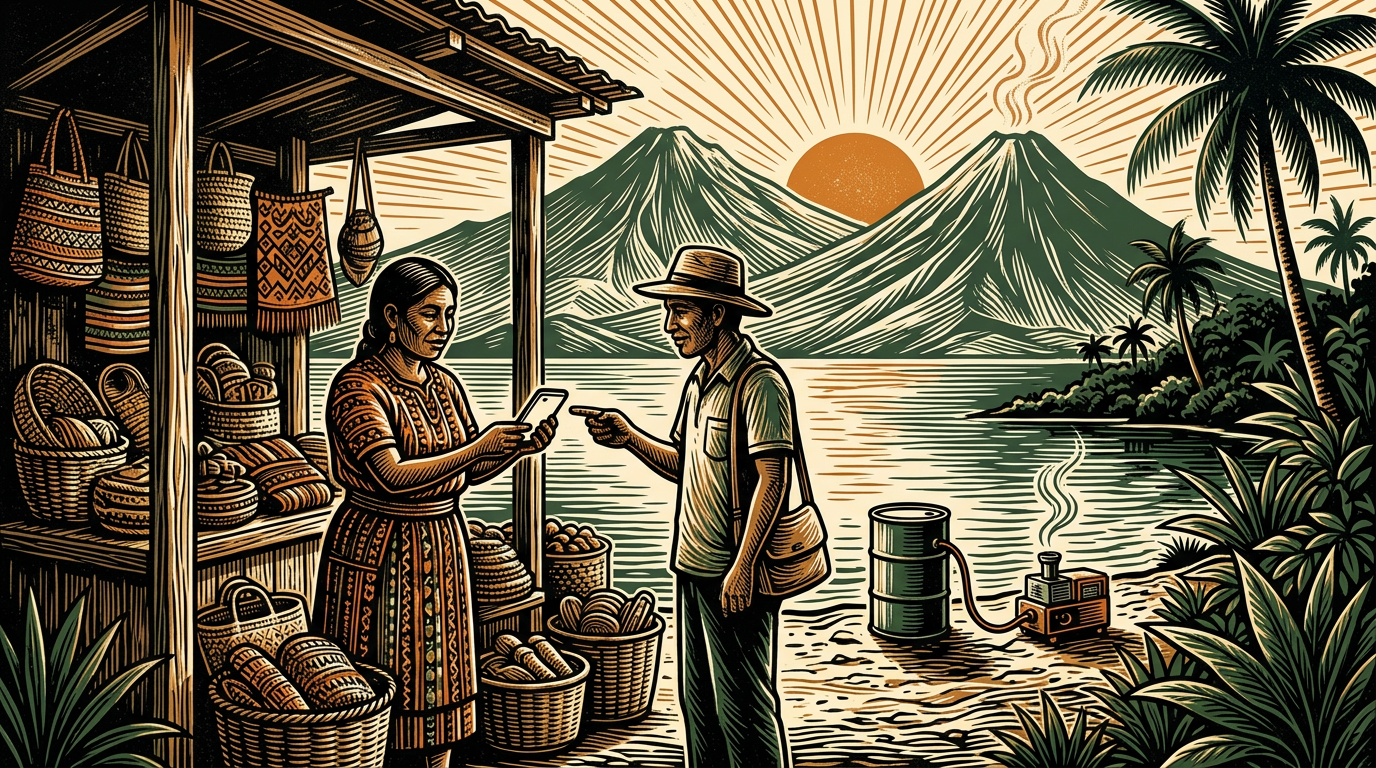
The volcanoes that ring Lake Atitlán draw the tourists; the exchange rate keeps them. In Panajachel, the lakeside town Guatemalans call Pana, a traveler can settle a hotel bill, a boat fare, or a plate of pepián by scanning a QR code and sending a few thousand satoshis over the Lightning Network. No bank sits between the buyer and the vendor. The money clears in seconds, and the vendor keeps it in bitcoin or swaps it for quetzales at will.
Locals call the project Bitcoin Lake — Lago Bitcoin. Since it began organizing merchants in early 2022, it has grown into one of Central America’s more durable circular economies: roughly 80 businesses around Pana and Lake Atitlán now accept bitcoin, from comedores and tuk-tuk drivers to hostels and coffee sellers. Earlier tallies counted about 60 merchants, of whom roughly 90% were unbanked — people who had never held a bank account, now transacting on a global settlement network from a secondhand phone.
That last figure is the whole story in a number. Guatemala’s formal banking system reaches a minority of adults, and remittances from abroad equal roughly a fifth of GDP. For a vendor with no account and no card terminal, bitcoin is not a speculation. It is the first electronic money she can accept without asking anyone’s permission.
The part that makes Pana unusual sits at the water’s edge. Lake Atitlán, one of the most beautiful bodies of water in the Americas, has been choking for years on runoff, sewage, and waste — including the used cooking oil that restaurants along the shore have long tipped into drains. Bitcoin Lake’s organizers built a project, nicknamed Kaboom, that collects that spent grease, converts it to fuel, and burns it to run bitcoin miners.
The loop is deliberately small and deliberately pointed. Waste that would have fouled the lake becomes electricity; the electricity earns bitcoin; the bitcoin funds the collection and the community programs. It will not clean Lake Atitlán on its own — the lake’s problems dwarf a few drums of fryer oil — but it reframes the argument that mining is only extraction. Here the miner is a garbage-disposal that happens to pay.
A circular economy dies if only tourists use it, so Bitcoin Lake pairs the merchant network with education. It runs the vendor-neutral My First Bitcoin curriculum — the same course, born in El Salvador, now taught in dozens of countries — at a local school, the Centro Educativo Josué, where the first class graduated in April 2023. Students learn what a private key is before they learn to trade.
Payments run mostly through Lightning wallets such as Blink, which turn a phone number into a bitcoin address and hide the plumbing behind a QR scan. A buyer never sees a channel or a routing fee; a seller sees the equivalent of a few quetzales arrive. The design lesson is the same one El Zonte taught in El Salvador and Kibera taught in Nairobi: adoption follows a wallet simple enough that a first-time user cannot get lost.
Pana is one node in a small constellation. Bitcoin Lake is explicitly modeled on Bitcoin Beach, the El Salvador project that turned the surf town of El Zonte into the movement’s founding myth. Other Guatemalan efforts have sprung up in tourist towns like El Paradón on the Pacific coast. None is a national program; Guatemala has passed no bitcoin law and shows no sign of wanting one.
The absence of a law is arguably the point. What is happening on Lake Atitlán was not decreed. It grew from a handful of organizers, a curriculum, a wallet, and a specific local problem — a dirty lake — that a miner could be pointed at. That makes it fragile in the ways grassroots projects always are, dependent on a few committed people and on tourist traffic that can dry up. It also makes it real in a way a treasury announcement never is.
The numbers to track are boring ones, and that is the tell: how many of Pana’s 80 merchants are still taking bitcoin a year from now, how many students pass through the Josué classroom, how much oil the Kaboom loop diverts from the lake. Merchant counts and repeat transactions, not price, are what separate a circular economy from a photo opportunity.
Why it matters: bitcoin becomes money where it solves a specific local problem — here, a town with few bank accounts and a dying lake — not where a government tells people to use it.
Editor’s note: merchant counts are as reported by Bitcoin Lake and independent visitors and move as businesses join or drop off; the roughly-80 figure is an approximation, not an audited total. Nothing here is financial advice.
Free. Five minutes. No hype.
Subscribe free