 The Bitcoin Beacon
A decree signed July 25 bars bitcoin mining across the city of Moscow, its region and parts of Kursk until the end of 2032 — to spare a strained grid, and reshuffling where the world’s hashrate lives.
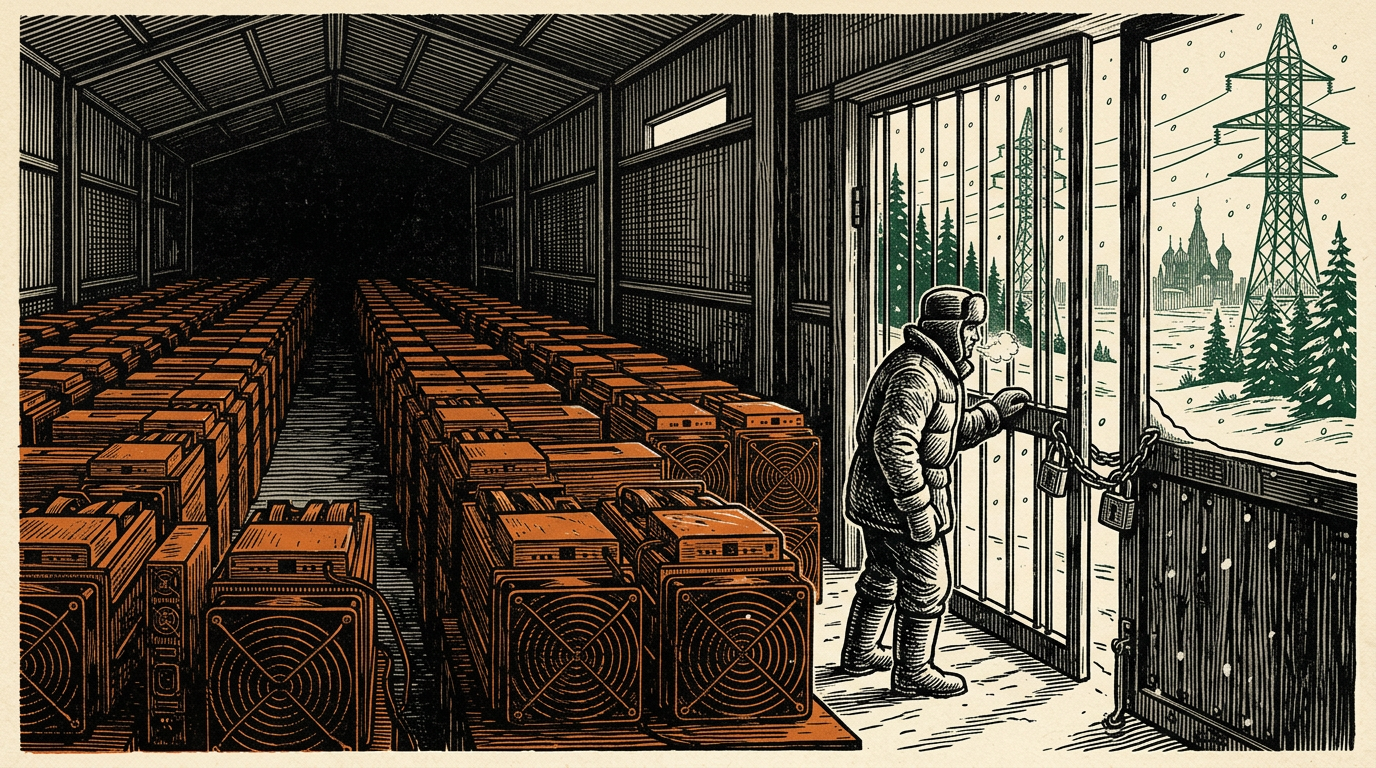
On July 25, Russian Prime Minister Mikhail Mishustin signed Resolution 936 — a short amendment with a long reach. It folds the city of Moscow, the surrounding Moscow region and nine districts of Kursk into an existing ban on bitcoin mining, and keeps them there until December 31, 2032. The prohibition takes effect on August 15.
The order is blunt about why. A government commission on the electric-power industry recommended the ban because mining strains local grids. Regulators count more than 65 data centres around Moscow drawing some 734 megawatts — roughly the appetite of a mid-sized city. Pull that load off the wires, the logic runs, and the capital’s households and “social facilities” keep their power through the cold months.
This is an expansion, not an invention. In December 2024, Moscow banned mining outright in ten regions — Dagestan, Chechnya, North Ossetia and other North Caucasus republics, plus the occupied Ukrainian territories of Donetsk, Luhansk, Zaporizhzhia and Kherson — all places where subsidised or fragile grids buckled under mining demand. Deputy Prime Minister Alexander Novak said then that more restrictions would follow, to “connect social facilities and enterprises under construction first.” The Moscow amendment is that promise arriving on schedule.
The government also points to results. The energy ministry says an earlier seasonal ban in Siberia eased peak load by more than 300 megawatts, blunting shortages that had forced rationing. In the official telling, evicting miners is less an anti-bitcoin gesture than demand management: the cheapest megawatt is the one you never have to generate.
The timing is its own story. Russia is not turning against bitcoin wholesale; it is drawing sharp lines around where the asset may touch the economy. In July, the State Duma passed a law recognising bitcoin as property and legalising it for cross-border trade settlement — a sanctions-era workaround for exporters of oil, metals and grain — while banning bitcoin as a domestic means of payment. That framework takes effect September 1. The central bank, separately, has capped how much unqualified retail investors may put into crypto.
Read together, the moves sketch a state that wants bitcoin as an instrument of foreign trade and a strategic-reserve idea, but not as a rival to the ruble at home or a free-rider on the national grid. Mining falls squarely in the second bucket: energy-hungry, easy to meter at the substation, and politically expendable the moment the lights flicker.
For the network, the consequential figure is not 734 megawatts but Russia’s share of global mining. By various industry estimates, Russia hosts on the order of a sixth of the world’s hashrate — one of the three largest bases anywhere, alongside the United States. A ban around Moscow does not delete that capacity; it pushes it elsewhere.
Mining is the most portable heavy industry on earth. The machines ship in a weekend, the power contracts are short, and the economics are brutally simple: electricity is three-quarters or more of a miner’s running cost, so operators chase the cheapest idle kilowatt wherever it sits. When one jurisdiction closes, rigs migrate to another — to Siberian hydro where it isn’t banned, to Kazakhstan, to the Gulf, to stranded gas in Texas or surplus hydropower in Paraguay. The network’s difficulty adjustment absorbs the churn: when hashrate leaves, mining grows easier and more profitable for whoever stays, which pulls capacity back in.
That elasticity is why bans rarely dent the network for long, and why they are a clumsy tool for a government that also wants the industry’s tax revenue and its knack for monetising stranded energy. Russia’s own regions have played both sides — some courting miners for surplus-hydro income, others evicting them to keep the heat on.
The near-term question is where the displaced machines land. Operators around Moscow have until August 15 to power down; the larger, better-capitalised ones are already scouting permissive regions and cheaper grids. Cross a border and Russia exports the hashrate and the tax base with it. Move east within Russia and the ban will have shuffled the problem rather than solved it.
The deeper signal is about who draws the map. A decade ago, hashrate pooled wherever electricity was cheapest and least policed. Increasingly it pools wherever a government decides it is welcome — a reserve to be courted or a load to be shed. Bitcoin’s security still rests on spreading that decision across many jurisdictions. Moscow just made one of its own off-limits.
Why it matters: a mining ban doesn’t shrink bitcoin’s security budget — it relocates it, and grid politics now decides which countries host the network’s backbone.
Editor’s note: figures are as reported by the Russian government, TASS and Bitcoin.com News; Russia’s share of global hashrate is an external industry estimate and varies by source. The decree bans mining of “digital currency” broadly, of which bitcoin is the dominant share. Nothing here is financial advice.
Free. Five minutes. No hype.
Subscribe free