 The Bitcoin Beacon
Block wired Lightning into the terminal on America’s corner-store counters. The hard part was never the technology — it was the fee.
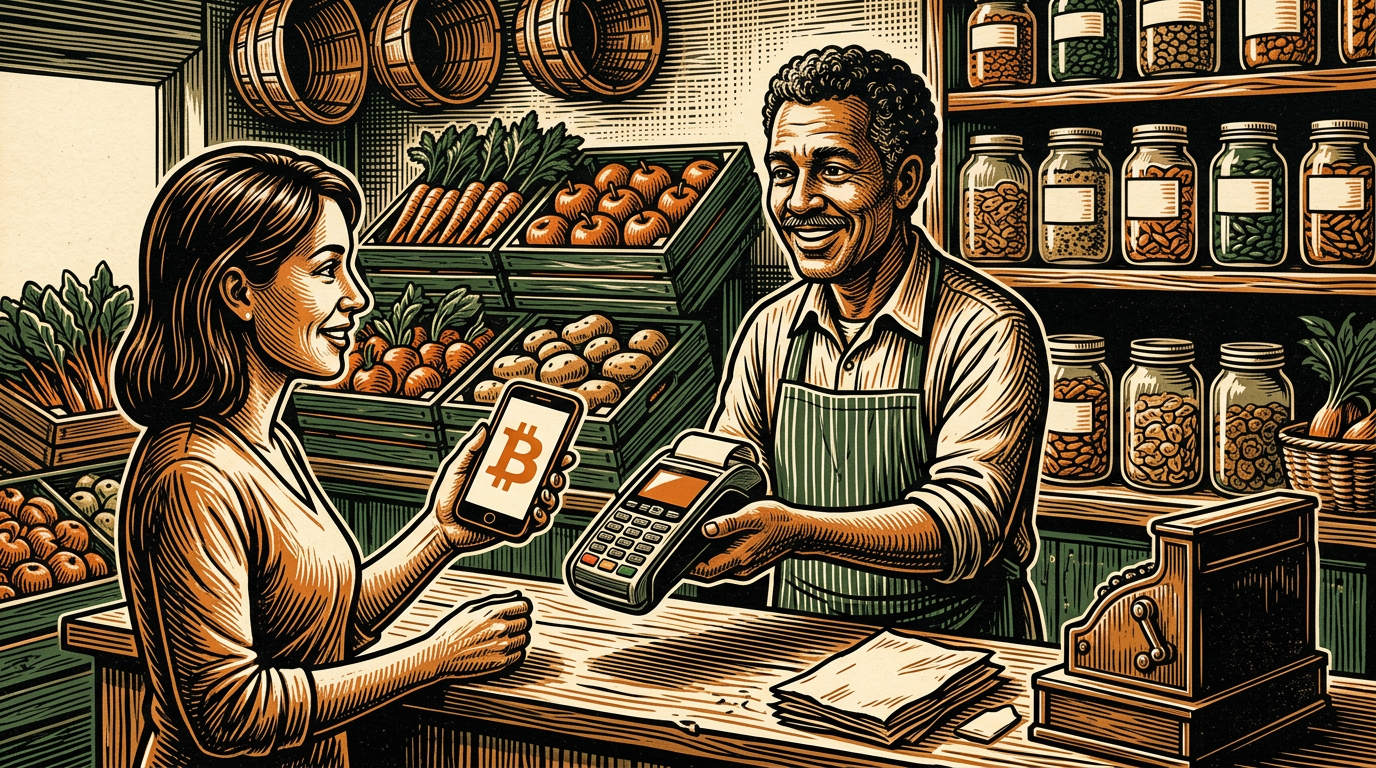
For a decade, “bitcoin adoption” meant a beach town, a Lightning conference, or a map dotted with a few thousand merchants who had gone out of their way to accept it. Block just skipped that phase. The company behind Square — the white terminal on the counter of coffee shops, salons, food trucks and corner stores across the United States — has switched on bitcoin acceptance over the Lightning Network for its sellers, and is opening it to a base of more than four million merchants.
The mechanics are deliberately boring. A merchant enables Bitcoin Payments in the Square Dashboard or point-of-sale app. At checkout, the terminal generates a Lightning invoice as a QR code; the customer scans and pays in bitcoin; the seller, by default, receives dollars. No new hardware, no wallet to manage, no crypto on the books unless the merchant chooses to keep it. A software update did the work.
Bitcoin has been technically spendable at the point of sale for years. What stopped it was economics and friction: a merchant had to want it, install something, and usually eat volatility. Block removed all three. Its lever is price. Bitcoin payments on Square carry zero processing fees through 2026, and a flat 1% after that — against the roughly 2.6% to 3% that card networks take on a typical swipe.
For a business running on thin margins, a two-point difference on every transaction is not a rounding error; it is the difference between a good month and a flat one. That is the pitch, and it is aimed at the merchant, not the ideologue. The customer paying in sats is incidental to a shop owner who simply keeps more of the sale.
The rail is now installed at the scale where habits form — whether or not anyone set out to change one.
This did not appear from nothing. Square added Bitcoin Conversions in 2024, letting merchants route a slice of their sales into bitcoin automatically. Acceptance is the natural next layer: instead of buying bitcoin with the day’s takings, the register can now receive it directly. Block began the rollout with U.S. physical-store sellers and is widening it toward full availability across its merchant base, with more than a million sellers already enabled.
Scale is the whole argument. BTC Map counted roughly 21,800 verified bitcoin-accepting locations worldwide at the end of 2025 — a figure built painstakingly, merchant by merchant, over years. Square’s base is more than a hundred times that. Even if only a fraction ever sees a bitcoin payment, the option now sits, unremarked, on an enormous number of counters.
Installing a rail is not the same as filling it. The overwhelming majority of Square customers will keep tapping a card, and a merchant enabling the toggle is not a customer choosing to pay with it. Default fiat settlement means many of these “bitcoin” transactions will be bitcoin for about one second before becoming dollars — useful for the network’s plumbing, less so for the circular-economy dream of sats that stay sats.
There is also concentration risk in celebrating it. A payments giant flipping a switch is adoption delivered from the top down, dependent on one company’s pricing decisions; the 1% fee that starts in 2027 is Block’s to raise. The grassroots version — a village where wages and groceries both move in bitcoin — is more fragile but more sovereign. Square’s version is more durable but more custodial. Both are real; they are not the same thing.
The metric that will settle the debate is opt-in: of the millions of sellers who can accept bitcoin, how many turn it on, and of those, how many customers actually pay that way once the novelty fades. Block has not committed to publishing that breakdown. If the numbers are strong, every other processor will feel the pull to match the fee. If they are weak, this becomes a marketing footnote — a rail that exists because it was cheap to build, used by almost no one.
Why it matters: adoption stops being a movement and becomes a default when the country’s biggest checkout counter quietly supports it — even if most shoppers never notice.
Editor’s note: rollout timing and merchant counts are as reported by Block and contemporaneous coverage; opt-in and actual bitcoin-payment volumes are not yet disclosed. Nothing here is financial advice.
Free. Five minutes. No hype.
Subscribe free