 The Bitcoin Beacon
A charity-built hydro plant on the Zambezi was going broke. Then a shipping container of bitcoin miners arrived — and 15,000 people kept their power.
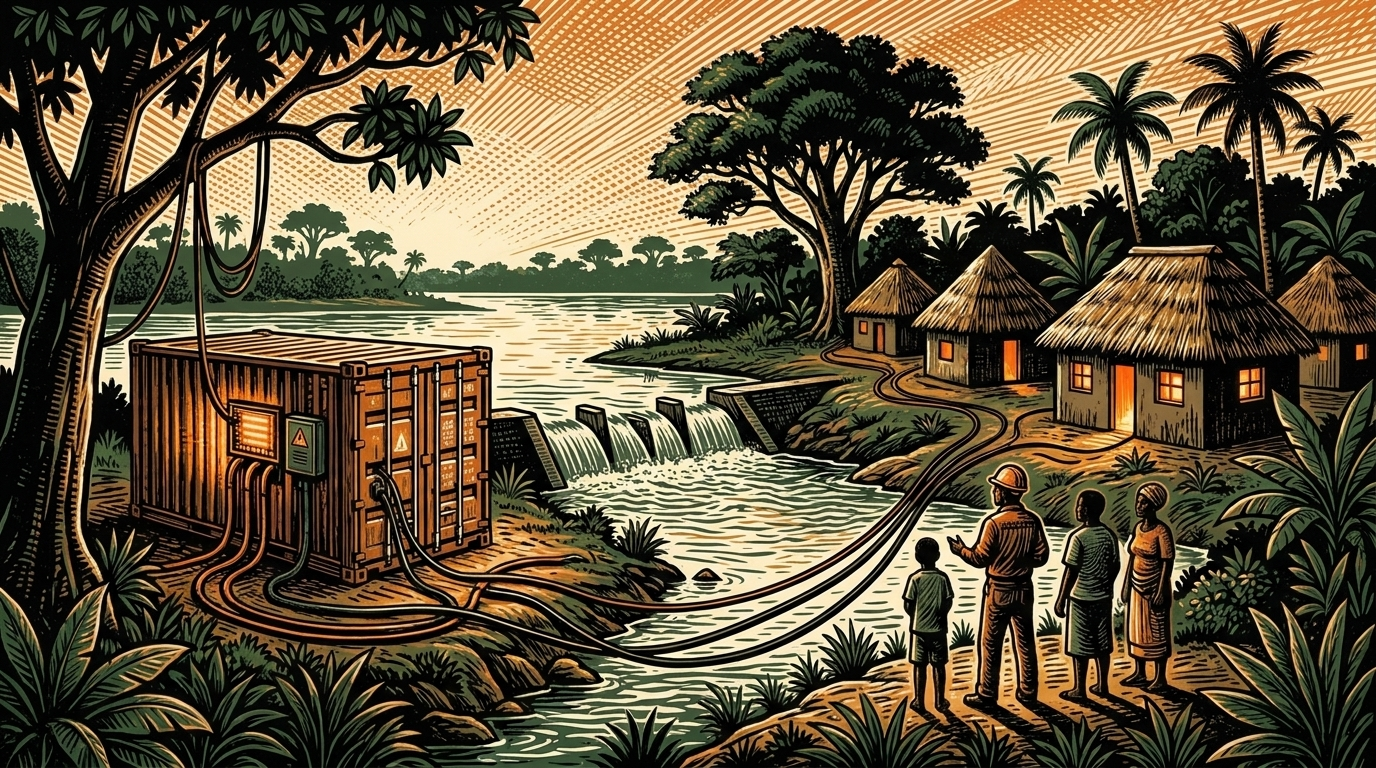
In the far north-west of Zambia, near the point where the country meets Angola and the Democratic Republic of Congo, a small hydroelectric plant sits on a tributary of the Zambezi. The Zengamina plant was built in the mid-2000s with roughly $3 million in charitable donations, meant to bring electricity to a district the national grid had never reached. It succeeded at the engineering and failed at the economics: the surrounding villages simply could not consume — or pay for — enough of its output to keep it running.
A power plant that cannot sell its power is a slow bankruptcy. Then, in 2022, a shipping container arrived carrying about 120 bitcoin miners. Plugged into the plant’s unsold electricity, the machines gave Zengamina a customer that never sleeps, never travels, and buys whatever the turbines produce. Today the plant supplies more than 15,000 people, and the mine is the reason the meter keeps spinning when the village does not.
The company behind the container is Gridless, an African bitcoin miner co-founded by Kenyan entrepreneurs and backed early by Jack Dorsey’s Block and by Stillmark. Its pitch is deliberately unglamorous: it does not build power plants or chase the cheapest megawatt on Earth. It shows up at small, rural, renewable mini-grids that already exist and buys the electricity nobody else is there to use.
That role — buyer of last resort — is the whole model. A rural hydro operator’s problem is not generation; it is demand. Load arrives slowly as a community grows, but the debt on the turbines is due now. A bitcoin miner is a flexible, interruptible load that can soak up 100% of the surplus today and then step aside, kilowatt by kilowatt, as homes, clinics and workshops come online and outbid it. Gridless says it now runs six sites across Kenya, Malawi and Zambia on that principle.
A power plant that cannot sell its power is a slow bankruptcy. The miners gave it a customer that never sleeps.
The revenue does not stay in a wallet. At Zengamina, income from mining has helped the plant stay solvent and extend service. In a village in southern Malawi running a community micro-hydro system, Gridless has said the mining revenue let the station afford to connect roughly 500 more households. In Zambia’s case, the plant that once struggled for customers is now expected to connect to the national grid within about a year.
When that happens, the miners lose their reason to be there — and that is the point. The rigs are mobile by design. Once Zengamina can sell its power to the grid at a fair price, Gridless packs the container and redeploys to the next stranded mini-grid that needs an anchor tenant. The subsidy was always meant to be temporary scaffolding, not a permanent fixture.
There is a second-order effect that bitcoiners like to point out. Mining has historically clustered in North America, China and a handful of energy-rich states. Every megawatt that hums in rural Zambia or Malawi nudges the network’s hashrate — and with it, a sliver of bitcoin’s security — onto a continent that has been a bystander to it. Analysts tracking African hashrate expect it to roughly double by 2027 as more of these renewable, off-grid sites come online.
Gridless is now raising capital to go a step further and develop its own small run-of-river hydro projects — systems that need no large dam and can operate in remote, off-grid terrain. The ambition is to stop renting the edge of other people’s grids and start building the edge itself.
This is not a story without limits. Mining economics ride on the bitcoin price and network difficulty; a deep, prolonged downturn would thin the margins that make a mini-grid whole. The load is a bridge, not a destination — it works precisely because it is temporary, and a site that never develops real local demand is a plant kept alive on subsidy rather than growth. And a single container at a single plant electrifies a village, not a nation; Africa’s power deficit runs to hundreds of millions of people.
What Gridless has proven is narrower and still meaningful: that stranded, wasted renewable energy in the poorest corners of the grid can be monetized instantly, in dollars, by a machine that will buy whatever is left over. For a hydro plant staring at an empty order book, that machine is the difference between the lights staying on and going dark.
Bitcoin mining is often framed as an energy villain. In rural Zambia and Malawi it is doing the opposite — underwriting the small renewable plants that bring first-time electricity to villages, then stepping aside as the community grows into its own power.
Editor’s note: site counts, household figures and the 15,000-resident tally are company- and community-reported and have not been independently audited. Mining economics depend on the bitcoin price and network difficulty. Nothing here is financial advice.
Free. Five minutes. No hype.
Subscribe free