 The Bitcoin Beacon
The naira has shed more than half its dollar value in three years. Millions of young, low-income Nigerians now park savings in bitcoin and dollar tokens instead.
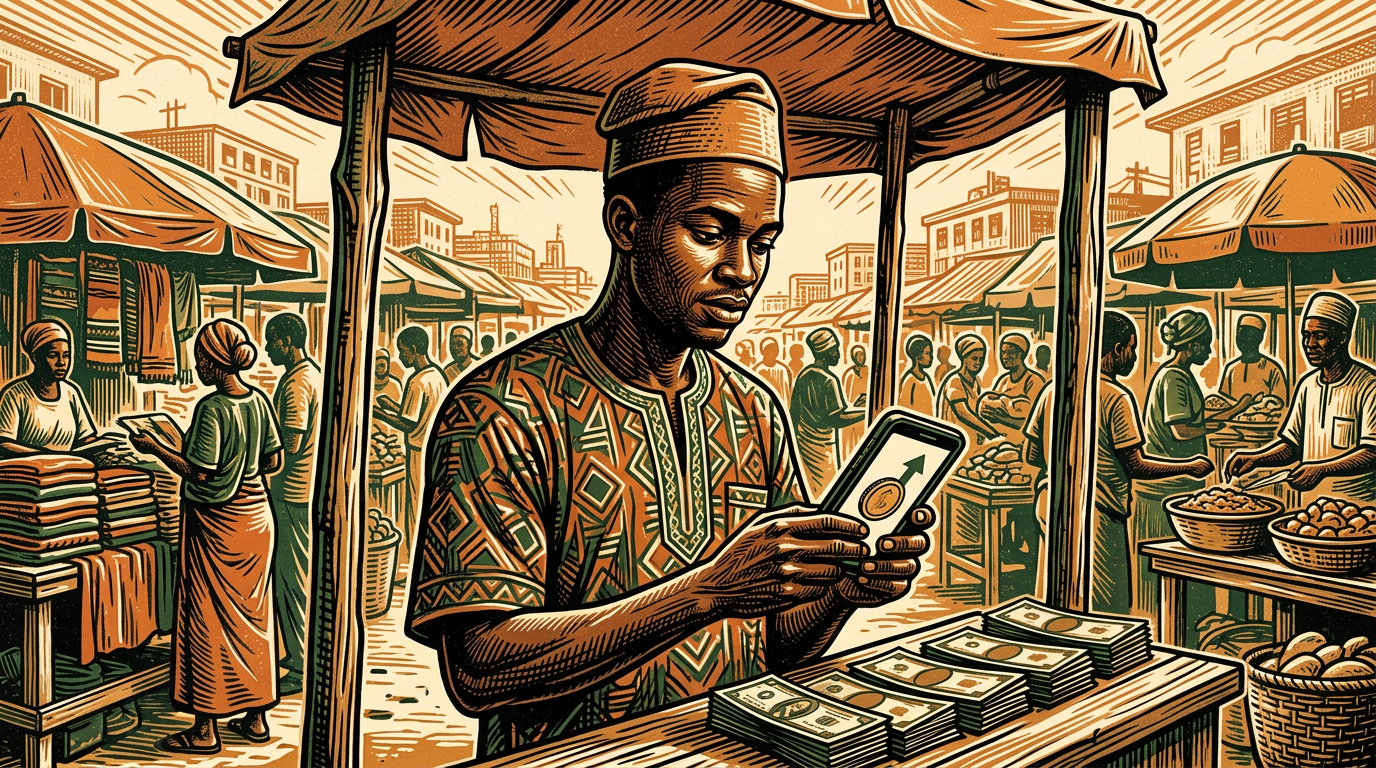
Do the arithmetic that every Nigerian saver has done in their head. In 2023, a dollar cost roughly ₦750. Today it costs close to ₦1,600. Anyone who kept their wealth in naira has watched more than 40% of its dollar value disappear — not through a bad investment, but by simply holding the national money and doing nothing wrong.
That single fact explains one of the world’s largest grassroots bitcoin markets better than any ideology. Nigerians are not, for the most part, chasing a moonshot. They are trying to stop bleeding value between paydays.
The slide has a clear origin. In mid-2023 the government floated the currency and unified its exchange-rate windows, part of a reform package meant to lure investment and end costly subsidies. The intended medicine was real; so was the side effect. The naira repriced sharply against the dollar and kept sliding. Inflation peaked around 26% in mid-2025 before easing to roughly 16% by mid-2026, according to the National Bureau of Statistics — cooler, but still fast enough to eat savings alive.
For a worker whose rent, school fees and food all creep upward while wages lag, a bank account denominated in naira is a leaky bucket. The rational move is to hold something the central bank cannot print at will.
Nigerians are not chasing a moonshot. They are trying to stop bleeding value between paydays.
The scale is striking. Industry trackers project Nigeria’s active crypto users will reach 27–30 million in 2026, and the country consistently ranks at or near the top of Chainalysis’s grassroots-adoption index, alongside India. This is not a wealthy elite’s hobby: one survey found roughly 85% of Nigerian crypto investors earn under ₦250,000 a month, placing them squarely in the low-to-middle income bracket. The typical adopter is a student, freelancer or young professional.
Their tools are practical. Peer-to-peer trading routes around banking friction; remittances arrive faster and cheaper than through money-transfer operators that can take days and skim high fees. For a continent that loses an estimated $5 billion a year to cross-border payment costs, shaving those fees is not abstract.
Here is the honest complication. Much of Nigeria’s day-to-day crypto activity runs not through bitcoin but through dollar-pegged stablecoins — a digital version of the greenback Nigerians have always craved. For paying a supplier or holding this month’s wages, a token that never moves from one dollar is simpler than an asset that can swing 5% before lunch.
Bitcoin plays a different, longer game in the same wallets. It is the harder-money, censorship-resistant store of value for savings measured in years, not weeks. The two coexist: stablecoins for spending, bitcoin for saving. Both are, at heart, the same vote of no confidence in the naira.
Officialdom has swung from hostility to grudging structure. After years of banking restrictions, Nigeria’s 2025 Investments and Securities Act recognised digital assets as securities and handed the SEC authority to license exchanges; the regulator has issued provisional approvals to a handful of local platforms and vowed to crack down on unlicensed ones. Recognition is not endorsement, but it is an admission of a market too large to wish away.
None of that changes the underlying driver. When a currency loses half its value in three years, people reach for money that cannot be quietly diluted. In Nigeria, bitcoin’s most effective marketing department is the naira itself.
Nigeria’s bitcoin boom is a savings story, not a speculation story. A currency that has lost 40%-plus against the dollar since 2023 has pushed tens of millions of ordinary earners toward assets the state cannot debase — even as regulators race to bring the market onshore.
Editor’s note: user counts and income breakdowns are third-party estimates and survey figures; exchange rates and inflation move continuously. Much of Nigeria’s crypto activity is in dollar-pegged stablecoins, of which bitcoin is one part. Nothing here is financial advice.
Free. Five minutes. No hype.
Subscribe free