 The Bitcoin Beacon
A grassroots project called Bitcoin Jungle has spent five years wiring the country's Pacific coast to accept bitcoin — and the merchants taking it are paid instantly, in colones.
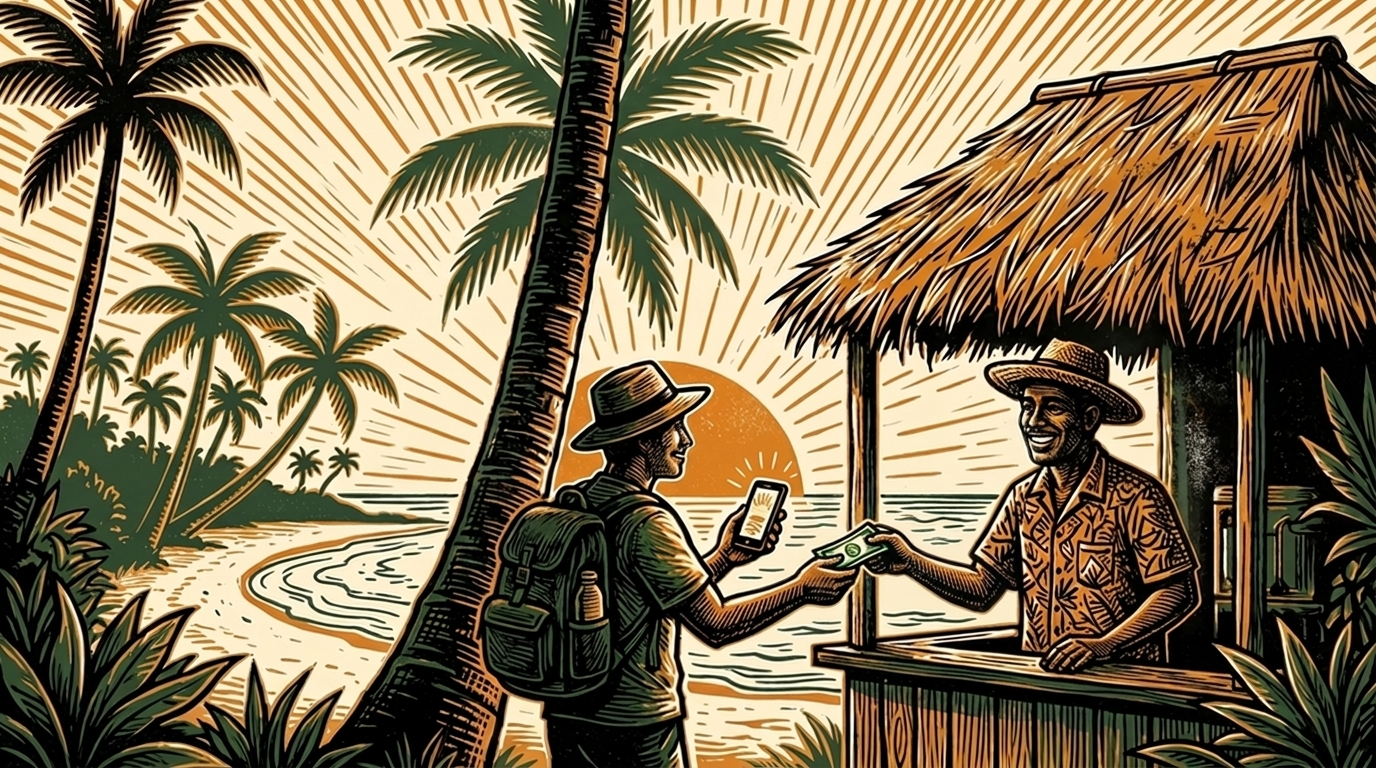
The transaction takes about a second, and nobody at the table looks up. On the Pacific coast south of Quepos, a diner at a Dominical soda — the local name for a small family restaurant — opens a wallet app, scans a QR code, and approves a total shown in Costa Rican colones. The owner's phone chimes. The money has already cleared. What moved between them was bitcoin, over the Lightning Network; what the owner keeps is local currency, in her bank account, before the plates are cleared.
That ordinariness is the product of five years of patient work by Bitcoin Jungle, a community project that began in the Osa region of Puntarenas in 2021 and has since turned a stretch of jungle coastline into one of Latin America's most active bitcoin economies. By its own count and that of independent trackers, more than 200 businesses across the country now accept bitcoin through the network it built — restaurants, surf schools, hotels, dentists, grocers and tour operators clustered along the beach towns of Jacó, Quepos, Dominical, Uvita and the Osa Peninsula.
The design goal was to remove every reason a merchant might say no. When a customer pays, Bitcoin Jungle's software accepts the Lightning payment and, if the merchant wants, converts it instantly and settles them in colones through SINPE, the central bank's real-time interbank transfer system that nearly every Costa Rican already uses. The shop owner need never hold bitcoin, watch its price, or open an exchange account. The volatility and conversion happen in the seconds between the scan and the confirmation.
The plumbing is deliberately open. The project runs on BTCPay Server, the free, self-hosted payment processor, and ships its own non-custodial wallet so users can hold their own keys rather than trust the project with their savings. Lightning is what makes the everyday purchase viable at all: a base-chain bitcoin fee is priced for global demand and can exceed the cost of a casado lunch, while a Lightning payment clears for a fraction of a cent.
The merchant sees colones. The customer spends bitcoin. The second in between is where the whole system lives.
Costa Rica's experiment is often compared to El Salvador's Bitcoin Beach, the El Zonte project that inspired a national law. But Bitcoin Jungle made a different wager. Bitcoin Beach seeded a local population with bitcoin and taught residents to circulate it; Jungle, sitting in one of Central America's busiest tourism corridors, bet instead on visitors who already own bitcoin and want somewhere to spend it. The coast draws surfers, retirees and digital nomads from North America and Europe — exactly the demographic most likely to arrive with a Lightning wallet already installed.
That changes the adoption math. A merchant does not have to be convinced bitcoin is the future; she has to notice that a slice of her customers would rather pay in it, and that saying yes costs her nothing because she is paid in colones anyway. Acceptance becomes a marketing decision, not an ideological one.
This is a small economy, and it would be dishonest to inflate it. Two hundred merchants along a tourist coast is a rounding error against Costa Rica's card networks, and much of the country's broader crypto activity is still trading and dollar-pegged stablecoins rather than spending. Many merchants convert every payment straight to colones the instant it lands, which means bitcoin is passing through as a rail more than circulating as money. On a quiet week, a shop might take one bitcoin payment or none.
But the direction is the point. A payments network that keeps working when the price falls, that a dentist in Uvita can switch on without changing her accounting, is a more durable form of adoption than a headline about a treasury purchase. It grows one storefront at a time and does not depend on anyone believing bitcoin will go up.
Costa Rica offered unusually fertile ground. It has an instant, ubiquitous domestic payment system in SINPE, a tourism economy that imports foreign customers by the planeload, a stable democracy, and a coastal culture already comfortable with apps and QR codes. Bitcoin acceptance did not have to change local behavior so much as slot into behavior that already existed. The project's other half is education — free community classes rather than paid academies — on the theory that people spend what they understand.
Bitcoin Jungle is not legal tender and not a government program. It is a payments network that happens to run on bitcoin, built by a community and settled in colones, quietly proving that the most convincing case for adoption is a lunch that gets paid for and a merchant who never has to think about it.
Editor's note: merchant counts are project- and tracker-reported and fluctuate. Bitcoin Jungle offers instant conversion to colones; not every merchant retains bitcoin. Nothing here is financial advice.
Free. Five minutes. No hype.
Subscribe free