 The Bitcoin Beacon
The headlines this month read like a funeral for the industry. Read them again: it is the companies dying, not the network they were built on.
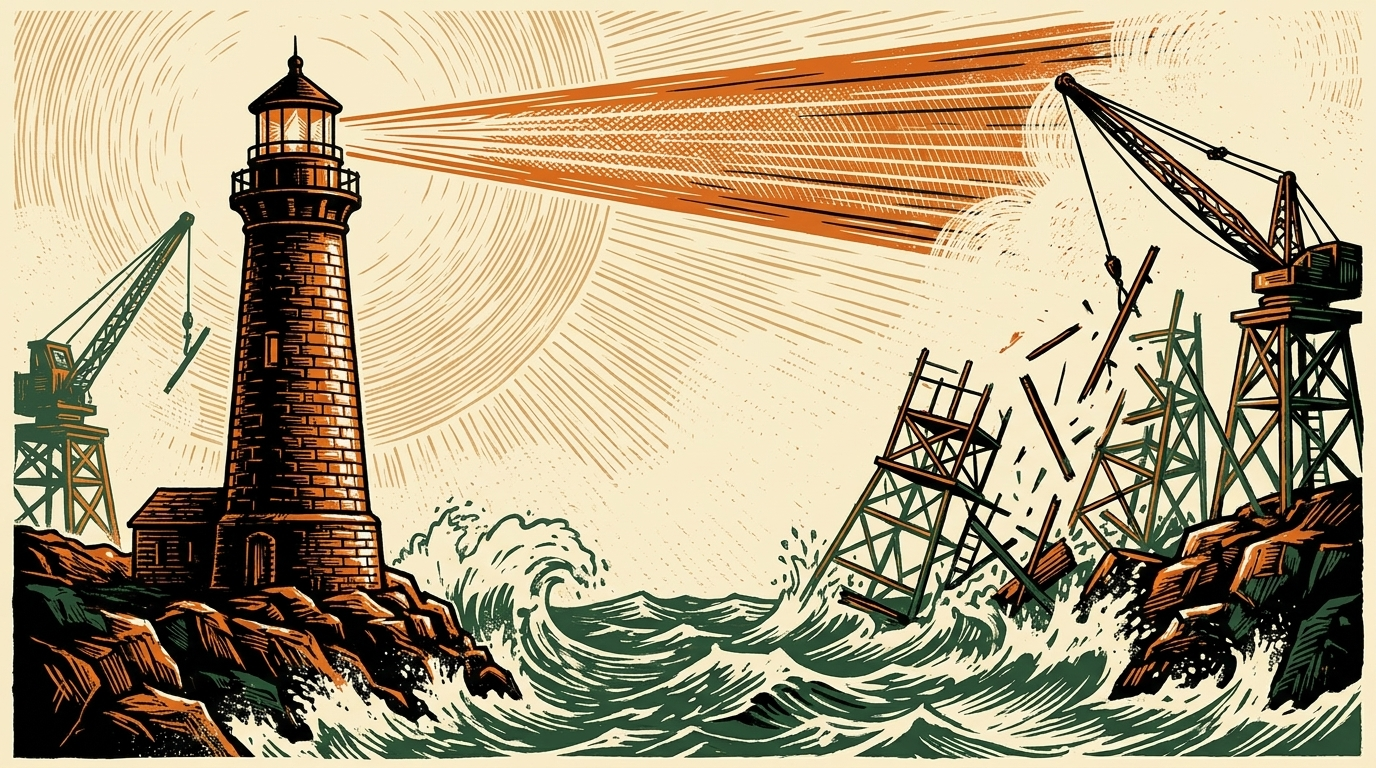
Take the month at face value and it looks grim. An exchange with nine years of history is winding down. A mining pool that once commanded a fifth of the network is in bankruptcy, owing frozen users $164 million. The largest corporate holder on earth stopped buying and started counting its cash. One tracker says 99 crypto projects have already died this year. If bitcoin were these companies, you would call it a rout.
It isn't. Every one of those failures is a business failing — a custodian, a matcher of orders, an issuer of a token, a leveraged treasury. Not one of them is the bitcoin network, which produced a block roughly every ten minutes through all of it, without a board meeting, a bailout or a press release. The distinction is not pedantry. It is the entire investment case, showing up as a live experiment.
"Crypto" has always smuggled two different objects under one word. One is an industry: exchanges, lenders, pools, funds, tokens — companies that make money as intermediaries and carry all the risks companies carry. The other is a protocol: a set of rules that settles bitcoin between strangers without any of those companies' permission. In good years the two rise together and the difference is easy to ignore. In a shakeout, the difference is the only thing that matters.
2026 is a shakeout, and it is sorting the two apart in public. BitMart closes; the protocol shrugs. Poolin's creditors line up; hashrate re-routes to other pools within hours. Strategy pauses its buying; the 843,775 coins it already holds do not care whether it adds more. The companies are cyclical. The network is not going through a cycle — it is going through users.
When a crypto company dies, its users become creditors. When they hold their own bitcoin, they stay owners.
The evidence that adoption is climbing is in the same edition as the obituaries. In South Africa, bitcoin now clears at more than 1,500 Pick n Pay stores and hundreds of thousands of smaller merchants, settling instantly in rand. Across Africa, one fintech reported last week that a majority of its bitcoin transactions have moved to Lightning. Pakistan is building a licensing regime because 40 million of its citizens already use the stuff. None of that shows up in a token chart. All of it is adoption.
That is the pattern beneath the noise. The speculative, company-shaped layer of the market is contracting — over-leveraged, over-tokenised, over-promised, and now being repriced. The usage layer — people spending, saving and sending bitcoin because it solves a problem their currency doesn't — is still growing. The first makes headlines when it breaks. The second rarely makes headlines at all.
The clean split can be oversold, so here is the other side. Most people still touch bitcoin through the exact companies that are failing — they buy on exchanges, hold on apps, and would lose real money if the wrong one froze withdrawals. A market with fewer venues is thinner and, in a panic, more prone to contagion; a large enough failure can drag the price of even self-custodied coins. "The protocol is fine" is cold comfort to a user who never moved their balance off a dying platform. Resilience at the network layer does not automatically protect people at the account layer.
But that is an argument for how to hold bitcoin, not whether the thing is working. The lesson of this month is not that bitcoin is fragile; it is that the companies around it are, and that the distance between "I own bitcoin" and "an exchange owes me bitcoin" is the difference between weathering a shakeout and being a line item in one.
Read 2026's casualty list as what it is: an industry shedding its excess, not a network in decline. The companies that over-promised are failing on schedule. Meanwhile, in Cape Town and Lagos and across Pakistan, more people are using bitcoin than ever. The scaffolding is coming down. The lighthouse is still lit.
Editor's note: this is opinion, and it is not financial advice. Figures cited are drawn from the reporting linked above.
Free. Five minutes. No hype.
Subscribe free