 The Bitcoin Beacon
Cheap hydropower drew the miners in. A staged tariff hike — 30% last winter, 24% this month, 28% next year — could send them back out.
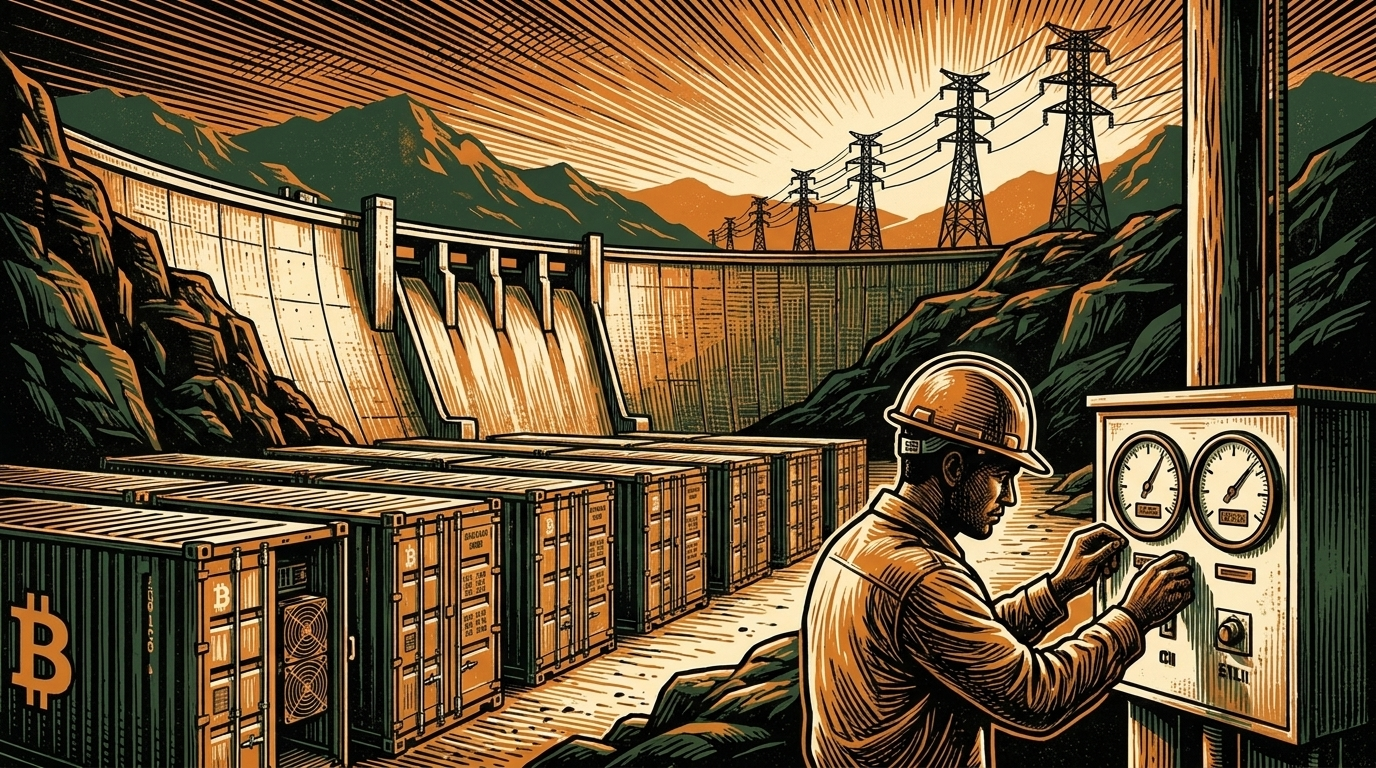
Ethiopia spent two years courting the world’s bitcoin miners with some of the cheapest power on earth. Now the national utility is raising the price of that power on a schedule steep enough that, by its own estimate, roughly half of the miners it invited could be losing money by the middle of this year.
Ethiopian Electric Power has set a three-year tariff climb for data-mining customers: a 30% jump last December, a further 24% this July, and 28% more in July 2027. In cash terms the daily-average rate rises from about four U.S. cents per kilowatt-hour today toward roughly 6.5 cents by 2028, inclusive of a 15% value-added tax and a regulatory fee. Miners had been paying closer to 3.2 cents.
Bitcoin mining is a margin business measured in fractions of a cent. Operators in West Texas, the industry’s largest hub, average around 2.8 cents per kilowatt-hour; once Ethiopia’s all-in rate crosses six cents, the arithmetic that made the country attractive inverts. EEP’s own reading is blunt: about half of the mines operating today become unprofitable by mid-2026, and more than 90% by 2027.
That is what industry insiders mean when they warn of a “Kazakhstan moment” — a reference to 2021, when a tax-and-tariff squeeze plus power shortages sent a mining boom fleeing the country almost as fast as it arrived. Machines are mobile; a container of rigs that stops paying its way in Addis can be shipped to Paraguay or Oman within a quarter.
Machines are mobile. Loyalty to a grid lasts exactly as long as the margin does.
The draw was the Grand Ethiopian Renaissance Dam, Africa’s largest hydroelectric project, formally inaugurated in September 2025. It gave the country a surplus of low-cost, low-carbon electricity and a government hungry for hard currency. Miners — many of them Chinese firms displaced by Beijing’s 2021 ban — supplied both, signing power deals that turned spare megawatts into dollars. By this year Ethiopia hosted on the order of two dozen mining operations drawing an estimated 600 megawatts.
The state’s calculation is not anti-mining; it is arithmetic of its own. The same electrons a miner buys could light homes and run factories in a country where millions still lack reliable power, and the utility would rather sell them at a higher price — to miners who can pay, or to a domestic economy that needs them. Bitcoin here was never legal tender or even a legal investment; institutions are barred from touching crypto. Mining was tolerated precisely because it paid in foreign exchange.
Raising prices on a mobile industry is a gamble that enough miners stay and pay the higher rate to beat the revenue lost when others leave. It can work: the most efficient operators, running the newest machines, survive at six cents where older rigs die. Ethiopia may end up with fewer, larger, better-capitalised miners — a consolidation, not a collapse — the same pattern now visible in Paraguay, where revenue rose even as operator counts fell.
Or the miners read the three-year curve, note that the cheap window is closing, and move before it does. Either way the episode is a lesson in what sovereign mining actually buys a state: not a permanent industry, but a rented one, loyal to the lowest marginal cost on the planet at any given moment. For now, the meters keep running in the highlands — and every operator is doing the same sum.
Ethiopia is testing whether a country can raise the price of its power without losing the miners that price attracted. The utility is betting on consolidation; the miners are pricing an exit. Watch the next difficulty adjustments and any reports of container shipments out of Addis for the answer.
Editor’s note: tariff figures and profitability estimates are from Ethiopian Electric Power and local reporting; operator counts are estimates. Nothing here is financial advice.
Free. Five minutes. No hype.
Subscribe free