 The Bitcoin Beacon
A Korean firm can't mine bitcoin profitably at home, so it's exporting the machines — to Omani gas and Paraguayan hydropower.
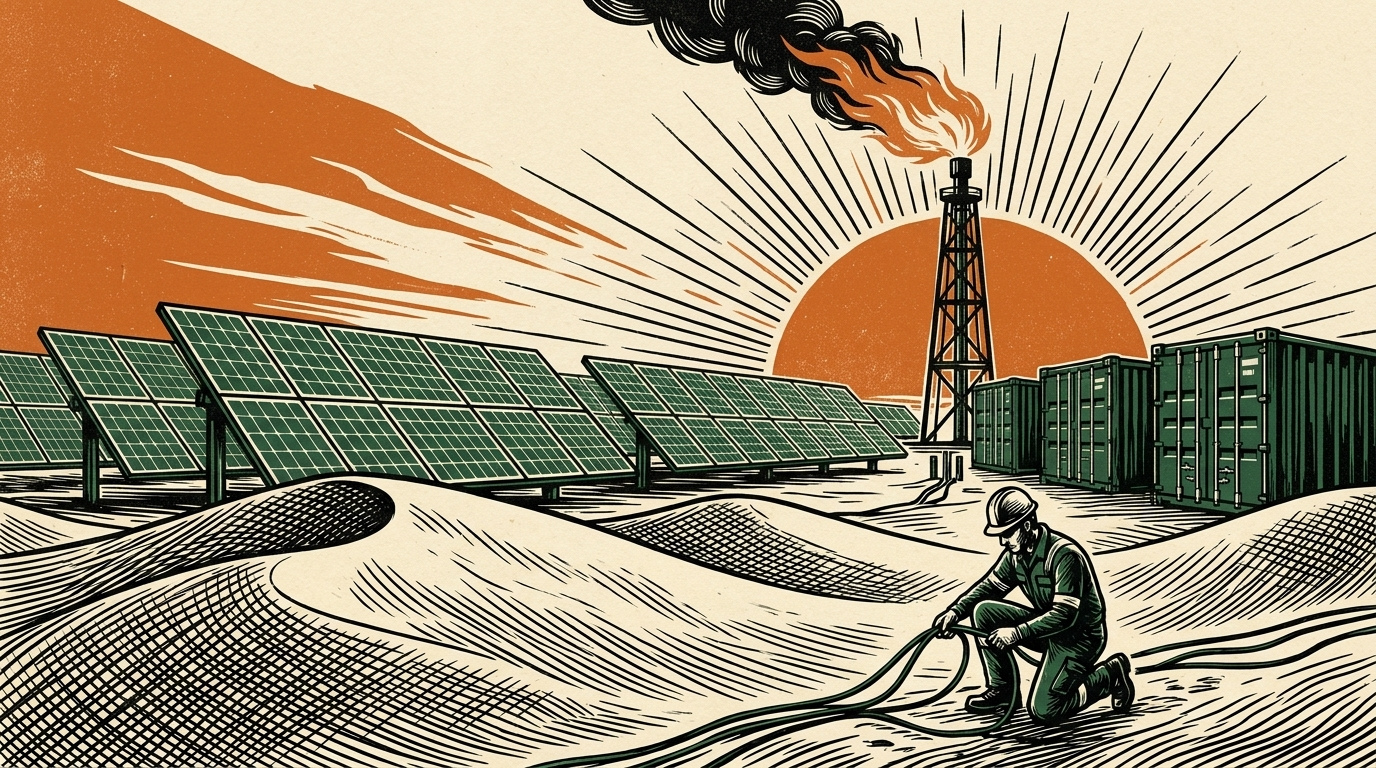
Bitcoin mining is a business with one input that decides everything: the price of electricity. South Korea has expensive power and a wary regulator, so a Seoul-based miner has made the logical move — it is taking its machines somewhere else. Bitplanet said in early July it would deploy about 15 billion won, roughly $10 million, in mining equipment across two countries an ocean apart: Oman and Paraguay, chosen for one reason each offers cheap, otherwise-wasted energy.
The scale is deliberately small. Bitplanet's first phase is projected to produce about 7 BTC a month, or north of 80 BTC a year — a pilot, not an empire. What makes it notable is the direction of travel. This is Korean capital crossing continents to rent the cheapest joules on Earth, and it lands in exactly the emerging hubs that have crept into mining's global top tier over the past year.
Oman has spent recent years courting miners as a way to monetize stranded and flared gas and to diversify a hydrocarbon economy; the sultanate now hosts licensed, regulated operations pitched at institutional players. Paraguay offers the other classic miner's bargain: a surplus of hydropower from the giant Itaipu dam, with some of the lowest industrial electricity rates anywhere — around $0.033 per kilowatt-hour. For a business whose margin is the gap between power cost and block reward, that spread is the entire proposition.
This is Korean capital crossing continents to rent the cheapest joules on Earth.
Bitplanet is a minnow beside the names already in these markets. Larger operators have planted flags in the same soil — roughly 300 megawatts of capacity in Paraguay for one publicly traded miner, tens of megawatts in Ethiopia for another — and Paraguay, Ethiopia and Oman have all pushed into the global top ten for hashrate. A $10 million pilot does not move that ranking. It signals something else: that mid-sized Asian firms now treat cross-border deployment as routine, not exotic.
Cheap power is rarely uncontested. Paraguay has spent the past year tightening the rules around miners — higher tariffs, tougher licensing — and its surplus is increasingly coveted by artificial-intelligence data centers willing to outbid bitcoin for the same electrons. A miner chasing the lowest rate is also chasing a moving target, exposed to the host country's next tariff decision and to competition from an industry with deeper pockets. Geographic diversification — one site in the Gulf, one in South America — is partly a hedge against exactly that.
Every deal like this spreads hashrate a little wider across the map, and a more geographically distributed network is a more resilient one — harder for any single government to disrupt. It also globalizes the capital: mining is no longer a story of Chinese or American operators alone, but of Korean, Gulf and Latin American money meeting over the same stranded megawatt. The machines follow the cheapest power, and the cheapest power keeps moving.
Bitplanet's $10 million pilot is tiny, but the logic is the whole industry's: mine where power is wasted and cheap, hedge across continents, and stay nimble as hosts change the rules and AI bids for the same grid. Watch whether the pilot scales — and whether Paraguay's tightening pushes the next wave toward the Gulf.
Editor's note: production estimates are the company's projections; actual output depends on price, difficulty and uptime. Nothing here is financial advice.
Free. Five minutes. No hype.
Subscribe free