 The Bitcoin Beacon
A new resolution routes a share of every licensed miner's output to the national bank — a government stacking bitcoin without buying a coin.
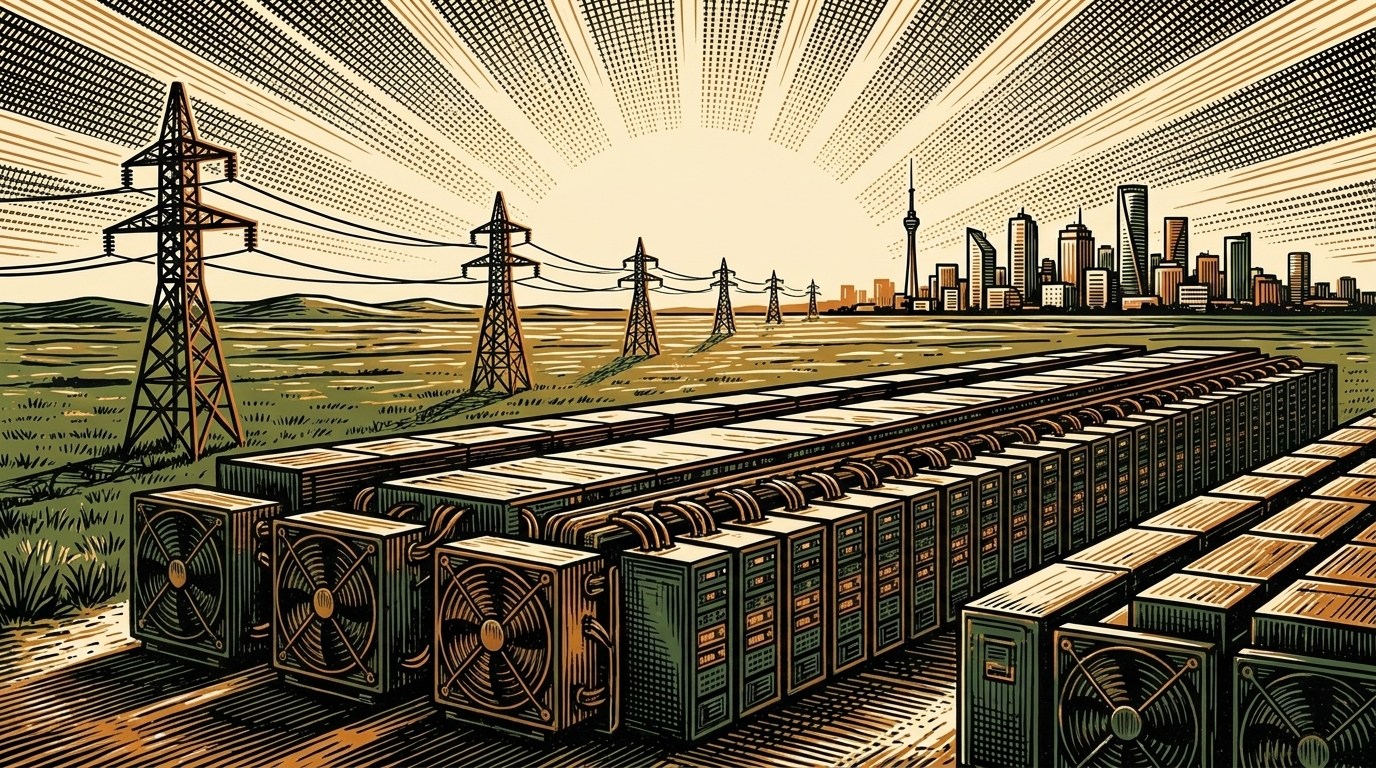
Kazakhstan has found a way to accumulate bitcoin without spending a tenge on it: make the miners hand some over. A presidential decree signed July 7 and Government Resolution No. 638, approved July 18 and effective August 1, set up a program of "strategic digital mining" that seeds a national reserve from the output of the country's own rigs.
The trade is explicit. Qualifying miners get scarce, cheap electricity; the state gets a standing claim on a portion of what they produce. No open-market purchase, no budget line, no politically awkward vote to "buy bitcoin." The coins arrive as a kind of royalty on power.
Under the resolution, large licensed miners receive electricity quotas at capped tariffs on 10-year contracts from designated power producers — long-term certainty in exchange for feeding the reserve. Each month they transfer a share of mined coins to a fund tied to the state-linked Astana Hub cluster. From there the coins pass to the JSC National Investment Corporation of the National Bank of Kazakhstan, which manages them inside a "national strategic crypto reserve."
Eligibility is set high enough to exclude hobbyists: a qualifying operation must run a data center of at least 150 megawatts, with individual rigs clearing at least 150 terahashes per second. This is a policy written for industrial-scale farms, not backroom setups.
The state isn't buying bitcoin. It's taxing electricity in bitcoin — and letting the national bank hold the receipts.
Local media have reported that miners will hand over 10% of output, but the published rules do not appear to specify the share, and Cointelegraph noted it could not independently verify the figure. Until the mechanics are spelled out on August 1, "10%" should be treated as a widely repeated estimate rather than a confirmed rate. The design principle is clear even if the percentage isn't.
Kazakhstan is an unlikely convert. After China expelled miners in 2021, the country became one of the world's largest bitcoin-mining hubs almost overnight — then buckled under the load, with power shortages and winter blackouts prompting a 2022 crackdown, higher tariffs, and a licensing regime. Resolution No. 638 is the endpoint of that arc: instead of fighting the miners or merely taxing them in cash, the state now conscripts a slice of their production into its own balance sheet.
It puts Kazakhstan alongside a small cluster of governments treating mining as sovereign strategy — neighboring Kyrgyzstan floated a state mine-and-hold plan, Pakistan earmarked 2,000 megawatts for the sector, and Ethiopia hosts state-owned rigs on surplus hydropower.
Capped-tariff, 10-year power deals are a subsidy, and subsidies to energy-hungry mining are exactly what triggered the 2022 grid stress; the state is betting its generation mix can carry the load this time. A reserve built from mining is also a bet on a volatile asset with public money, managed by a central bank that will have to decide when, if ever, it sells. And a claim on future output is only as good as the miners' economics — if hashprice compresses, marginal operators leave, and the royalty thins with them.
Buying bitcoin is a decision a finance minister has to defend. Mining it quietly, as a byproduct of power the state already sells, is one almost no one has to. Kazakhstan has found the politically frictionless on-ramp to a sovereign reserve — and other resource-rich states with cheap electricity are watching how the receipts add up.
Watch August 1 for whether the contribution rate is finally named, how many farms clear the 150-megawatt bar, and whether the National Bank discloses the reserve's holdings. A state reserve that grows in the dark is easy to announce and hard to audit.
Editor's note: the 10% miner-contribution rate is reported by local media but not confirmed in the published rules; provisions take effect August 1, 2026 and may be clarified or changed. "National strategic crypto reserve" may include assets beyond bitcoin. Nothing here is financial or legal advice.
Free. Five minutes. No hype.
Subscribe free