 The Bitcoin Beacon
A Peruvian cevicheria in La Paz became the first business in Bolivia to accept bitcoin over Lightning — two years after the country lifted its ban on the asset.
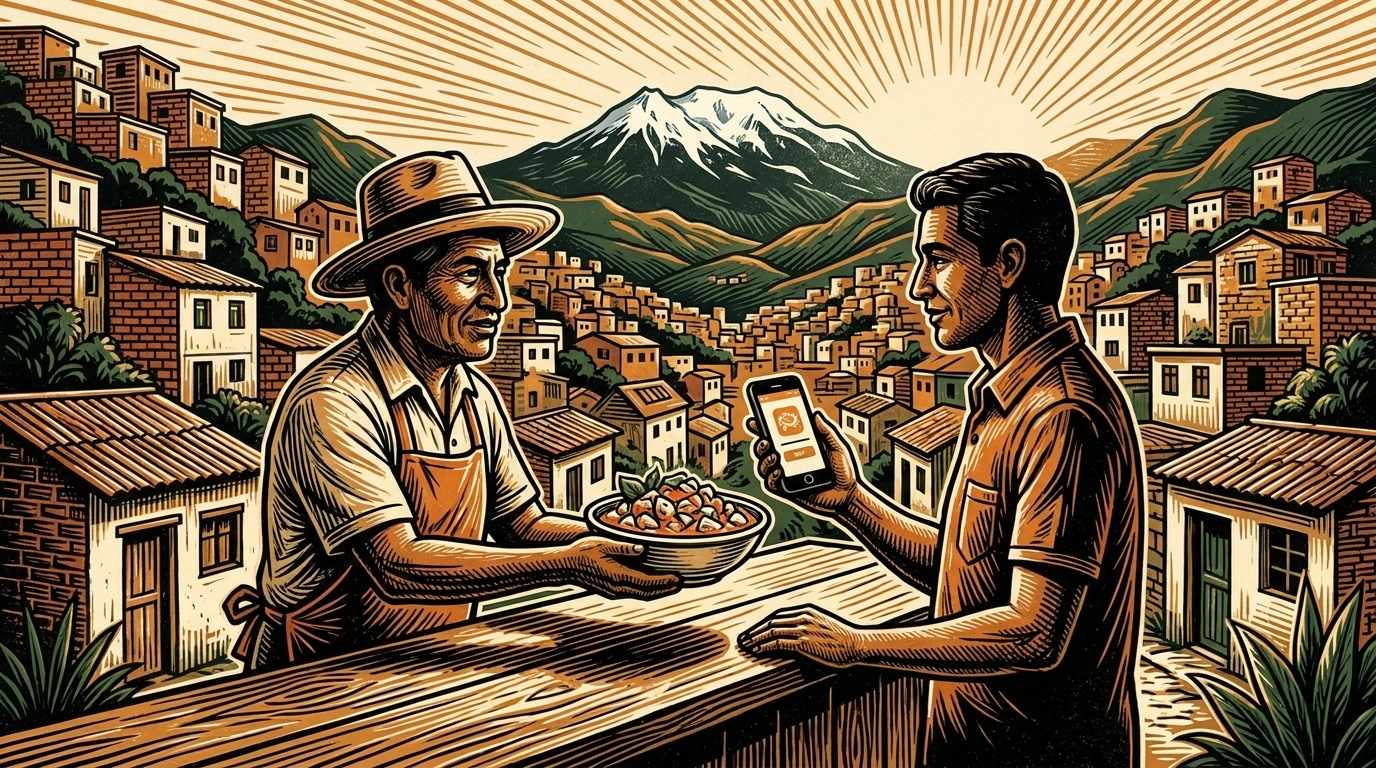
The first bitcoin payment in Bolivia's capital did not arrive by decree. It arrived at a lunch counter. El Pulpo, a ceviche restaurant on Avenida García Lanza in the Achumani district of La Paz, has served Peruvian food for nearly thirty years; its owner, Teresa Fernández, moved from Lima in 1991. This month it became the first merchant in the country to accept bitcoin over the Lightning Network.
The mechanism was mundane, which is the point. A customer wearing a shirt that read "Bitcoin Research" struck up a conversation about the Blink wallet. A demonstration followed. Fernández agreed to take payment in satoshis, a QR code went up by the register, and Bolivia's circular-economy experiment had its first storefront.
Two years ago this transaction would have been illegal. Bolivia banned cryptocurrency in 2020, one of the last outright prohibitions in South America. In June 2024 the Banco Central de Bolivia reversed course, authorizing financial entities to use electronic channels for buying and selling virtual assets.
The change unlocked demand the ban had only hidden. In the year after the rules loosened, crypto transaction volume reached roughly $14.8 billion, according to central-bank figures cited by local outlets — a national economy discovering rails it had been denied.
The backdrop is a currency emergency. Bolivia has run short of U.S. dollars for over a year, draining the reserves that once financed fuel and food imports and leaving businesses scrambling for hard money on the street. The boliviano's official peg looks increasingly theoretical.
Most Bolivians reaching for a digital escape have reached for stablecoins, not bitcoin. On July 11, Economy Minister José Gabriel Espinoza confirmed the government is drafting rules to let dollar-pegged USDT function as a recognized payment method; three Bolivian banks were already offering USDT-linked services by April. In a dollar-starved country, a token that tracks the dollar is the obvious tool.
That makes El Pulpo's choice the interesting one. Bitcoin is volatile against the boliviano and the dollar alike; no merchant takes it for price stability. What it offers is the thing a stablecoin cannot: no issuer, no company that can freeze the balance, no ministry that can switch it off. In a country that criminalized the entire asset class 24 months ago, that permissionlessness is not abstract.
The tooling is ordinary. Blink, the wallet built by the team behind El Salvador's Bitcoin Beach, provides a point-of-sale mode and a Paycode; a merchant needs only a phone. Lightning settles in seconds for a fraction of a cent, which is what makes a modest plate of ceviche a plausible bitcoin transaction at all.
The evangelism is deliberate. Bitcoin Research, a local education outfit, has been working merchant by merchant, explaining why a business might keep even a sliver of its takings outside the banking system. El Pulpo is the proof of concept: one shop, one conversation, one QR code — the same script that turned a single beach town in El Salvador into a movement.
No law made bitcoin legal tender in Bolivia. A ceviche shop just made it usable.
The honest caveat is scale. This is a single merchant in a city of nearly a million, and Bolivia's digital-money story will be written mostly in stablecoins for the foreseeable future. Circular economies are built one vendor at a time, and most never make it past the first.
But the pattern is familiar. El Zonte in El Salvador, Bitcoin Ekasi in South Africa, Bitcoin Dua in Ghana — each began with a merchant willing to take the first payment and a group willing to teach the second. Bolivia now has its merchant. The question is who takes the next order.
Bolivia didn't legalize bitcoin as money — it merely stopped banning the asset. Whether it becomes money is being decided not in the central bank but at counters like El Pulpo's, one plate at a time.
Editor's note: the ~$14.8B volume figure and USDT policy details are reported by local outlets and government officials and are not independently audited; the El Pulpo milestone is reported by Bitcoin Research/Blink. Most Bolivian digital-money activity is in dollar stablecoins, not bitcoin. Bitcoin is volatile; nothing here is financial advice.
Free. Five minutes. No hype.
Subscribe free