 The Bitcoin Beacon
Banxaas lets West Africans swap between the CFA franc and bitcoin through the mobile-money wallets they already use — and it now reaches four countries.
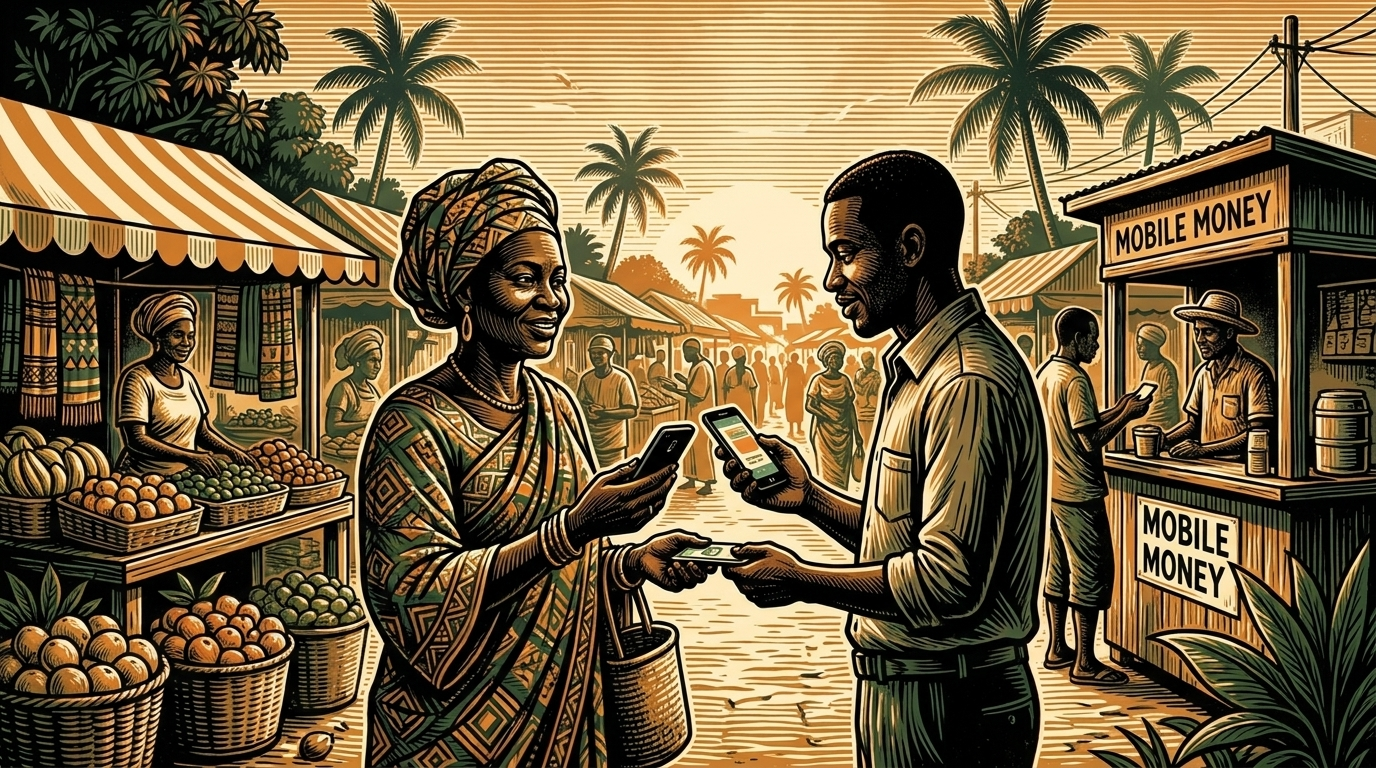
The unit most West Africans still price their lives in is the CFA franc — a currency pegged to the euro and, for historical reasons, backstopped by the French Treasury. It is stable, and it is not entirely theirs. In Dakar, a small startup is building a way to move value that sidesteps that arrangement without asking anyone's permission: bitcoin, tucked underneath the mobile-money apps people already carry.
The tool is called Banxaas, built by Yité Technologies, a Bitcoin startup based in Senegal. It does one deceptively simple thing. It lets a person swap between the CFA franc and bitcoin directly through their mobile-money wallet — deposit francs from Wave or Orange Money and receive bitcoin over the Lightning Network, or send bitcoin and have francs land in a mobile-money account. No exchange account, no card, no branch visit.
Banxaas advertises three operations, and none of them require the user to think about bitcoin at all. Swap fiat for bitcoin via mobile money. Swap bitcoin back to fiat, received directly in a mobile-money wallet. And transfer fiat between operators and across borders — the part that quietly matters most.
According to the company, the service now spans four countries — Senegal, Côte d'Ivoire, Guinea and Cameroon — and connects to around ten mobile-money operators, including Wave, Orange Money and MTN. Those operators are the real financial infrastructure of the region: most adults have a mobile-money account, far more than have a bank account, and the apps are already how people are paid, buy airtime, and settle small debts.
Bitcoin's role is not to replace them. It is to be the connective tissue between them. Mobile-money networks are walled gardens — an Orange Money balance does not natively move to an MTN wallet in the next country — and moving value across those walls, or across a border, traditionally means a bank wire, a remittance desk, or an informal courier. Banxaas uses Lightning as the neutral rail in the middle: francs in one wallet become bitcoin for a few seconds, cross the gap, and become francs again on the other side.
If there was a moment this approach announced itself, it was in Nairobi. At the bitcoin++ hackathon held June 17–19, 2026, a project called WestToEast — built by Nourou, the developer behind Banxaas — won first overall. What it demonstrated was pointed: a payment leaving a West African mobile-money account and arriving in Kenya's M-Pesa, the continent's most famous mobile-money system, stitched together with Lightning, the LNURL standard, Banxaas, and the Kenyan tool Tando.
That is a corridor no bank offers cheaply. A trader in Dakar paying a supplier in Nairobi, or a worker in Abidjan sending money to family in Kenya, has historically had bad options and worse fees. A demo is not a product. But it showed the pieces snapping together — West African mobile money on one end, East African mobile money on the other, bitcoin invisible in between.
Mobile money is the front door most West Africans already trust. Bitcoin is quietly becoming the hallway between the rooms.
Banxaas did not start as a payments convenience. The Human Rights Foundation named it among its top freedom-technology projects of 2025, and the platform has been used by human-rights defenders who need to move money without a bank able to freeze it. That lineage matters in a region where currency is entangled with politics: the CFA franc's peg and French backstop have been a live sovereignty grievance for decades, and capital controls are a fact of life.
Seen that way, a bitcoin-and-mobile-money bridge is less a trading app than an exit ramp — a way to hold and move value outside a system a government or an outside power can throttle. The everyday-payments framing and the dissident-tooling framing are the same product viewed from two angles: money that clears without a gatekeeper.
Banxaas is one node in a fast-thickening African bitcoin mesh. Machankura pushes bitcoin onto basic feature phones over USSD codes, no internet required. Tando turns Kenyan mobile-money numbers into Lightning addresses. Yellow Card and others build on- and off-ramps across the continent. What is new is the interoperability layer — tools that let these national systems talk to each other, so a Senegalese wallet and a Kenyan one can transact as if the border and the currency mismatch were not there.
The honest caveat is scale. These are early tools with user bases measured in the thousands, not millions, and Banxaas's own coverage figures are self-reported. Volume on the ground is still dominated by mobile money in local currency and, increasingly, by dollar stablecoins for anyone who wants to escape a soft currency. Bitcoin's specific edge here is narrow and real: it is the one rail with no issuer, no country, and no counterparty who can decline the transaction.
Francophone West Africa rarely features in the bitcoin-adoption story, which has clustered in East and Southern Africa. Banxaas is a sign that is changing — and that the interesting frontier is no longer "does a merchant accept bitcoin" but "can two incompatible money systems settle across a border without a bank." On that question, a Senegalese startup just built a working answer.
Editor's note: coverage figures (countries and operators) are reported by Banxaas/Yité Technologies and are not independently audited; user bases for these tools remain small, and local mobile money and dollar stablecoins still dominate transaction volume in the region. Bitcoin balances carry price volatility. Nothing here is financial advice.
Free. Five minutes. No hype.
Subscribe free