 The Bitcoin Beacon
A permanent federal regulator and a huge power allocation turn one of the world's biggest grey-market bitcoin habits into declared industrial policy.
Pakistan spent years insisting its citizens should not touch bitcoin while tens of millions of them did anyway. This year the state stopped fighting the tide and started trying to tax and channel it. The result is one of the more ambitious — and internally contradictory — national bitcoin programmes anywhere.
The legal spine is the Virtual Assets Act 2026, which cleared the Senate in late February and the National Assembly in early March and was signed by President Asif Ali Zardari. It converts the Pakistan Virtual Assets Regulatory Authority, or PVARA, from a hastily announced body into a permanent federal regulator empowered to license and supervise exchanges, custodians and token issuers.
PVARA is already doing the thing regulators do: issuing approvals. Bitget, a global exchange, secured a no-objection certificate to enter Pakistan's regulated market — a signal to bigger platforms that the country now has a front door rather than only a back alley. The authority estimates Pakistan has around 40 million crypto users and annual volume near $300 billion, figures that would place it among the top handful of nations by grassroots adoption.
The man selling this vision is Bilal Bin Saqib, chief executive of the Pakistan Crypto Council, who first announced a state bitcoin reserve on stage at a Las Vegas conference in 2025 and has since framed the technology in populist terms. His pitch is not for speculators; it is for a young, under-banked, remittance-dependent country looking for a rung to climb.
Crypto isn't a luxury in Pakistan. It's a ladder for the masses.
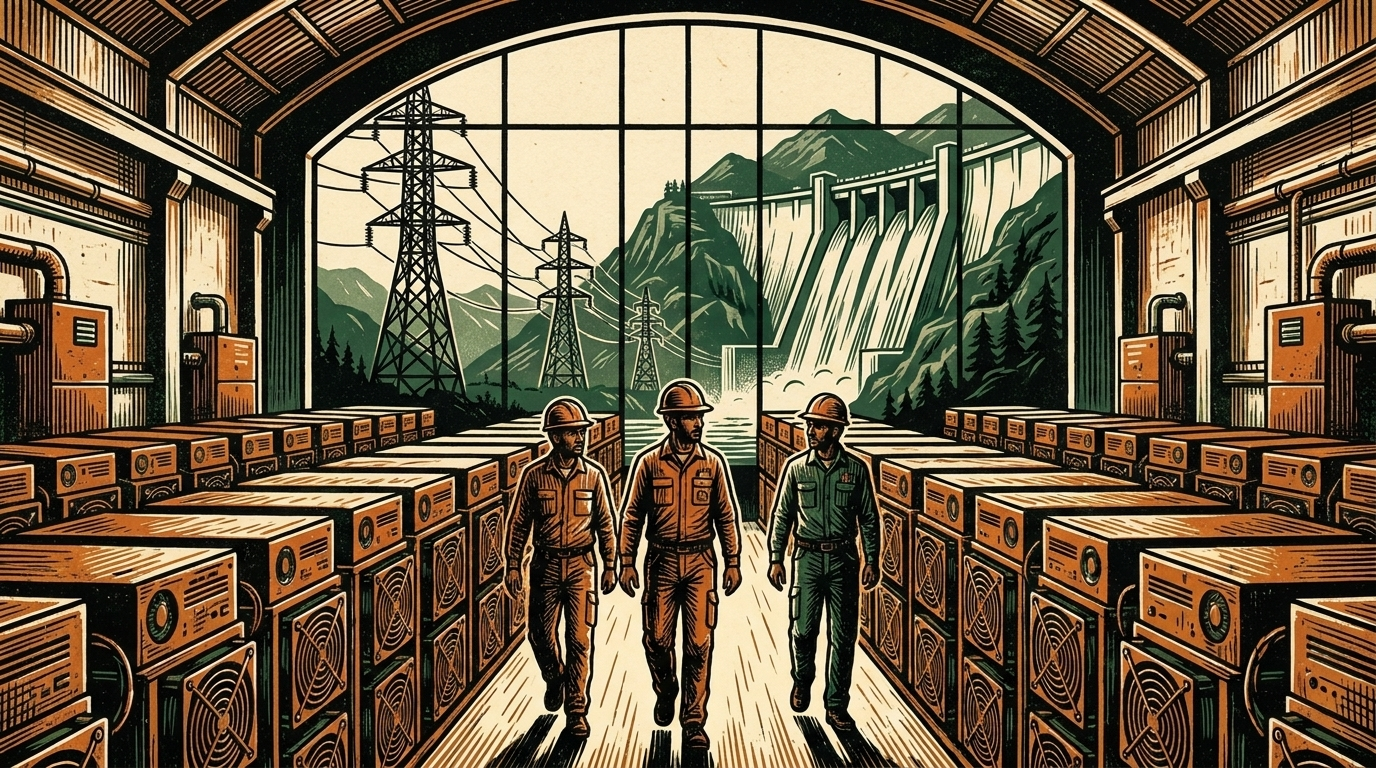
The mining piece is where Pakistan's plan gets concrete. The government has earmarked roughly 2,000 megawatts of surplus electricity for bitcoin mining and AI data centres. Crucially, the state does not intend to run the rigs itself. It plans to act as landlord and power supplier — selling otherwise-stranded capacity to private miners and collecting fees, a portion of which flows into a national bitcoin reserve alongside coins seized by law enforcement.
The logic mirrors what the Beacon has documented from Ethiopia to Oman: a country sitting on power it cannot fully use turns those idle watts into a hard, exportable asset. Pakistan's grid has long suffered from the opposite of scarcity in pockets — expensive capacity contracted years ago that now runs below potential. Mining is a buyer of last resort that shows up, pays in dollars-equivalent, and leaves when the price no longer works.
Here is the tension the government has not squared. Even as PVARA licenses exchanges and the state courts miners, the State Bank of Pakistan has continued to signal that cryptocurrency is not legal under existing law. The country is simultaneously building a licensed industry and maintaining that the underlying activity is prohibited — a posture that will have to break one way before serious foreign capital commits real megawatts.
There are softer doubts too. A reserve seeded mainly from confiscated coins and miner fees will be modest for years, more symbol than sovereign war chest. And a power-hungry mining programme in a country with a history of load-shedding invites an obvious political attack: why sell electricity to bitcoin rigs when households have faced shortages? The answer — that the allocated capacity is genuinely surplus and paid for whether used or not — is sound economics but a hard sell on a hot afternoon in Karachi.
Pakistan has done the hard institutional work — a real law, a real regulator, real licences — that most bitcoin-curious governments only talk about. What it hasn't done is reconcile that machinery with a central bank still saying no. Until it does, this is a genuine adoption story wearing an unresolved legal question like a loose thread.
Editor's note: user-base and volume figures are PVARA estimates; the State Bank of Pakistan has maintained that cryptocurrency is not legal under current law, a tension unresolved at publication. Nothing here is financial advice.
Free. Five minutes. No hype.
Subscribe free