 The Bitcoin Beacon
In Nairobi's largest settlement, a circular economy pays young people satoshis for collecting waste — and 2,600 residents now spend them at the shops next door.
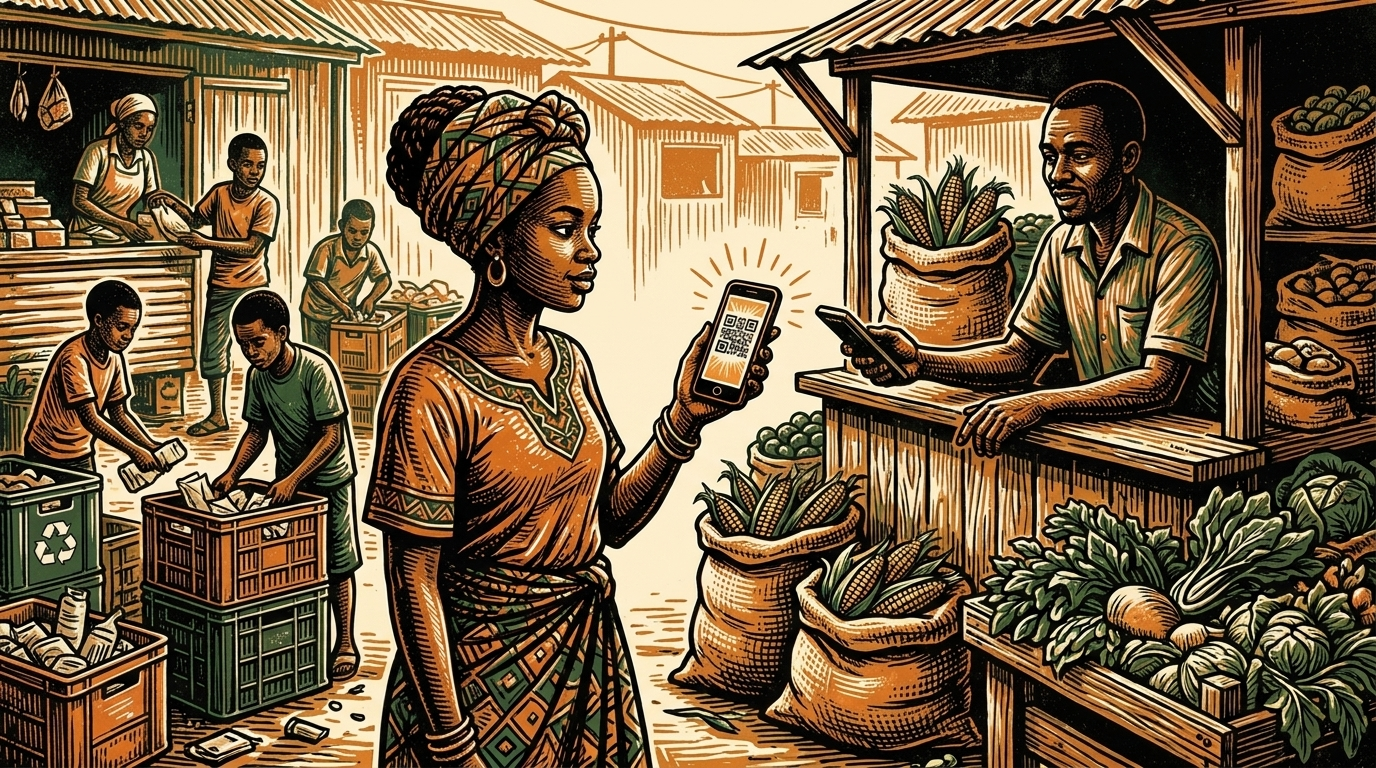
The unit of account in Kibera is not the shilling, the dollar, or the euro. On a Saturday morning in one of Africa's largest informal settlements, it is the satoshi — one hundred-millionth of a bitcoin — and it arrives on a phone in exchange for a sack of collected plastic.
The organiser is Afribit Africa, a Kenyan outfit that runs a bitcoin circular economy stitched into a community waste programme. Young people earn sats for recycling and clean-up work; Afribit then onboards the grocers, kiosks and vegetable sellers around them to accept those same sats over the Lightning Network. Roughly 2,600 residents are inside the loop. The point is not charity dressed up as technology. It is a closed circuit where money is earned, spent, and earned again without ever touching a bank.
The mechanics are deliberately boring, which is the whole idea. Participants hold a Lightning wallet — typically Blink, the Salvadoran-built app that made sats spendable in El Zonte — on a basic smartphone. Community work pays out in satoshis directly to that wallet. When the earner wants groceries, she scans a merchant's QR code and the payment settles in about a second for a fraction of a cent.
Lightning is what makes the economics possible. A conventional card network or mobile-money transfer would eat a meaningful slice of a payment measured in cents; Lightning fees are effectively rounding error. In a place where the median transaction is tiny and the median resident has never held a bank account, that difference is not a nicety — it is the difference between the system existing and not.
Crucially, merchants are recruited before earners are paid. A circular economy dies the moment the sats have nowhere to go, so Afribit's first job in any block is signing up the shops. Only once a cluster of grocers, water sellers and phone-credit kiosks accepts bitcoin does paying people in it make sense.
The honest question is whether this beats simply distributing Kenyan shillings. Afribit's answer is that shillings leak. Aid denominated in local currency tends to flow one way — in from a donor, out to a wholesaler, gone — and it leaves nothing behind but the memory of a handout.
Bitcoin, spent inside a network of local merchants who also hold and re-spend it, is designed to keep circulating within the community for longer before it exits. The recycling framing matters too: participants are paid for producing something of value — a cleaner settlement, sorted waste that can be sold on — rather than for showing up to collect. The project's own language is “financial sovereignty,” the idea that a person controls savings no landlord, employer, or bank can touch.
A circular economy holds only if the same coins keep moving between the same hands — earned, spent, re-earned — instead of leaking out as charity.
Kibera is the newest node in a lineage that runs through Bitcoin Beach in El Salvador and Bitcoin Ekasi in South Africa's Mossel Bay, where a township project pays its staff entirely in bitcoin and has onboarded dozens of local shops. Machankura, another African tool, has pushed bitcoin onto basic feature phones with no internet by using the same USSD codes that power mobile money, extending the reach beyond smartphone owners.
What links them is a thesis the Beacon returns to often: adoption on the ground does not wait for a legal-tender law or a central-bank blessing. It shows up where a real problem — exclusion from formal finance, extractive fees, currencies that lose value faster than wages rise — meets a tool that solves it cheaply. Kibera has all three problems in abundance.
None of this is a finished success, and it would be a disservice to pretend otherwise. Bitcoin's price volatility is a real burden for people with no cushion: sats earned on Saturday can buy less by the following weekend, and a savings technology that sometimes shrinks is a hard sell to someone living close to the edge. The projects lean on donor funding to seed the initial coins, which raises the same sustainability question every aid programme faces — what happens when the grant ends.
And the loop is only as strong as the merchants' willingness to keep accepting sats rather than immediately converting to shillings. If every shopkeeper cashes out at once, the “circular” part collapses into just another payment rail. The honest read is that Kibera is a live experiment, not a proof, and its value lies in what it reveals about whether these loops can hold at scale in the hardest possible conditions.
Kibera will not settle the debate over whether bitcoin can be money for the poor. But it reframes it. The question is no longer whether a slum can run on bitcoin — a corner of one already does — but whether the loop can outlast its seed funding and hold its merchants. That is a far more interesting problem than the one the skeptics keep answering.
Editor's note: participant and merchant figures are reported by Afribit Africa and community coverage; independent audited numbers for the Kibera project are limited. Satoshi earnings carry bitcoin's price volatility, and several circular-economy projects rely on donor funding to seed initial balances. Nothing here is financial advice.
Free. Five minutes. No hype.
Subscribe free