 The Bitcoin Beacon
A government sandbox now turns a visitor's bitcoin into baht at the checkout — no bank account, no legal-tender law, just a QR code the shopkeeper already knows.
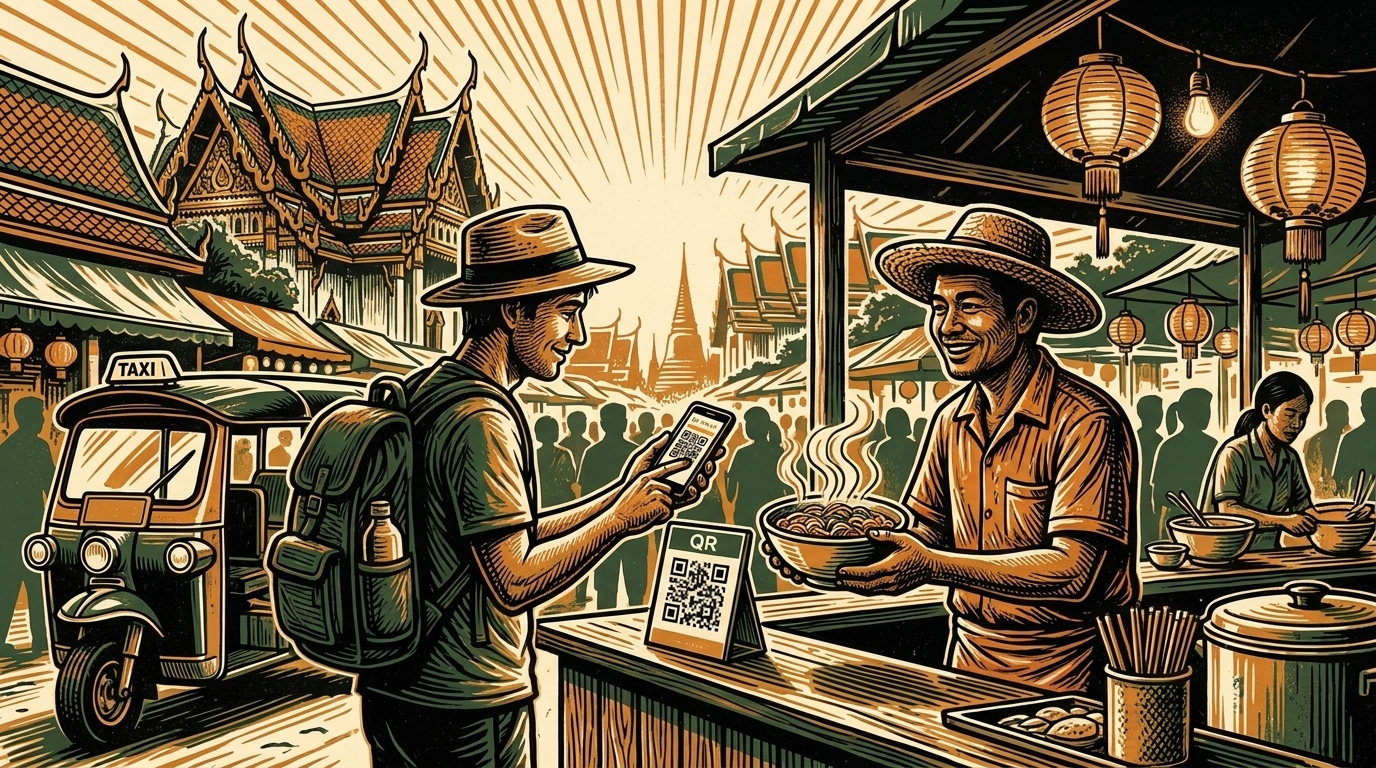
At a Bangkok night-market stall, the transaction looks like every other one: the customer holds up a phone, a QR code resolves, the vendor's screen chimes in baht. What the vendor never sees is where the money started — a bitcoin balance held by a tourist who, minutes earlier, had no Thai bank account and no baht at all.
That is the entire design of TouristDigiPay, the crypto-to-baht sandbox Thailand's Ministry of Finance launched as an 18-month pilot. It does not make bitcoin legal tender. It does something quieter and, for adoption, arguably more useful: it removes the reason a foreign coin can't be spent in a Thai shop.
A visitor sends bitcoin (or another supported asset) to a licensed Thai exchange, which converts it to baht and loads a dedicated Tourist Wallet. From there, payments run over the country's standard QR rails — the same ones locals use for everything from noodles to taxis. The merchant is paid in baht and never touches a digital asset.
The guardrails are deliberately tight. Approved merchants can receive up to ฿500,000 a month through the scheme; smaller vendors are capped at ฿50,000. Cash withdrawals are banned — funds stay inside the wallet until the tourist closes the account on departure, keeping every baht traceable. Oversight is shared across the Ministry of Finance, the Securities and Exchange Commission, the Bank of Thailand, the Anti-Money Laundering Office, and the Ministry of Tourism and Sports.
The pitch to the treasury is tourism, not monetary reform. Officials have said the scheme could lift visitor spending by around 10% and add as much as ฿175 billion — roughly $15 billion — to the economy. Thailand is chasing the wallets of crypto-holding travelers the way it once chased their duty-free receipts.
This is a familiar shape. On Boracay, in the Philippines, bitcoin became spendable not because a law commanded it but because tourists and remitters had a reason to use it and a rail that made it painless. Thailand is running the same play from the top down: instead of a wallet startup onboarding one dive shop at a time, the finance ministry is wiring the on-ramp into the national payment system.
The logic is the same in both places. Adoption follows utility, not decree. A traveler who would never fill out paperwork for a local bank account will happily convert a slice of a bitcoin balance to pay for dinner, because the alternative — airport FX counters, card foreign-transaction fees, cash he has to guess the amount of — is worse.
You don't need a legal-tender law to make bitcoin spendable. You need a checkout that accepts it and doesn't punish the person using it.
Honesty about the mechanism matters, because the mechanism is the catch. The tourist does not pay the merchant in bitcoin. A licensed operator sells the bitcoin, holds the baht, and settles fiat — a custodial, convert-at-the-edge model, not a circular economy where bitcoin itself changes hands and stays in the community. When the visitor flies home, the bitcoin economy he briefly joined evaporates behind him.
Nor is bitcoin guaranteed the starring role. The sandbox accepts multiple assets, and in payment corridors like this, dollar stablecoins tend to dominate volume because a wallet pegged to the dollar removes the price risk that a bitcoin balance carries between breakfast and dinner. Bitcoin's specific advantage is different: it is the asset the tourist already holds with no issuer, no permission, and no counterparty — the thing that makes the on-ramp worth building in the first place.
There is also a sovereignty tell in the fine print. Every baht stays inside a monitored wallet; nothing can be withdrawn as cash; the account is closed and reconciled on exit. Thailand has found a way to welcome crypto money while never letting it out of the regulated perimeter. That is the compromise on offer to most of the world right now: yes, you may spend it — on our rails, under our watch.
Thailand didn't declare bitcoin money. It did something more repeatable: it made a tourist's bitcoin work at a noodle stall without asking anyone to change how they run their shop. That's how adoption tends to arrive — not as a mandate, but as a checkout that finally accepts what people already hold.
Editor's note: TouristDigiPay was launched as an 18-month pilot beginning in late 2025 and is reported to be operating; figures for spending uplift and economic impact are government projections. The scheme converts crypto to baht through licensed operators — the tourist does not pay merchants directly in bitcoin, and dollar stablecoins are likely to carry most payment volume. Nothing here is financial advice.
Free. Five minutes. No hype.
Subscribe free