 The Bitcoin Beacon
The sovereign bitcoin reserve is mostly a press release. The coins that sit on government balance sheets were seized, not bought — and the gap between the two is the whole story.
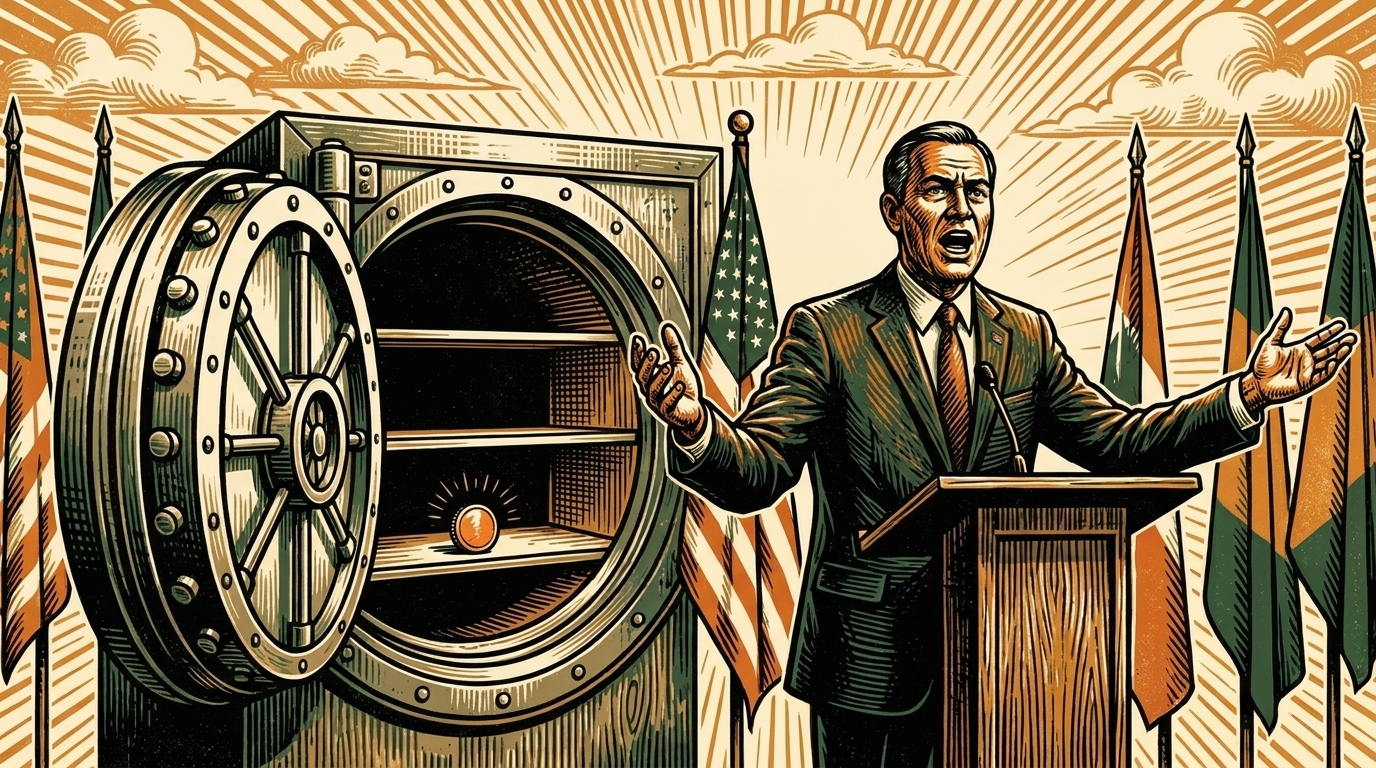
There are two maps of sovereign bitcoin, and they do not match. On one, drawn from speeches and headlines, more than 40 governments have “committed” to holding bitcoin — a number now repeated by exchange executives as evidence of an unstoppable adoption wave. On the other, drawn from what is actually verifiable on-chain and in disclosures, roughly 13 governments hold confirmed bitcoin, worth on the order of $37.9 billion. The distance between those two maps is this year’s real sovereign-bitcoin story.
A pledge is cheap. It costs a minister nothing to say the state will explore, pilot, or someday hold bitcoin; it costs a great deal, politically and fiscally, to appear on a public ledger having spent public money on a volatile asset. So the pledges pile up and the balance sheets barely move.
The deeper tell is where the existing government bitcoin came from. The largest single holder, the United States, sits on roughly 328,000 BTC — about $25 billion when a White House digital-asset official first disclosed the figure — almost all of it forfeited by criminals, not purchased as a reserve. There is still no operational program to buy bitcoin on the open market; analysts think the earliest a U.S. Treasury purchase could even begin is late 2026, and only if legislation passes and a budget-neutral constraint allows it.
That pattern repeats. The bitcoin on government books is overwhelmingly seized coin sitting in custody, sometimes awaiting sale, occasionally reclassified as a “reserve” after the fact. Holding what you confiscated is not the same act as deciding to hold bitcoin as a monetary asset. One is evidence; the other is conviction. The headlines routinely conflate them.
A pledge is a press release. A balance sheet is a decision. So far the gap between them is the whole story.
Look closely at the programs held up as proof and the picture softens. El Salvador, the founding example, has functionally paused its daily buying under the terms of its IMF arrangement, even as officials keep the reserve’s public profile high. Bhutan, once celebrated for quietly mining a billion-dollar stack, has been drawing it down to fund state projects — a sovereign wealth fund spending, not a reserve accumulating. Pakistan announced a national bitcoin wallet and, within days, watched its own central bank tell a parliamentary committee that crypto remained effectively banned at home.
None of this means the trend is fake. It means the trend is early, uneven, and far smaller than the round numbers suggest. “Over 40 countries” is a claim about intentions; “13 governments, mostly holding seized coin” is a claim about facts. A serious reader should weight the second far more heavily than the first.
The optimistic case is not empty, and it deserves a fair hearing. Adoption curves do start with talk; pledges shape norms, and norms shape budgets. It took a decade for bitcoin to go from ignored to seized to, in a few places, deliberately held — and the direction of travel across those steps has been one way. The U.S. deciding merely to keep its forfeited coins rather than auction them is itself a shift from a few years ago.
And a reserve does not need many members to matter. If one mid-sized central bank converts a slice of its FX reserves and the experiment survives a drawdown, the reference case changes for everyone else. The pledges may be vapor today and precedent tomorrow.
Bitcoiners should want the honest number, not the flattering one. The strength of the sovereign case is that it does not need inflation to be true — so it should not be inflated. Thirteen governments, mostly holding coins they took from criminals, is a real and interesting fact. “Forty countries are buying bitcoin” is a slogan. Confusing the two is how a good argument gets a bad reputation.
Editor’s note: the “40+ countries” figure is an industry characterization of commitments/intentions, not confirmed purchases; the ~13 governments and ~$37.9B come from public trackers and vary with methodology and price. The U.S. ~328,372 BTC is largely forfeited coin per a May 2026 White House disclosure; a Treasury purchase program is contingent on legislation. Nothing here is financial advice.
Free. Five minutes. No hype.
Subscribe free