 The Bitcoin Beacon
Six years of a collapsed banking system taught Lebanese to hold value on their phones. The dollar-stablecoin wins the day; bitcoin is the piece no one can freeze.
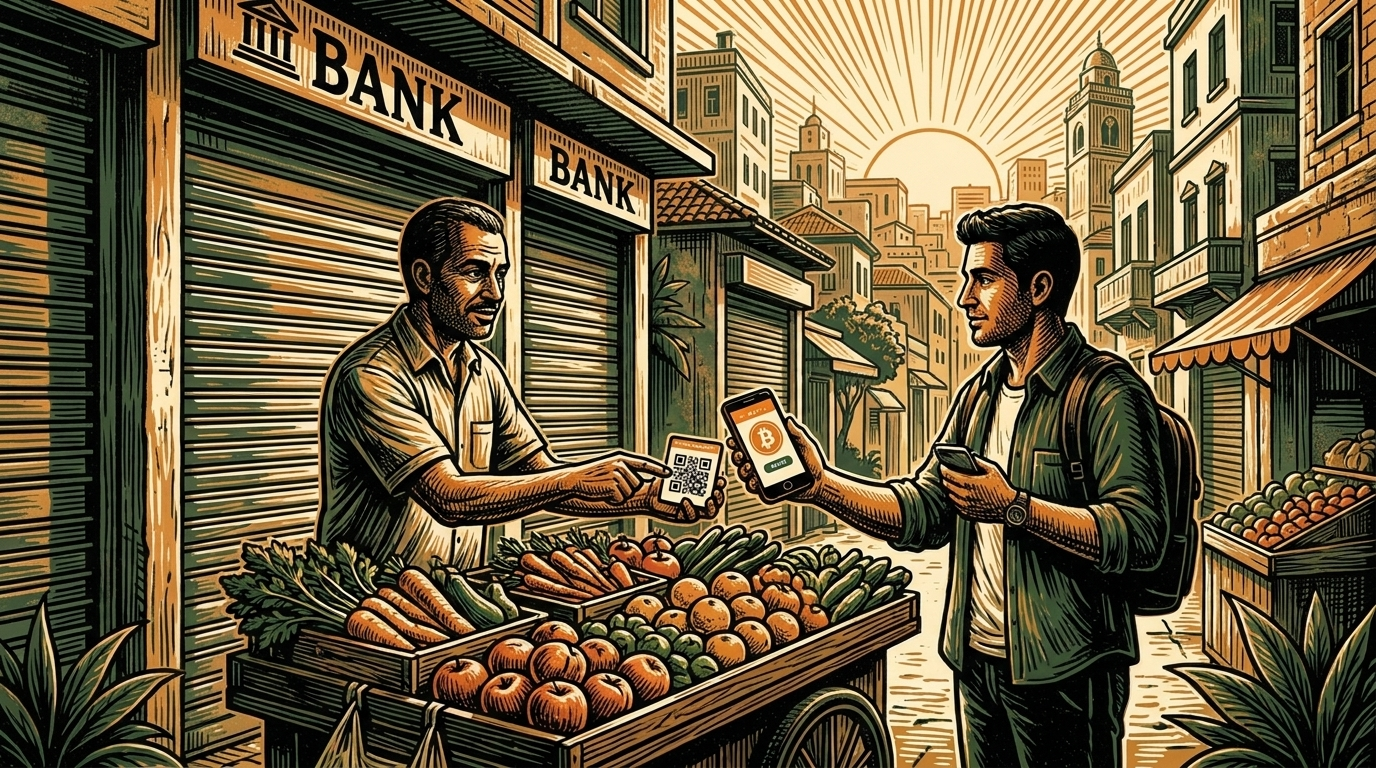
The unit of account in Beirut is the dollar; the unit of trust is whatever the buyer can hand over without a bank in the middle. At a fruit stall the price may be marked in lira, but the sale is closed in cash, in physical dollars, or with a few taps on a phone. What began as a workaround for a broken system has hardened into the way an economy runs.
Lebanon’s banks stopped functioning as banks in the 2019 crisis, when lenders imposed informal capital controls and savers found they could no longer withdraw their own dollars. The lira went on to lose the overwhelming majority of its value. The result is a country where the formal financial system is present but not trusted — and where holding money outside it is not ideology but arithmetic.
By the estimates that circulate among researchers, close to a fifth of Lebanese now use a crypto wallet as a primary store of value — a rate that, if accurate, ranks among the highest anywhere on earth. The number is a symptom, not a triumph. People did not discover bitcoin at a conference; they reached for it after a bank teller told them their savings were, in practice, gone.
Most of that on-chain activity is denominated in dollars, not bitcoin. Dollar stablecoins — tokens that hold a fixed dollar value — are the workhorse, because a merchant pricing bread in dollars wants to be paid in dollars, not in an asset that can move 5% before lunch. In a dollarized street economy, a tokenized dollar is the natural medium.
Bitcoin’s role is narrower and, in a way, more fundamental. It is the reserve underneath the reserve: the asset with no issuer to sanction, no bank to freeze it, and no central authority that can decide, overnight, that your balance is now subject to controls. For a population that watched exactly that happen to their deposits, that property is not abstract.
The clearest test of the new plumbing has been humanitarian. International organizations working in Lebanon have experimented with distributing aid as stablecoins sent directly to recipients’ phones, bypassing a banking sector that can neither be relied upon to move the money nor trusted to hold it. The recipient converts to cash through a local peer-to-peer market, or simply spends from the wallet.
It is a quiet inversion of how development finance is supposed to work. The formal institutions — banks, correspondent networks, wire rails — are the point of failure; the informal network of wallets and traders is the reliable layer. Where the state’s money broke, a bearer network kept its promises.
Where the banks stopped working, Lebanese didn’t wait for a law to make bitcoin money. They made it money.
None of this is a clean story, and it should not be told as one. A collapse that pushes people toward self-custody is still a collapse; adoption born of desperation is a measure of how badly the currency failed, not of how well bitcoin is doing. The people using these tools would, most of them, rather have a functioning banking system and a stable lira.
The volume story is a stablecoin story, which means it is a dollar story — American monetary policy reaching into Beirut through a token rather than a bank. Bitcoin’s slice is smaller, and its volatility is a real cost for anyone forced to hold it between paycheck and rent. And the same permissionless rails that route aid also route sanctions evasion and scams; neutrality cuts both ways.
Lebanon is what bitcoin’s pitch looks like when a state removes every alternative. Nobody legislated it; nobody had to. When the banks stopped being banks, people moved to money the banks couldn’t touch — and the dollar came along, in token form, for the ride.
Editor’s note: adoption figures (including the ~20% wallet-use estimate) come from secondary research and survey work, and reflect a crisis-driven state rather than a single dated event this week. Stablecoins — not bitcoin — account for most transaction volume; the bitcoin-specific point is its freeze-resistance. Nothing here is financial advice.
Free. Five minutes. No hype.
Subscribe free