 The Bitcoin Beacon
As towns vote down $24 billion in data centers, the miners already wired to the grid become the shortcut the AI boom can’t permit into existence fast enough.
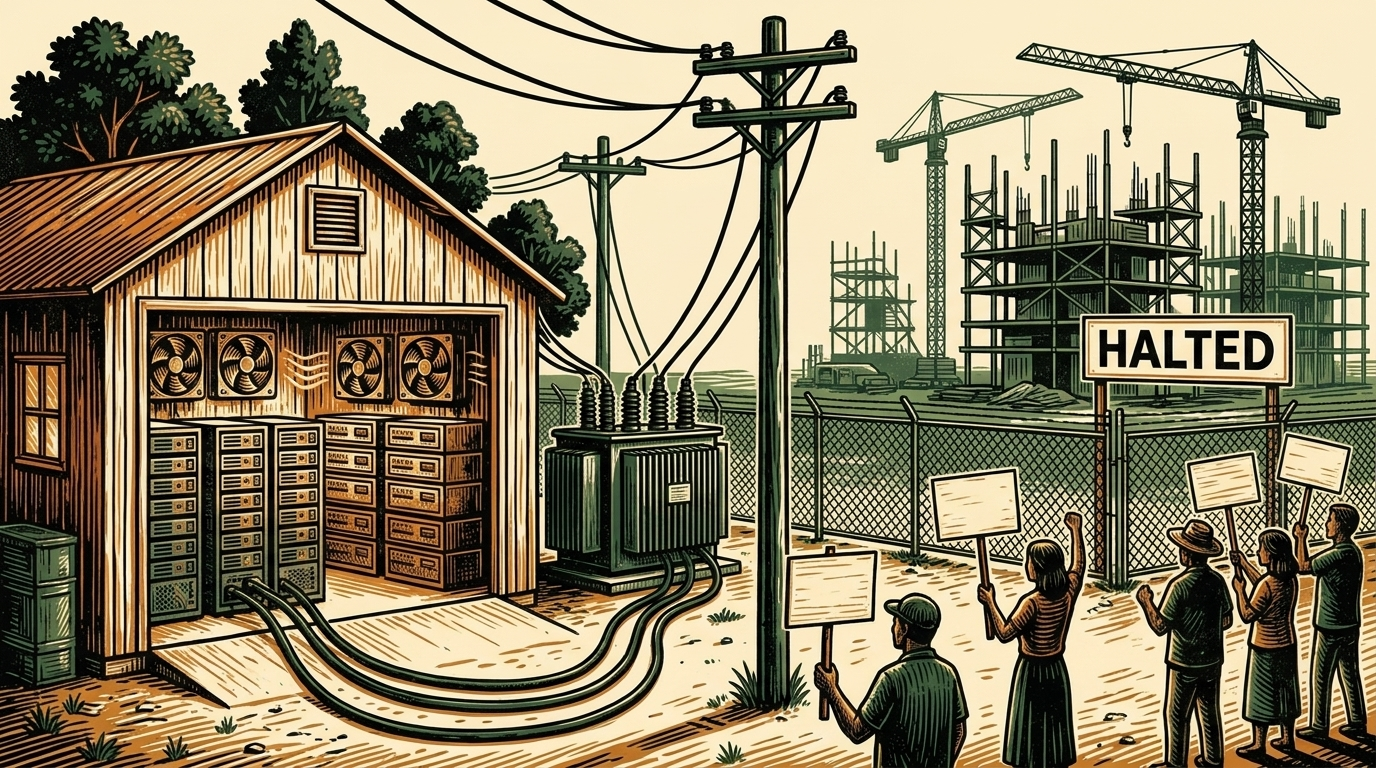
For a decade the standard indictment of bitcoin mining was that it wasted electricity — power that could have gone to something useful, burned instead on a lottery of hashes. The AI boom has quietly turned that indictment inside out. The scarce resource in America right now is not chips or capital. It is a place to plug in.
According to the Bitcoin Policy Institute, roughly $24 billion in US AI data-center projects has been delayed or blocked, as local councils vote down expansions over strain on the grid and the water table. The compute demand is real and enormous; the permission to build it is not keeping pace. And permission, it turns out, is exactly what bitcoin miners spent a decade quietly accumulating.
Strip away the hashing and a bitcoin mine is a rare and valuable object: a parcel of land with a signed interconnection agreement, an energized substation, transformers, and industrial cooling — already permitted, already drawing power, already surviving the neighbors. Those are precisely the assets an AI operator needs and cannot conjure quickly, because the bottleneck is regulatory and physical, not financial.
So the money is moving. Public miners are now fielding more than $70 billion in prospective contracts to host high-performance AI compute on infrastructure they built to mine bitcoin. The sector is splitting in two: hybrid firms pivoting toward AI landlording, and smaller operators left with the base economics of mining alone.
The industry accused of wasting power turns out to own the one thing AI can’t permit into existence fast enough.
There is a satisfying reversal here for anyone who sat through years of “bitcoin boils the oceans” op-eds. The miners were never buying electricity so much as buying optionality on the grid — the right to be a large, flexible, interruptible load at the exact locations where power is cheap and stranded. That option is now worth a fortune, because the alternative buyer, AI, can’t get its own approvals.
It also vindicates a subtler bitcoin argument: that mining is a buyer of last resort for energy that would otherwise be wasted, and thus a subsidy for building generation and grid in the first place. The infrastructure the miners financed on bitcoin’s dime is now the runway AI wants to land on.
But cheer carefully. If hosting AI pays several times what hashing does, the rational move for a public miner is to stop mining — to rent the substation to the higher bidder and let the machines go quiet. Taken far enough, that hollows out the very hashrate that secures the network, concentrating what remains among those who stay.
There are counter-forces. Bitcoin’s difficulty adjustment lowers the bar for whoever keeps mining, and solo and small-scale mining is actually rising — independent miners found 24 blocks in the past year, up more than 40%. The grid arbitrage may prove a windfall that funds more resilient, distributed mining rather than gutting it. And AI’s appetite for power and water carries every environmental objection once aimed at bitcoin, now magnified.
The honest verdict is that this is a gift with a hook in it. Miners hold the assets the moment demands, and they will be paid handsomely for them. Whether that money strengthens bitcoin’s security or quietly rents it away is the question the next two years will answer.
Why it matters: when the grid says no to AI, it says yes to whoever already got permission — and for now, that is bitcoin.
Editor’s note: the $24 billion in stalled projects and the $70 billion-plus in prospective AI hosting contracts are figures cited by the Bitcoin Policy Institute and industry coverage, not audited totals. This is an opinion column; it argues a view and airs the counterarguments, but nothing here is investment advice.
Free. Five minutes. No hype.
Subscribe free