 The Bitcoin Beacon
Years after banks were barred from touching crypto, the state now demands every bitcoin dealer register — and takes a 2% cut of the trade it once tried to outlaw.
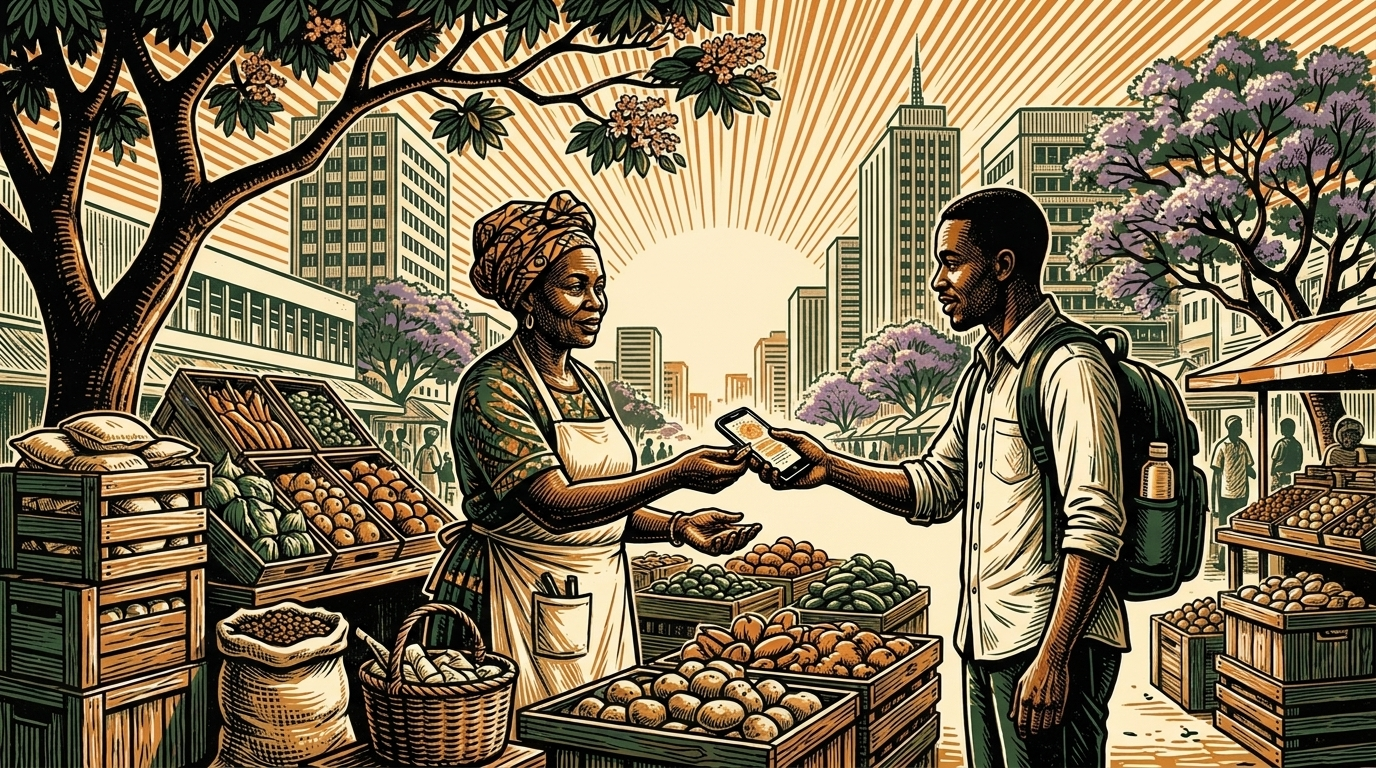
On the pavements of Harare's Kopje district, the exchange rate that matters is not the one on the central bank's board. It is the one a trader quotes into a phone: US dollars in, bitcoin or a dollar-pegged token out, settled before the customer has crossed the street. For years this trade lived in a legal grey zone the state alternately ignored and threatened. This month it acquired a rulebook.
Statutory Instrument 99 of 2026 — Zimbabwe's first dedicated framework for virtual assets — requires anyone who helps people buy, sell, move or store crypto to register with the Financial Intelligence Unit, the anti-money-laundering arm of the Reserve Bank of Zimbabwe. The Unit's registration mandate became binding on June 16. Registration costs US$500 a year; a 2% transaction levy and a 15% withholding tax on international digital services sit alongside it. Operating unregistered is now an offence.
The reversal is striking because Zimbabwe spent years on the other side of the argument. In 2018 the Reserve Bank ordered commercial banks to stop servicing crypto exchanges, pushing the trade off formal rails. It did not stop. It went peer-to-peer, onto phones and messaging apps, where it has stayed and grown.
Zimbabweans had reasons no circular could outweigh. The country has lived through two episodes of hyperinflation inside two decades. The local unit has been redenominated, abandoned for the US dollar, reintroduced, and in 2024 replaced again by the gold-backed ZiG — which has itself lost ground. In an economy that has taught its citizens not to hold the national money overnight, bitcoin and dollar stablecoins are not a punt on the future. They are a way to keep this week's earnings until next week.
The scale is not marginal. Analysts estimate crypto flows at roughly 6% of GDP, among the highest shares of any surveyed emerging market, and the informal sector that dominates the economy already runs on mobile money. Tokens that hold their value against the dollar are the natural next layer on top of it.
SI 99 is built for oversight, not adoption. Registered providers must screen customers, keep records and file suspicious-activity reports; the FIU frames it as closing a laundering gap that grey-market trading left open. For a government that also wants revenue, a registered exchange is a countable one, and a taxable one.
The trade-off is the one bitcoiners have watched play out from Rabat to Jakarta. Formalisation brings consumer protection and a paper trail, and it prices out the smallest operators — the corner dealers who onboarded the very people the banks refused. A US$500 annual fee and reporting duties are trivial for a funded exchange and fatal for a one-phone hustle.
When a government stops trying to ban a money and starts trying to count it, the argument is over.
So some of the trade the rules mean to capture will move the other way — further peer-to-peer, or onto self-custody wallets and USSD tools that need no registered middleman at all. Regulation can license the on-ramps; it cannot license a private key. The Reserve Bank has drawn a border around the formal market, not around bitcoin itself.
Honesty about volume matters. Most of what moves through Zimbabwe's crypto economy is dollar stablecoins, not bitcoin. When the point is to hold the value of a dollar, a token that tracks the dollar does the job directly, and most users want exactly that.
Bitcoin's role is the longer, harder bet: the bearer asset with no issuer to freeze it and no foreign bank to honour or refuse the transfer. A citizen reaching for stablecoins is fleeing the local currency. A citizen holding bitcoin is opting out of the currency question altogether — including the question of who controls the dollar the stablecoin tracks.
The new rules touch both, because both now run through registered doors. But only one of them can be switched off by whoever issues it. That is the distinction the Global South keeps sharpening this year, and Zimbabwe — a country that has watched more than one currency die — is an unusually clear place to see it.
Why it matters: a state that once ordered banks to shun bitcoin is now taxing it. The ban is over; the counting has begun.
Editor’s note: Statutory Instrument 99 of 2026 and the FIU registration mandate reported here took effect in mid-June 2026; enforcement is still ramping. The ~6%-of-GDP crypto-flow estimate and the tax figures (US$500 annual registration, 2% transaction levy, 15% digital-services withholding) come from the Zimbabwean and pan-African reporting cited above and may be refined as rules are applied. Stablecoins, not bitcoin, are described in those sources as the larger share of transaction volume.
Free. Five minutes. No hype.
Subscribe free