 The Bitcoin Beacon
A legislator’s pitch to park 0.5% of Taiwan’s $602bn in bitcoin isn’t about returns. It’s insurance against the day dollar assets get switched off.
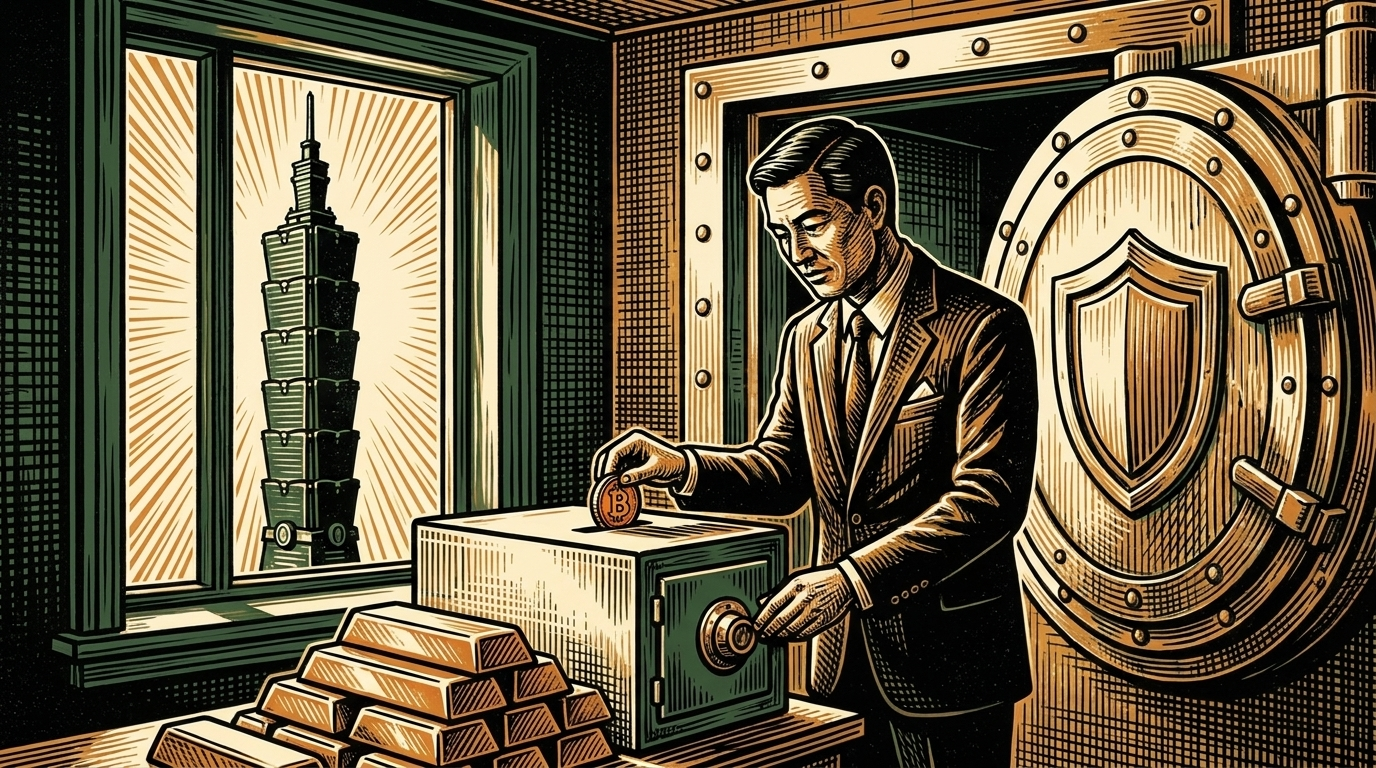
Most bitcoin-reserve proposals are about upside: hold the asset, ride the appreciation, look bold. Taiwan’s is about something bleaker and more interesting. It is about what happens if the island’s money stops working.
Legislator Ko Ju-chun has been pressing the government to allocate roughly 0.5% of Taiwan’s reserves — about $2.5 billion out of some $602 billion — to bitcoin, and delivered a Bitcoin Policy Institute report making the case to the premier and the central-bank governor. He now puts the odds of a strategic bitcoin reserve within five years at “roughly 80%,” and near-certain within ten.
Over 80% of Taiwan’s reserves sit in dollar-denominated assets held, ultimately, inside the Western financial system. For most countries that is prudence. For the one democracy Beijing openly threatens to absorb, it is a concentration risk with a specific failure mode: in a serious confrontation, those dollar assets could be frozen, sanctioned or rendered unreachable.
Russia is the worked example. After 2022, roughly half its central-bank reserves were immobilised overnight by the countries that held them. The lesson every exposed government drew was the same: reserves you cannot access in a crisis are not reserves. Bitcoin, whatever its volatility, has one property gold shares and dollar deposits do not — held in self-custody, it cannot be switched off by a foreign capital.
You can think a 0.5% allocation is symbolic — it is — and still see the logic. This is not a bet that bitcoin outperforms. It is the purchase of an option: a small, liquid, seizure-resistant slice of reserves that keeps working if the other 99.5% is compromised. Insurance is not supposed to have a good expected return. It is supposed to pay out in the one state of the world you most fear.
Taiwan also has the domestic scaffolding now. Its Virtual Asset Service Act, passed June 30, is what Ko calls the island’s “CLARITY moment” — the regulatory floor a central bank would want before touching the asset.
The objections are serious and deserve stating. Bitcoin’s volatility is real; a reserve asset that can fall 40% is an awkward hedge, and a central bank forced to book mark-to-market losses may lose its nerve at the worst moment. Custody is the hard part — a self-custodied sovereign reserve is only as safe as its key management, and states are not famous for operational security. And 0.5% is too small to matter in the very scenario it is designed for; if Taiwan’s dollar reserves are truly frozen, $2.5 billion in bitcoin does not save the economy.
All true. But the same was once said of every central bank’s first unconventional reserve, and the case here does not rest on size. It rests on holding one asset whose availability depends on no one’s permission — which, for a state living under the threat Taiwan lives under, is not a yield play. It is a fire exit.
The Take: a bitcoin reserve makes the least sense for a country with no enemies and the most sense for one with a powerful, hostile neighbour. Taiwan is not reaching for bitcoin because it is fashionable — but because it answers the one question no other country has to ask.
Editor’s note: this is opinion. Ko Ju-chun’s proposal (~0.5% of reserves, ~$2.5bn) is an advocacy position, not government policy; Taiwan’s central bank has not committed to a bitcoin allocation. Reserve figures (~$602bn, 80%+ in dollar assets) and the “80% in five years” estimate are as stated by Ko and the Bitcoin Policy Institute.
Free. Five minutes. No hype.
Subscribe free