 The Bitcoin Beacon
A law in force since July 1 lets exporters settle oil, metal and grain in bitcoin — a sanctioned economy testing the one asset no government can freeze.
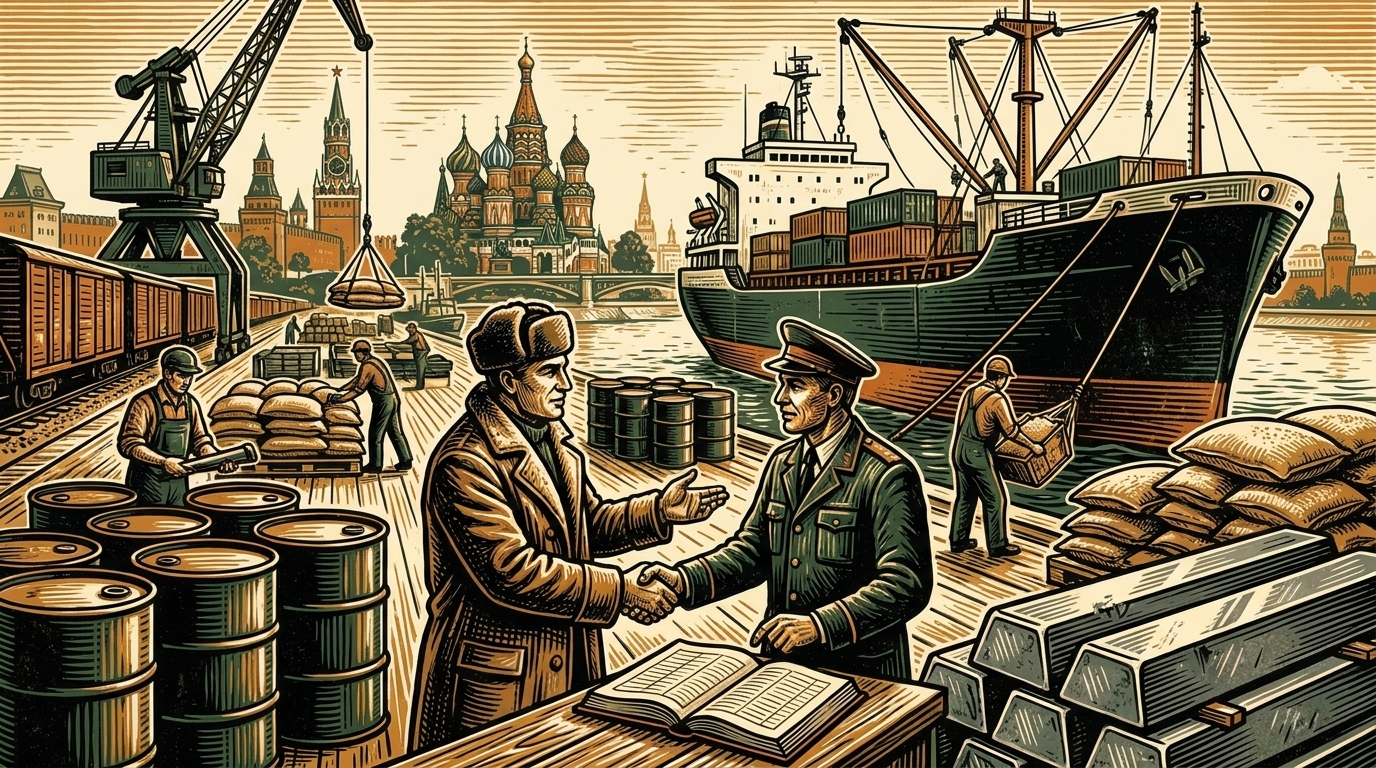
On July 1 a Russian law took quiet effect that would have been unthinkable a decade ago: exporters may now invoice and settle cross-border trade in bitcoin and other digital assets. The ruble remains Russia’s only domestic money — you still cannot buy bread with bitcoin in Moscow — but for the oil, metal and grain that earn the country its foreign currency, a new rail has opened.
The move formalises a workaround. Cut off from much of the Western banking system after 2022, Russia spent two years running an “experimental legal regime” that let selected firms use crypto for international payments. Officials say that pilot processed on the order of $11 billion in crypto-facilitated commerce last year. The new law turns the experiment into standing policy.
The logic is sanctions arithmetic. When correspondent banks will not clear your dollars and counterparties fear secondary sanctions, a bearer asset that settles peer-to-peer stops looking like ideology and starts looking like plumbing. Bitcoin needs no SWIFT message and no foreign bank’s permission; a payment either confirms on the network or it does not.
That is precisely the property Russia is buying. For a commodity exporter, the question is not whether bitcoin is volatile over a year but whether a shipment can be paid for this week without a Western institution in the middle. Convert on arrival and the volatility window is hours, not months.
A money designed so no one needs permission is useful to whoever most lacks it.
This is not a bitcoin standard, and it is not mass adoption. The corridor is permissioned and built for large exporters, not citizens; the state keeps the ruble firmly in charge at home. Much of the actual settlement will likely run through dollar-pegged stablecoins and other tokens, with bitcoin one option among several rather than the default.
There is also the uncomfortable politics. Bitcoin’s neutrality is the whole point — it does not check the passport of the sender — and that neutrality serves a sanctioned state as readily as a Zimbabwean saver or a Filipino worker. The same property that lets a nurse in Lagos hold money no official can seize lets Moscow route around a blockade. The protocol does not take sides, and observers should be honest that this cuts more than one way.
The significance is less in the volumes than in who is reaching for the tool. When a G20 economy writes bitcoin settlement into trade law, it concedes something its central bankers spent years denying: that a money outside the state system has a use even states cannot always match.
Russia is not adopting bitcoin because it admires it. It is using bitcoin because, for the job of getting paid across a hostile border, nothing else does quite what it does. The case for censorship-resistant money is usually made by dissidents and the unbanked. Here it is being made, involuntarily, by a nuclear-armed government — which is its own kind of proof.
Why it matters: the moment a sanctioned superpower needs bitcoin’s neutrality, it stops being a talking point and becomes infrastructure.
Editor’s note: this piece relies on English-language secondary coverage of the Russian law that took effect July 1, 2026, and of the preceding “experimental legal regime.” The ~$11bn figure for crypto-facilitated trade under the pilot is a reported estimate, not an audited total, and the mix of assets actually used for settlement (bitcoin vs. stablecoins) is not publicly broken out. Bitcoin is not legal tender for domestic payments in Russia.
Free. Five minutes. No hype.
Subscribe free