 The Bitcoin Beacon
Cheap dam power drew the rigs; a doubled tariff and hungry AI buyers are thinning the field — even as the state utility banks record mining revenue.
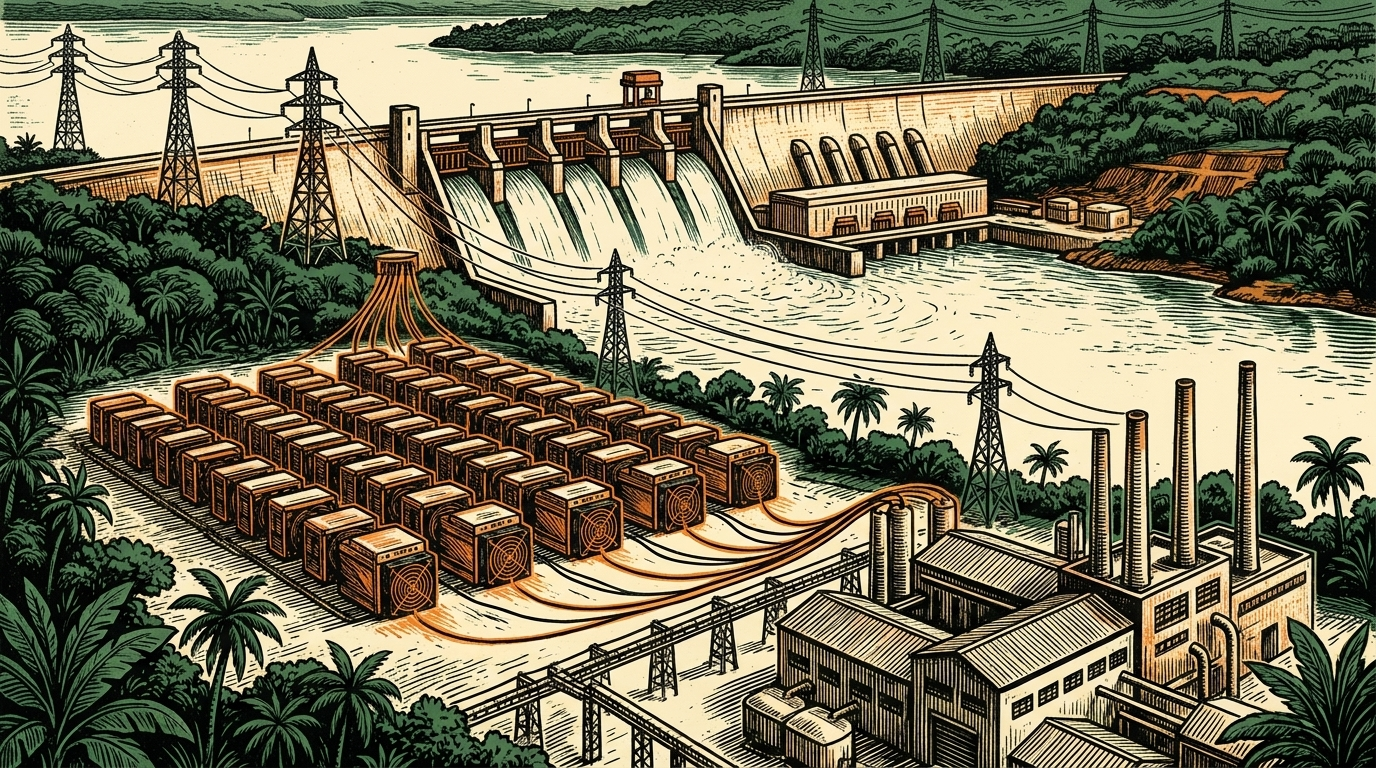
Paraguay built its bitcoin-mining boom on one number: electricity at roughly three cents a kilowatt-hour, the cheapest surplus in the Americas, spilling off the giant Itaipú and Yacyretá dams. That number is climbing, and the boom is thinning out.
The national utility, ANDE, has pushed the regulated mining tariff from about $0.03 toward $0.06 per kilowatt-hour — a near-doubling — and warned that further increases could make roughly half of current operations unprofitable. The count of licensed miners has already fallen from 71 at the start of 2025 to 41 in 2026, largely as the higher rate squeezed out the smaller projects.
Fewer miners does not mean less mining. The survivors are bigger: just four firms now reserve 730 of the 944 megawatts held by all 41 operators. ANDE’s expected mining revenue has climbed from about $100 million in 2024 to a projected $350 million in 2026 — the utility earns more from a smaller, heavier roster.
For a state power company sitting on surplus hydro and short of hard currency, that is close to ideal: capture the revenue, shed the marginal operators, keep the load concentrated where it can be metered. Miners still grumble about roughly 8% network losses at the substation — drawing 100 MW but paying for 108 — a reminder that “cheap power” is never quite as cheap as the headline rate.
Mining rents the cheap edge of a grid. It never owns it.
The deeper pressure is competition for the same electrons. Artificial-intelligence data centres chase the exact profile bitcoin miners prize — large, steady, low-cost power — and can often pay more per megawatt while promising jobs and prestige a mining shed cannot. Paraguayan officials, like their peers from Laos to West Texas, increasingly eye that trade.
The clock is explicit. ANDE says every current crypto-mining contract expires on December 31, 2027, and calls the deadline non-negotiable as it looks to reclaim power for households and traditional industry. Miners are no longer being courted; they are being put on notice.
Paraguay is a gentler version of the pattern the Beacon tracked in Laos last week: not a plug pulled overnight, but a tariff dial turned until the economics do the eviction. The steelman for the miners is real — they monetised genuine surplus, turned spilled water into export earnings, and paid ANDE hundreds of millions for the privilege.
But the surplus was never theirs. When a better-paying tenant appears, or the state simply wants its power back, the lease gets repriced or torn up. The miners that endure in Paraguay will be the largest and best-capitalised — the ones that can survive six-cent power, and are already scouting the next country with three-cent surplus.
Why it matters: the cheapest power on earth is also the most contested. Bitcoin mining thrives at the margin until the margin becomes valuable — then it has to move.
Editor’s note: tariff figures ($0.03→~$0.06/kWh), the operator count (71→41), the 730-of-944 MW concentration, the $100m→$350m ANDE revenue path and the Dec 31, 2027 contract expiry come from the industry and regional reporting cited above; some are projections and may be revised as ANDE finalises rates.
Free. Five minutes. No hype.
Subscribe free