 The Bitcoin Beacon
Draft amendments would let the government mine bitcoin and stand up a national crypto reserve — a small, indebted, river-rich country betting on a stack.
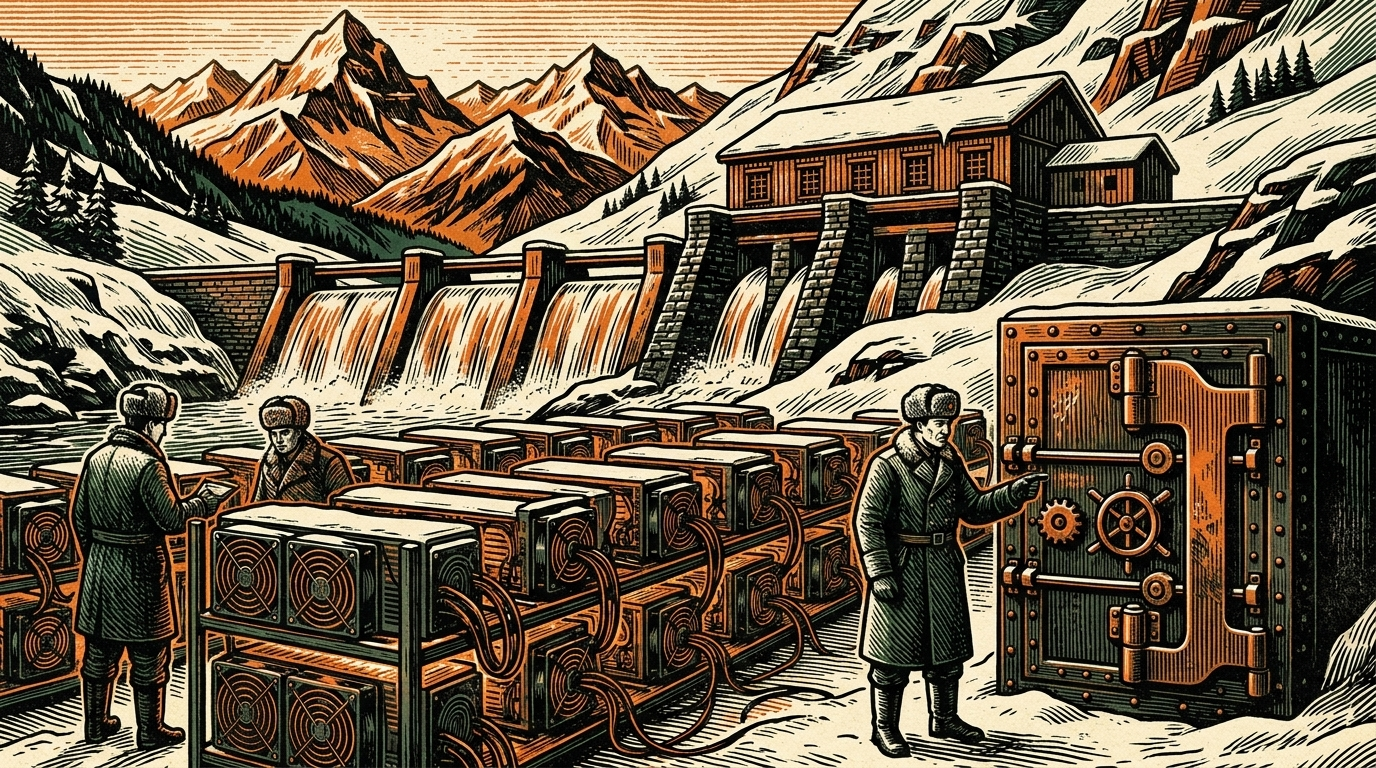
Kyrgyzstan wants to do what most governments only tolerate: mine bitcoin itself, and keep it. Draft amendments to the country’s virtual-assets law would introduce two new legal creatures — “state mining” and a “state cryptocurrency reserve” — and sketch how a small Central Asian republic might build a sovereign stack from its own rivers.
The reserve, as drafted, would be filled three ways: by state-run mining, by tokenising real assets, and by issuing stablecoins backed by the national currency, the som. It is an unusually explicit blueprint for turning surplus hydropower into a balance-sheet asset the state controls end to end.
Kyrgyzstan has two things bitcoin mining wants: mountains full of falling water and a shortage of hard currency. Roughly 90% of its electricity comes from hydropower, and it has long exported seasonal surplus cheaply. Mining lets it export that same energy as bitcoin instead — no transmission line to a neighbour, no buyer to haggle with.
For a heavily indebted economy, a reserve it mines rather than buys is appealing precisely because it costs energy, not foreign exchange. Where Taiwan debates spending dollars on bitcoin and El Salvador buys it on the open market, Kyrgyzstan proposes to manufacture its reserve from the one resource it has in abundance.
The risks are equally plain. State mining plants a volatile, price-sensitive business inside a government budget — when bitcoin falls or difficulty rises, the loss lands on the treasury. Hydropower is seasonal; the same rigs that soak up spring meltwater compete with households for scarce winter power, the squeeze that just cost Laos its miners.
Then there is the company the plan keeps. Kyrgyzstan is already home to the A7A5 stablecoin, a som- and ruble-linked token that reportedly moved somewhere between $72 billion and $93 billion in 2025 and has drawn scrutiny as a possible sanctions-evasion rail. A “state cryptocurrency reserve” built partly on state-issued stablecoins invites exactly the questions Russia’s new trade law does — and Bishkek sits squarely in Moscow’s economic orbit.
The cheapest bitcoin a river-rich state can hold is the bitcoin it mines.
This is a bill, not a launch. Draft amendments can be watered down, stalled or quietly shelved, and “the state will mine bitcoin” is far easier to legislate than to operate profitably through a full price cycle. The Beacon has watched several sovereign-mining pledges — from Pakistan’s promised national reserve to assorted “in weeks” mines — crawl from announcement to hashrate.
Still, the direction is the signal. A year ago, sovereign bitcoin was a story about El Salvador and a few US states. Now a landlocked Central Asian republic is writing state mining and a national reserve into statute. Holding bitcoin has stopped being exotic for a government; the argument now is over how — buy it, mine it, or print a token and call it a reserve.
Why it matters: once “mine your own reserve” is written into law, every mountain economy with cheap water has a template — and a temptation.
Editor’s note: the “state mining” and “state cryptocurrency reserve” provisions are draft amendments to Kyrgyzstan’s virtual-assets law and are not yet in force. The A7A5 stablecoin’s reported $72–93bn of 2025 flows are third-party estimates; its links to sanctions-evasion concerns are allegations under external scrutiny, not settled findings.
Free. Five minutes. No hype.
Subscribe free