 The Bitcoin Beacon
The central bank’s own QR rail now carries bitcoin, converted to pesos at the till — a spend button bolted onto a $35-billion remittance economy.
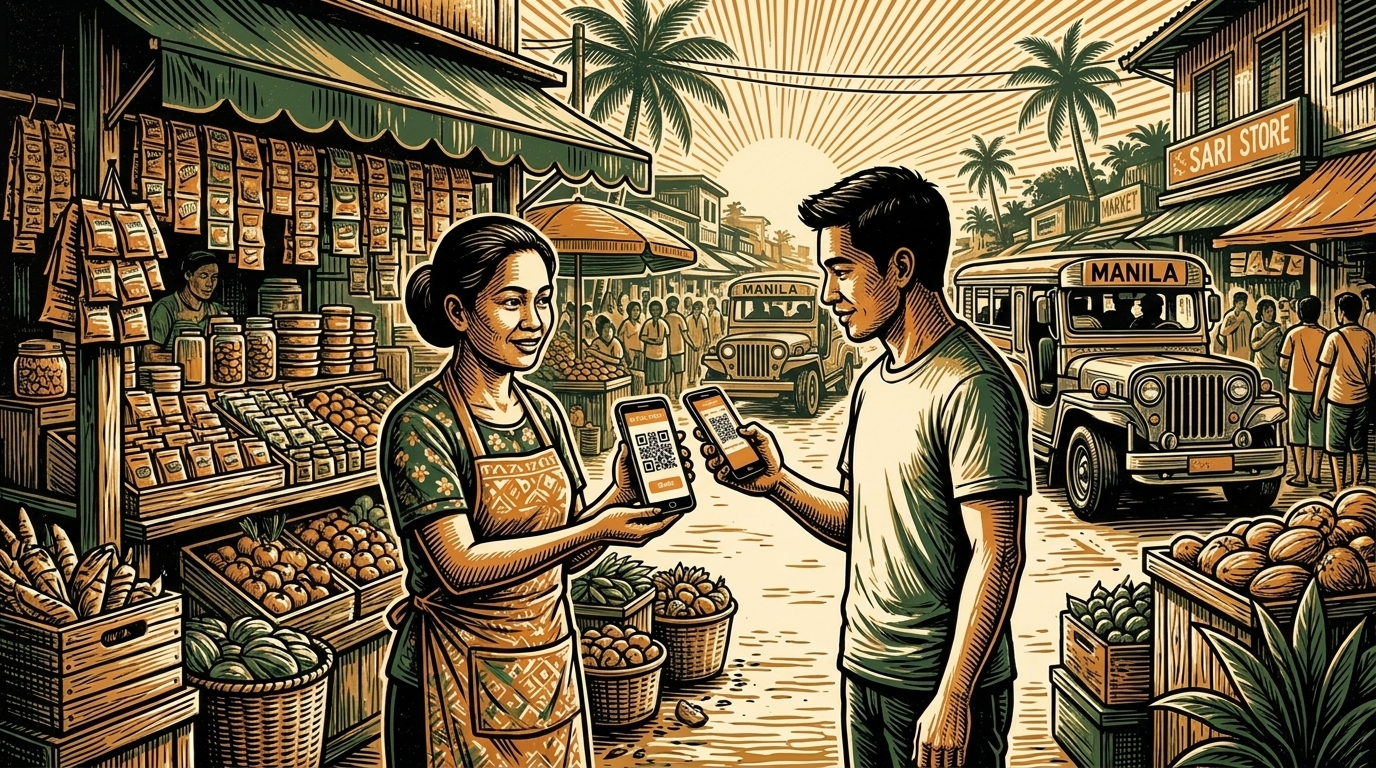
The most consequential thing about spending bitcoin in the Philippines is how little the shopkeeper has to know about it. A customer opens a wallet, scans the same QR sticker taped to the counter for every other digital payment, and pays. The store sees pesos land in its account. Whether the money arrived as bitcoin, a stablecoin or a bank transfer is, from the merchant’s side, invisible.
That is now possible at roughly 700,000 merchants nationwide. The wallet Coins.ph connected bitcoin and ether to QR Ph — the national QR standard built by the Bangko Sentral ng Pilipinas — so that crypto balances can be spent anywhere the country’s interoperable QR is accepted, with an automatic conversion to pesos at checkout. The merchant is never exposed to a price swing; the customer simply spends.
Merchant bitcoin acceptance has been tried in dozens of countries by bolting a new app onto a shop. It rarely sticks, because it asks the merchant to install something, learn something and trust something. Routing bitcoin through QR Ph inverts that. The shop already accepts the national QR; nothing changes on its side. The integration meets the payment network where it already is, rather than asking hundreds of thousands of small businesses to adopt a parallel system.
It is the same pattern the Beacon has tracked from Bolivia’s OpenBCB rail to Africa’s settle-in-fiat gateways: the winning products hide bitcoin entirely and compete on being a cheaper, faster checkout. The Philippines is a natural fit because it built the plumbing first. The country was among the first anywhere to route stablecoin payments — USDT and USDC — through a national QR standard earlier in 2026; adding bitcoin extended an existing rail rather than laying a new one.
The shop already accepts the national QR. Nothing changes on its side.
Payments are only half the pull. The Philippines is one of the largest remittance markets on earth: Filipinos abroad send home more than $35 billion a year, over $12 billion of it from the United States alone. Traditional remitters have long skimmed 6–10% off those transfers, and Lightning-based services have undercut that for years — bitcoin used as an invisible wire that turns dollars into pesos in seconds.
Bolt a domestic spend button onto that inflow and the loop starts to close. Money can arrive from abroad over bitcoin rails and be spent at the corner store over the same national QR, without a detour through a bank branch or a cash-out fee. For a household living on remittances, the friction removed is not abstract; it is the cut that used to disappear at both ends of the transfer.
None of this is happening in a vacuum of oversight. The BSP has moved to harden its rules for virtual-asset service providers even as it lets bitcoin onto the national rail, ordering stricter screening, monitoring and delisting standards. Its guidance leans on a due-diligence checklist — issuer background, market maturity, real use cases, transparency, traceability and security, and legal compliance — that a token must satisfy before a regulated provider lists it. Bitcoin, as the oldest and most liquid asset, clears those bars easily; the framework is aimed more at the long tail of tokens behind it.
Two caveats keep this from being a circular-economy fairy tale. First, auto-conversion means most of these transactions are a payment rail, not a bitcoin standard: the customer spends bitcoin, the merchant banks pesos, and the peso economy is undisturbed. That is a feature for adoption and a limit on how “bitcoin” the everyday economy really becomes. Second, stablecoins share the same rail and, as across most emerging markets, do the heavy lifting for people who just want something dollar-shaped; bitcoin is the neutral, issuer-less option riding alongside them rather than the volume leader.
Set against those limits is a simple fact: a national payment network with hundreds of thousands of merchants now treats bitcoin as spendable money by default. In a country that never passed a legal-tender law, adoption is arriving the way it usually does — not by decree, but because someone made it the path of least resistance.
Editor’s note: the QR Ph bitcoin/ether integration was announced by Coins.ph in May 2026; this dispatch reports it as the live state of everyday bitcoin spending in the Philippines alongside the BSP’s tightened VASP due-diligence regime. The 700,000-merchant reach and ~$35bn remittance figures are company and industry estimates. Strike’s Philippines Lightning remittance service dates to 2023 and is cited as background. Coins.ph’s planned PHPC peso stablecoin is a separate, BSP-pending product.
Free. Five minutes. No hype.
Subscribe free