 The Bitcoin Beacon
The “battery of Southeast Asia” invited miners to soak up spare hydropower. Buried in debt, it now wants the electricity back for industry and AI.
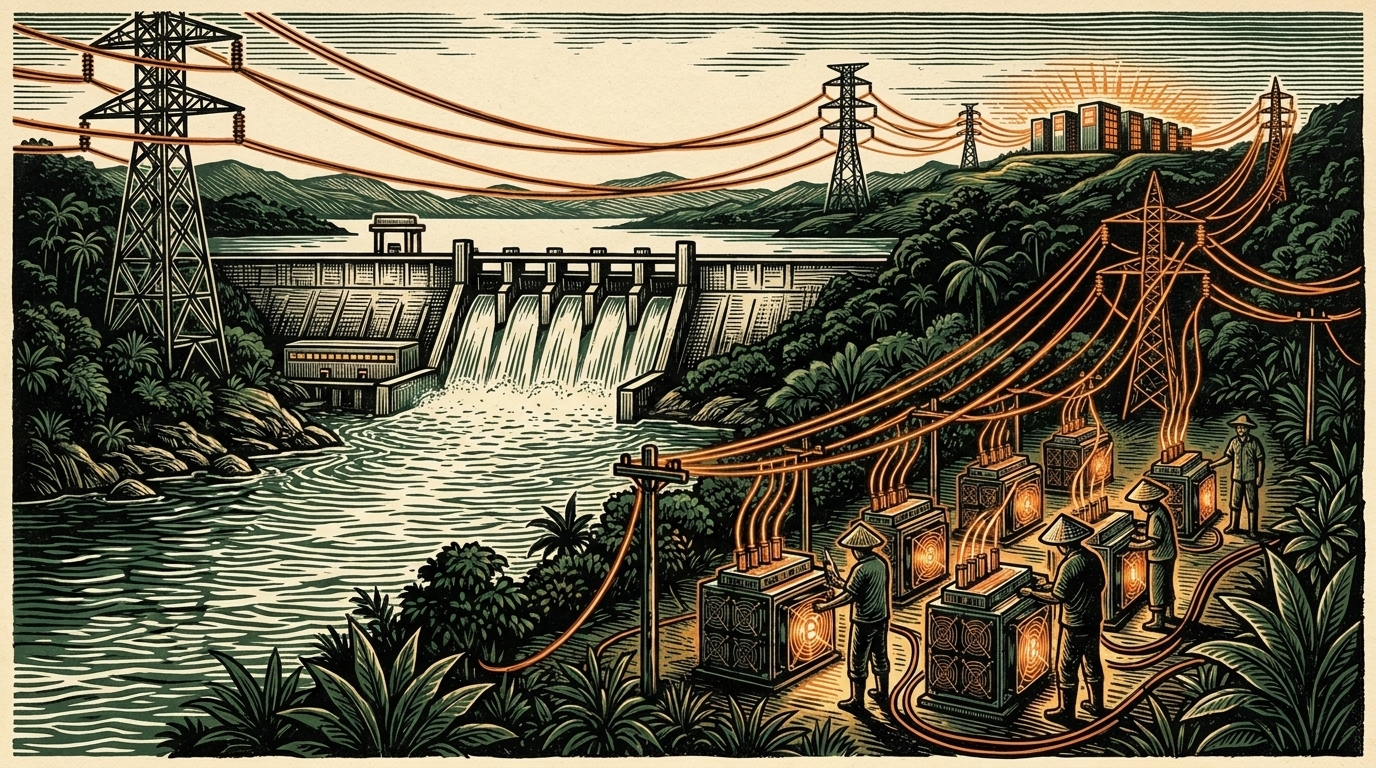
A few years ago, Laos looked like a natural home for bitcoin mining. The landlocked country had built dam after dam on the Mekong and its tributaries, branding itself the “battery of Southeast Asia,” and it often generated more power in the wet season than it could sell. In 2021 it licensed crypto mining to soak up that surplus and earn hard currency. Now it is reversing course.
Deputy Energy Minister Chanthaboun Soukaloun has said the government is moving to cut electricity to crypto miners, telling Reuters the industry delivers few benefits and almost no jobs, and that the state would rather steer its power to activities that “contribute more to economic growth” — including AI data centers. It is a striking inversion of the sovereign-mining playbook the Beacon has tracked all month, from Kazakhstan’s tax breaks to Oman’s national pool: a state that once opened the door is now closing it.
The reversal is a lesson in what “stranded” power really means. Mining is the ideal buyer of energy nobody else wants — until someone else wants it. Crypto operations, mostly bitcoin, consumed more than a third of Laos’s electricity output last year, and a data-center and mining boom around Vientiane helped drive a roughly 50% jump in domestic electricity demand in the first half of the year, according to a World Bank manager cited at a UN forum. Power that had looked spare was suddenly load.
Hydropower makes the squeeze worse. Output swings with the rains: Laos runs a genuine surplus in the wet months and has to import electricity from its neighbors in the dry season. A miner that helpfully mops up wet-season overflow is also a fixed, always-on draw competing for scarce dry-season supply — and, unlike an aluminium smelter or a factory, it employs almost no one locally.
Mining is the ideal buyer of power nobody wants — until someone else wants it.
Behind the energy math sits a balance-sheet crisis. The World Bank projects Laos’s external public debt service will average about $1.3 billion a year through 2028 — on the order of 9% of GDP — much of it owed on the very hydropower build-out that made the country a battery. The strain is visible at the state utility: a Chinese dam operator has launched a roughly $555 million arbitration against Électricité du Laos over unpaid dues.
Against that backdrop, every megawatt has to justify itself in export revenue or domestic value added. Selling firm power to Thailand or Vietnam, or hosting an industrial customer that hires Laotians, beats renting it to mining rigs whose profits leave in bitcoin. When a government is this cash-strapped, the marginal, low-employment, high-consumption buyer is the first to be shown the door.
Mining’s defenders have a real case. In its wet-season window, mining monetized power that would otherwise have spilled over dam gates unsold, converting a physical surplus into hard currency a debt-laden state badly needed. The problem was never that the wet-season electrons had no better use; it was that Laos also faces a dry-season deficit and an export market for firm power, and an always-on miner sits awkwardly across both.
There is an irony worth naming. The alternative Laos now favors — AI data centers — can consume as much power and water as mining, or more, depending on scale; swapping one energy-hungry tenant for another is not obviously a climate win. And the AI pivot is the same move bitcoin miners themselves have been making from Paraguay to West Texas, chasing better-paying compute. Here the state is doing the swapping instead of the miner.
For bitcoin, the takeaway is the one this network keeps relearning: mining rents the edge of a grid, it never owns it. Where the surplus is durable and the politics stable, the rent gets paid for years. Where the surplus was a temporary accident of overbuilding and debt, the lease can be torn up as fast as it was signed. Laos courted the miners to survive its dams; it is dropping them for the same reason.
Editor’s note: the plan to cut power to miners reflects statements by Laos’s deputy energy minister reported by Reuters and secondary outlets in late 2025 and early 2026; timing and enforcement remain fluid. The one-third-of-output, 50%-demand-jump, ~$1.3bn debt-service and ~$555m arbitration figures come from World Bank commentary and news reporting cited above. “Mostly bitcoin” reflects those reports’ characterization of the mining fleet.
Free. Five minutes. No hype.
Subscribe free