 The Bitcoin Beacon
A 500-megawatt data center in a Himalayan valley is turning a small kingdom’s hydropower straight into bitcoin.
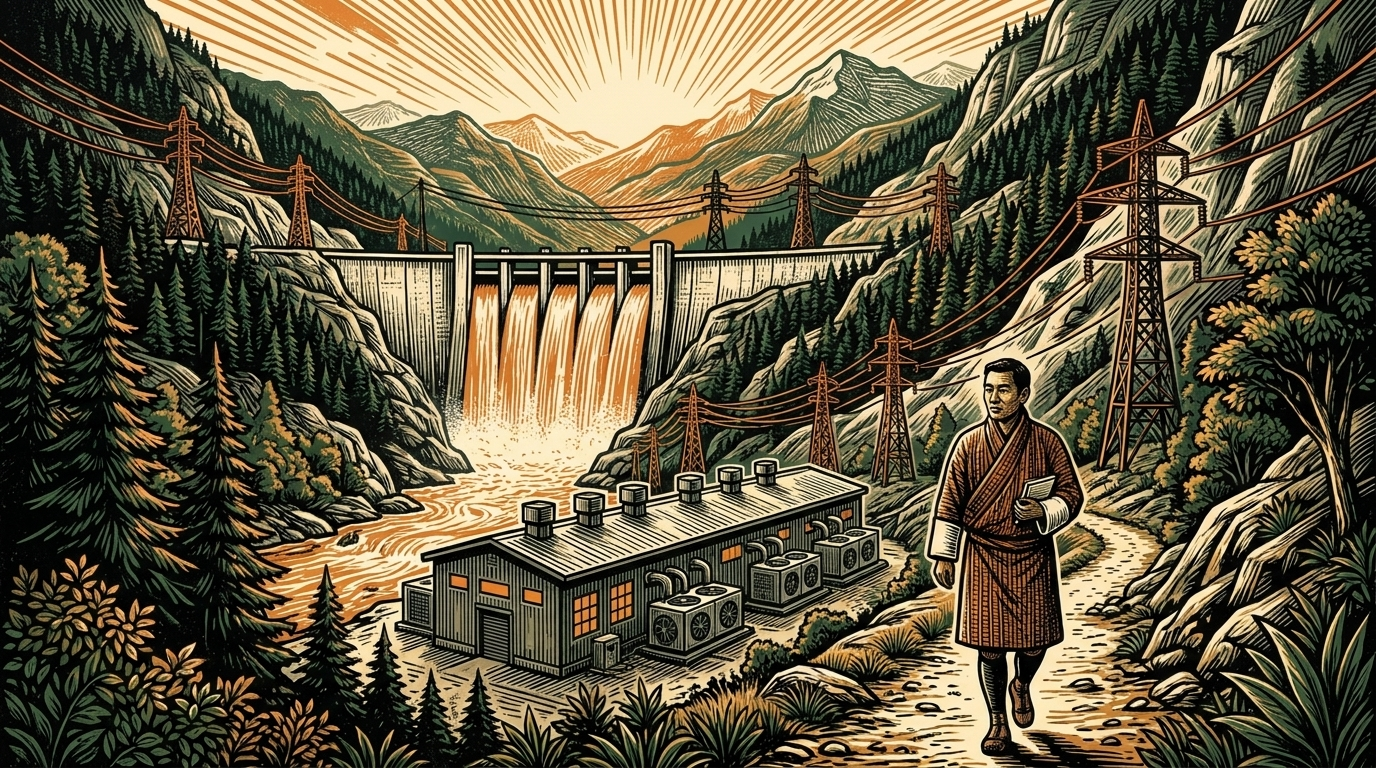
In a river valley in southern Bhutan, a 500-megawatt data center is powering up to its full design load this year, and every watt of it is aimed at one job: mining bitcoin. The Jigmeling facility, in the Sarpang district, is operated by the Nasdaq-listed miner Bitdeer and was built through a roughly $500 million fund partnership with Druk Holding & Investments (DHI), the commercial and investment arm of the royal government. Phased operations began in March 2025; 2026 is the year it runs flat out.
It makes Bhutan something almost no other country is: a sovereign that mines its own reserve asset directly, at industrial scale, on power it already owns.
Most states that hold bitcoin buy it, seize it, or receive it. Bhutan produces it. Through DHI, the government has quietly accumulated a hoard reported at more than $1.4 billion, built over years of hydro-powered mining rather than open-market purchases. Jigmeling, sitting on 70 to 90 acres of a larger 733-acre industrial estate, is the biggest single step yet in scaling that operation.
The revenue is not abstract. Combined with Bhutan’s existing sites, the country is estimated to mine on the order of 11 to 12 bitcoin a day — roughly $880,000 to $960,000 in daily output at recent prices. For a nation of fewer than 800,000 people, that is a materially large, hard-currency income stream flowing into the sovereign balance sheet.
Most states that hold bitcoin buy it or seize it. Bhutan produces it.
Bhutan’s advantage is geography. Steep Himalayan rivers give it abundant hydroelectricity, historically its main export to India, and that power is both cheap and carbon-free. Bitcoin mining is a way to monetize electricity that is otherwise hard to store or ship — especially surplus generated in the wet season that would otherwise be spilled. A mine is, in effect, a buyer of last resort for stranded megawatts, paid in a globally liquid asset.
That logic is why hydro-rich, remote economies keep turning up in bitcoin’s mining map. Bhutan’s twist is that the state itself, not a foreign operator extracting value, is the principal owner of the upside.
The strategy is a leveraged wager on bitcoin. Mining income rises and falls with the price and with network difficulty, and 2026 has been unkind on both counts: difficulty and hashprice have swung sharply, and miners worldwide have seen profitability compress. A treasury built on mined bitcoin is exposed twice over — to the asset’s price and to the economics of producing it.
There is concentration risk, too. The flagship facility is run by a single commercial partner, Bitdeer, whose own fortunes are tied to the global mining cycle. And Bhutan has been drawing on its bitcoin reserve to fund government needs, including public-sector pay, which means the pile is not a one-way accumulation but a working account — income mined at the top of the valley, spending flowing out the bottom.
Jigmeling reaching full power turns Bhutan’s rivers into a daily bitcoin income of close to a million dollars, on carbon-free power the state already controls. It is the clearest example yet of a government treating mining as national industrial policy — and, like any leveraged bet on a volatile asset, one whose payoff depends on prices and difficulty it cannot set.
Editor’s note: daily-output figures (11–12 BTC; ~$880k–$960k) and the >$1.4bn holdings estimate are drawn from secondary reporting and vary with price; Bhutan’s government does not publish a live reserve figure. The Jigmeling full-scale timeline is “during 2026” per local reporting rather than a single dated switch-on.
Free. Five minutes. No hype.
Subscribe free