 The Bitcoin Beacon
A currency crisis drained the country of hard cash — and pushed La Paz vendors, importers and even the state energy firm onto bitcoin’s rails.
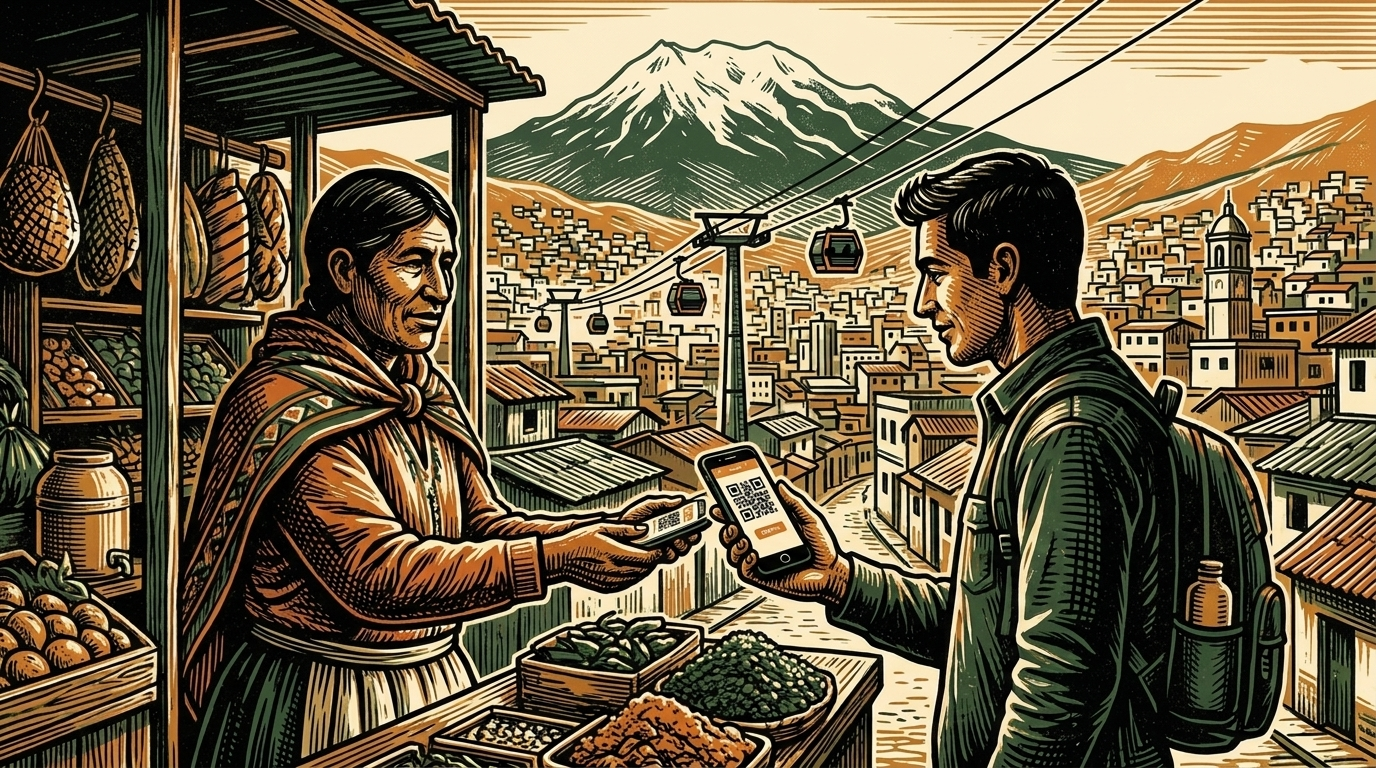
For a decade Bolivia was the awkward exception in Latin America: a country that had banned bitcoin outright since 2014 while its neighbours experimented. Then the dollars ran out. A widening gap between the official boliviano peg and the street rate hollowed out the banks, importers could not source hard currency, and by 2024 the central bank quietly reversed the ban. What followed was not a policy triumph. It was improvisation — millions of people routing around a broken currency the only way left to them.
The numbers describe a stampede. Virtual-asset transactions handled through the financial system reached roughly $294 million in the first half of 2025, against $46.5 million in the same period a year earlier, according to figures the central bank itself has cited. That is growth of about 532% in twelve months, off a base of almost nothing.
Most of that volume is not bitcoin. It is dollar-pegged stablecoins, and a bitcoin paper should say so plainly: when a Bolivian importer needs to pay a supplier in Shenzhen or São Paulo, they reach for a digital dollar, not a volatile reserve asset. Car dealers began taking stablecoins because it was the only way to pay for the vehicles they imported.
But underneath the dollar demand sits a bitcoin layer doing the work stablecoins cannot. Small, instant, sub-cent payments over the Lightning Network have become the practical rail for everyday commerce. In La Paz, a coffee stand takes payment through a Blink wallet QR code; barbershops and gyms accept satoshis; in Cochabamba, crypto ATMs have appeared and salons offer discounts for paying in bitcoin. For amounts too small and too frequent to justify a bank wire that no longer clears anyway, Lightning is simply cheaper than the alternatives.
A ban held for ten years. A dollar shortage broke it in one.
The most telling adopter is not a merchant but the government. YPFB, the state-owned energy company, has turned to crypto to settle some fuel-import deals — because the dollars to pay foreign suppliers were not there. A country that criminalised digital assets a decade ago now uses them to keep the pumps running.
The rails keep thickening. On July 9, the payments firm AEON extended support for Bolivia’s national QR standard, OpenBCB, letting shoppers scan a merchant’s code and pay from a crypto wallet while the merchant is settled in bolivianos. That is the same architecture that made bitcoin acceptance frictionless in Kenya and South Africa: the buyer holds digital value, the seller receives local currency, and neither has to understand the plumbing in between.
Adoption born of crisis is not the same as adoption by choice, and it would be a mistake to read Bolivia as a bitcoin success story pure and simple. The dominant asset is the digital dollar, not bitcoin; much of the volume is people trying to preserve dollar purchasing power, not opting into a new monetary standard. If the boliviano stabilised tomorrow, some of this would recede.
The volatility cuts the other way too. A vendor who accepts satoshis in the morning carries price risk until they convert, which is why the QR-settle-in-local-currency model matters: it lets merchants touch bitcoin’s rails without holding its swings. And a government paying for fuel in crypto is a sign of desperation as much as innovation.
Strip away the caveats and a hard fact remains. When a national currency fails and the correspondent-banking system stops returning calls, people need a way to move value that does not depend on either. Stablecoins give them a dollar. Bitcoin’s network gives them the rail — open, borderless, and running whether or not a bank in Miami approves the transaction.
Bolivia did not adopt bitcoin because a conference persuaded it or a president decreed it. It adopted the rails because the old ones broke and these ones were there. That is the least romantic and most durable reason any technology gets used: it worked when nothing else did.
A dollar shortage did what a decade of advocacy could not — put bitcoin’s payment rails into everyday Bolivian commerce. Stablecoins carry most of the value; bitcoin carries the small, instant, unstoppable part. The lesson is not that Bolivia chose bitcoin. It is that when money breaks, people take the rail that has no gatekeeper.
Editor’s note: much of Bolivia’s crypto volume is dollar-pegged stablecoins, not bitcoin; this piece isolates the bitcoin/Lightning payment layer and flags the stablecoin share explicitly. The $294M/532% figures are central-bank data cited in secondary coverage; the H1 2025 window predates this issue and is used as the most recent official measure. Merchant scenes are drawn from reported accounts. Verify before quoting.
Free. Five minutes. No hype.
Subscribe free