 The Bitcoin Beacon
Phoenix Group has 132 megawatts hashing at the Grand Ethiopian Renaissance Dam — and the state utility has stopped signing anyone else up.
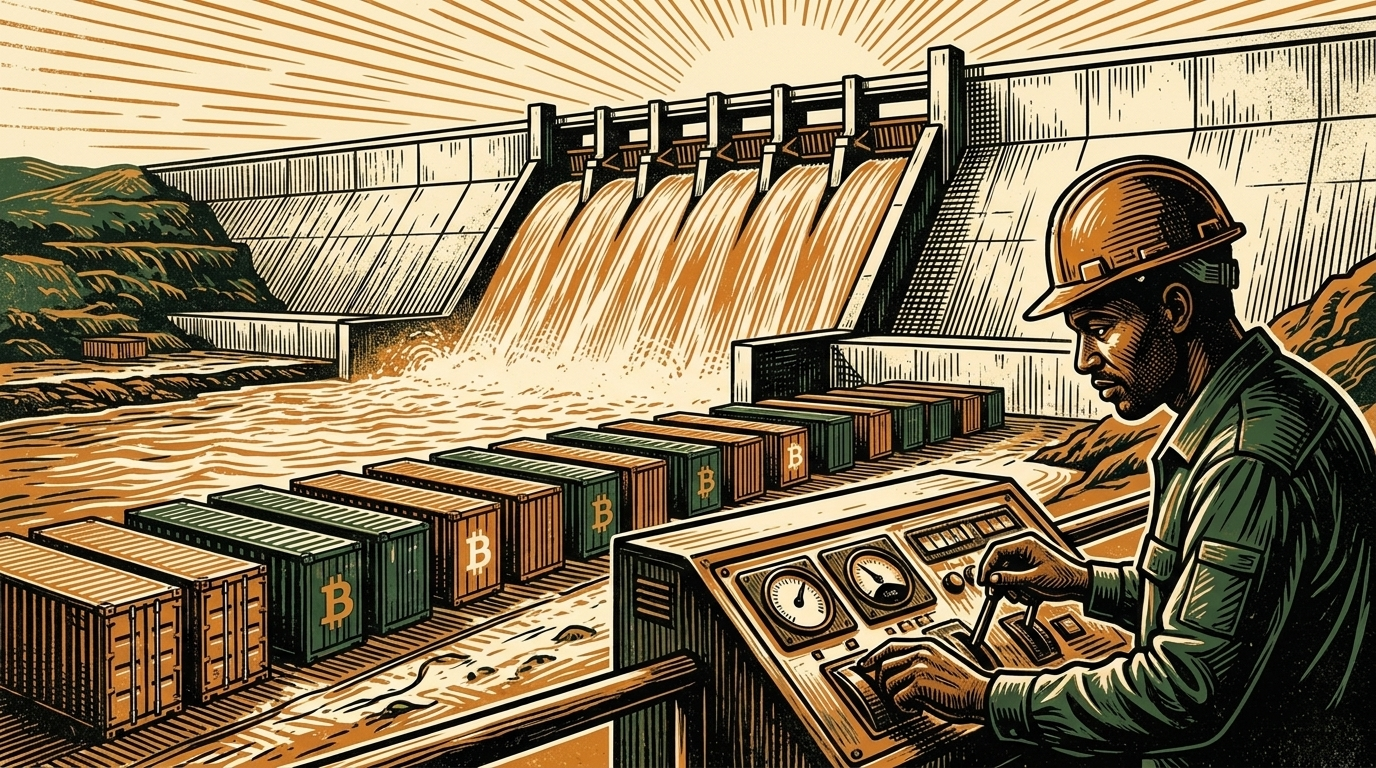
The Grand Ethiopian Renaissance Dam was built to light a country and sell power to its neighbours. It is also, increasingly, running bitcoin miners. Phoenix Group, a Gulf-based operator, now has 132 megawatts of mining capacity online in Ethiopia drawing on the dam’s hydropower, with another 90 MW expected to come on this year — a build that would push the company’s self-mining hashrate toward roughly 13 EH/s.
Ethiopia has become the mining story almost no one predicted. On the back of cheap, near-zero-carbon hydro, the country now accounts for something like 2.6% of the entire bitcoin network — enough to rank among the ten largest mining nations barely two years after it started courting the industry.
The pull is electricity that is both cheap and clean. Independent portfolios put Ethiopian power near $0.04 per kilowatt-hour, and because it comes from water rather than gas or coal, the coins carry almost no carbon. For an industry under permanent scrutiny over its energy mix, hydro-mined bitcoin is close to the best address you can have. Roughly 23 mining operations now consume an estimated 600 MW across the country.
For Ethiopia the appeal is the mirror image. The GERD gives the country more generating capacity than its grid and its export links can yet absorb, and miners are the buyer of last resort for power that would otherwise be spilled — a flexible, interruptible load that turns surplus water into hard currency. The government said in January it was actively seeking partners to build and operate mining infrastructure.
A dam built for electrification is being bankrolled, in part, by the one customer that will take power nobody else can use yet.
Then comes the catch. The state-owned utility, Ethiopian Electric Power, has stopped issuing new permits for supply to mining companies, saying it has reached the limit of what it can offer without shortchanging households and industry. Expansion is effectively frozen for anyone not already connected.
That freeze is the whole tension of frontier mining in one line. The same surplus that made Ethiopia attractive is finite, and the state has to weigh export revenue and domestic electrification against the miners bidding for the margin. Phoenix can finish the capacity it has already contracted; the next entrant may find the door shut.
Every megawatt of hydro that joins the network nudges bitcoin’s energy mix cleaner and its geography wider — away from the US-and-China concentration of the last cycle and toward stranded renewables in the Global South. That is the healthy version of the story: mining as the anchor tenant that makes a big public power project pay for itself.
The limit is a reminder that this is a rented edge, not an owned one. Ethiopia’s hydro will increasingly be claimed by its own growth and by export contracts, and miners are explicitly the load that gets shed first. The hashrate that hydro built can be throttled the moment the water is worth more elsewhere — which is exactly why the smartest operators treat cheap frontier power as a head start, not a home.
Ethiopia turned surplus hydropower into a top-ten share of the bitcoin network in under two years. The permit freeze shows the ceiling arrived just as fast — the surplus is real, and it is finite.
Editor’s note: capacity, hashrate and operator counts are drawn from company disclosures and industry trackers, which vary; Phoenix’s 90 MW addition and ~13 EH/s target are company projections. The permit freeze was reported earlier in 2026 and remains in force per the latest available reporting. Verify before quoting.
Free. Five minutes. No hype.
Subscribe free