 The Bitcoin Beacon
The June minutes show a committee split down the middle, an easing bias deleted, and inflation forecasts revised up.
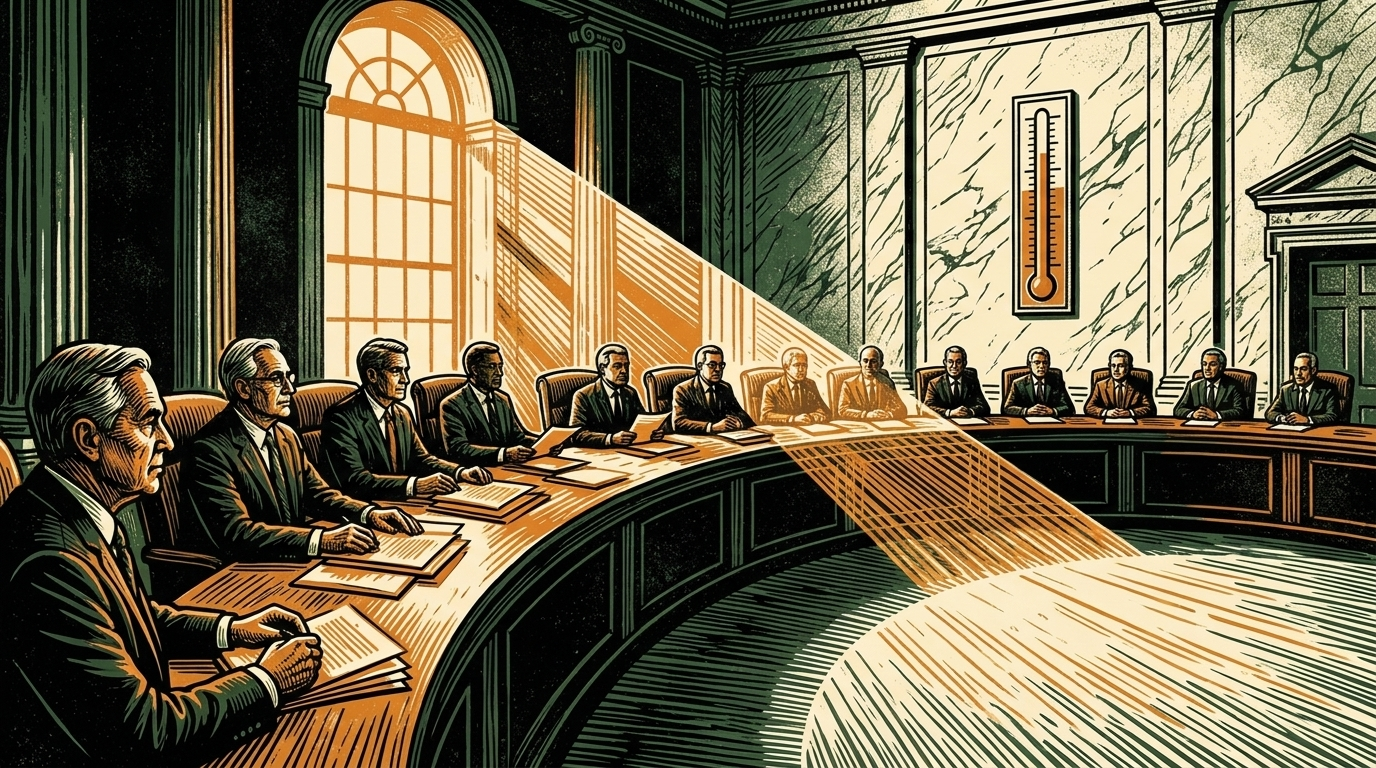
The Federal Open Market Committee held rates at 3.50–3.75% in June, unanimously. The minutes, released on July 8, show that the unanimity was cosmetic.
Nine of eighteen officials projected at least one more rate hike before the end of 2026. Eight projected no change. One projected a cut. Kevin Warsh, chairing his first meeting, declined to publish his own dot — a break with a decade of practice, and a straightforward statement that he does not intend to be bound by it.
The statement dropped its reference to an easing bias. Staff raised the quarterly core PCE projection from 2.7% to 3.3%. The minutes name three sources of upside inflation risk, and none of them are the kind a central bank can talk down:
All three are supply-side. Rates do not build power plants, unwind tariffs, or reopen the Strait of Hormuz. A committee that hikes into supply-driven inflation buys credibility and pays for it in output.
Higher-for-longer raises the opportunity cost of holding a zero-yield bearer asset. The textbook says bitcoin falls. It did not. It bottomed near $61,453 on the morning of July 8, recovered through the Asian session, and traded at roughly $64,341 by Friday morning — through a hawkish minutes release, a collapsed US–Iran ceasefire, and an $84.9 million net outflow from US spot bitcoin ETFs.
The rate story and the debasement story point in opposite directions. This week the debasement story won.
Two readings are available, and only one of them flatters bitcoin. The flattering one: with inflation forecasts rising and a Fed unwilling to commit, holders are buying a hedge against energy-driven currency debasement, exactly as the asset's advocates have argued for a decade. The unflattering one: bitcoin is a high-beta risk asset, it fell 1.5% on the Iran headlines like every other risk asset, and its recovery was a bounce off $61,400 support by algorithms, not a macro verdict.
The June meeting was Warsh's first. His refusal to show a dot means the market cannot price his reaction function, which is itself a policy choice: it maximises his flexibility and minimises the committee's ability to pre-commit. If nine officials mean it, the September meeting is live. If the Middle East supply shock persists, the Fed will be hiking into a war premium.
Bitcoin does not care which story is right until it does. Its 24-hour move through the minutes was a gain of 0.75%.
A split Fed with no visible chair and rising inflation forecasts is precisely the environment bitcoin was designed for — and precisely the one in which a levered risk asset gets sold. It cannot be both for long.
Editor’s note: dot-plot counts and the core PCE revision are drawn from press coverage of the minutes, not the primary document. Verify against the Federal Reserve’s published minutes before citing the 9–8–1 split.
Free. Five minutes. No hype.
Subscribe free