 The Bitcoin Beacon
The state utility will collect a record $350 million from miners this year — while it plans to hand their electricity to AI.
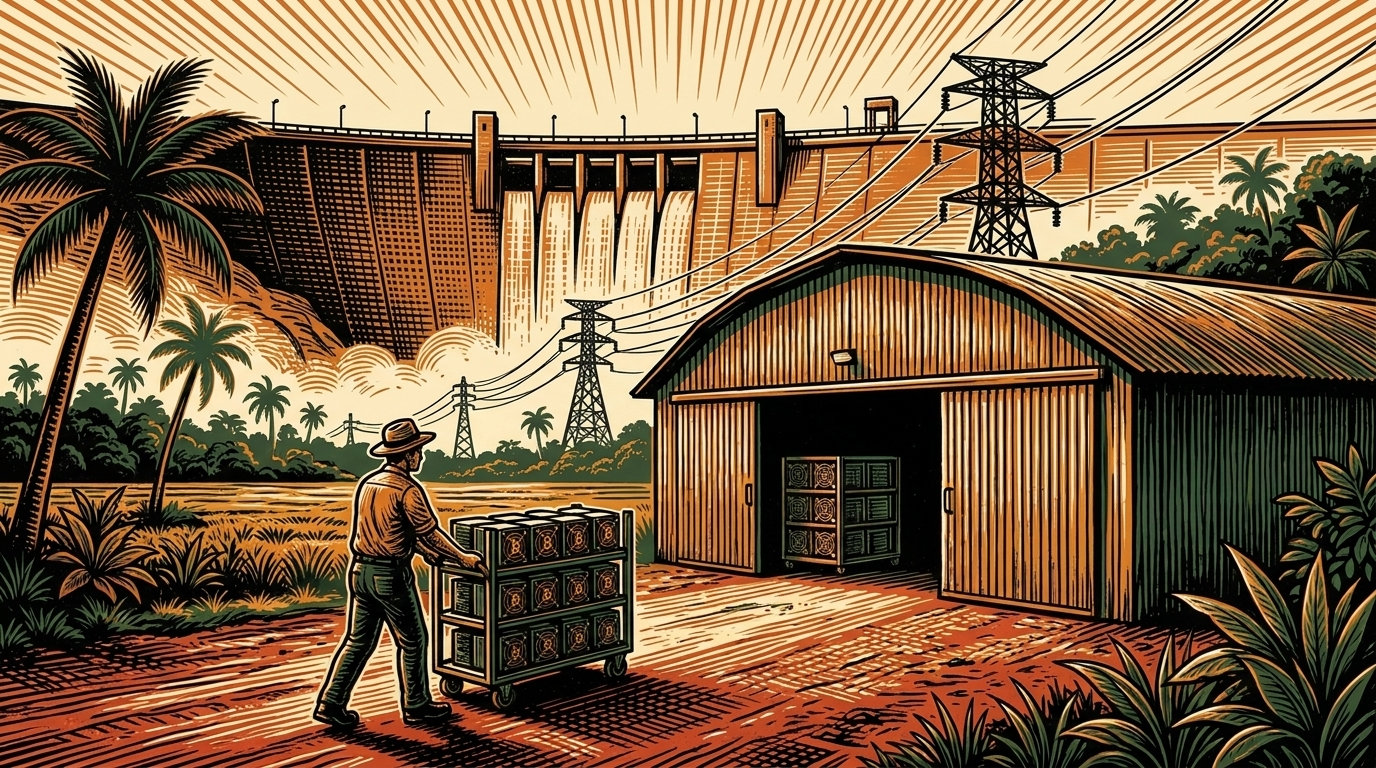
Paraguay runs almost entirely on water. The Itaipú and Yacyretá dams long produced more electricity than seven million people could use, and the surplus made the country one of the cheapest places on earth to mine bitcoin — roughly 4.3% of the global network runs here, behind only the United States, Russia and China.
This week the state utility ANDE put numbers on what that surplus is worth. It expects about $350 million in mining tariffs in 2026, up from $295 million last year and $100 million in 2024. Record revenue — from a shrinking industry.
Licensed operators fell from 71 at the start of 2025 to 41 today, a 42% drop. Higher power rates and guarantee deposits that can reach several million dollars pushed the small farms out; the survivors are giants. The 41 remaining miners reserve 943.8 MW, and four firms alone hold 730 MW — more than one of Itaipú's twenty turbines produces.
Consolidation suits the government. Big clients are easier to police than hundreds of small farms, some of which were caught tapping the grid illegally. The tax authority now chases crypto gains at the 10% income rate, and the country's first mining-related criminal case — over a noisy site in Villarrica — is in court.
Every current mining contract expires on December 31, 2027, and ANDE calls the date non-negotiable. The surplus is running down; the utility wants the power back for homes, industry and the data-center buyers President Santiago Peña has been courting in Taiwan and the United States. A senior telecoms official put the plan in one line: unplug crypto, plug in artificial intelligence.
Mining rents the surplus. It never owns the grid.
Local experts add a caution: AI data centers need near-perfect uptime, serious cooling and bandwidth Paraguay does not yet have. Swapping ASICs for GPUs is not a cable change. If the pivot stalls, the miners' leases may get quietly extended — which is exactly the leverage ANDE now enjoys.
The consolidation has not stopped new money at the door. Bitplanet, the Seoul-listed company building one of South Korea's most aggressive bitcoin treasuries, said its first mining machines — part of a roughly $10.8 million deployment agreed with Nasdaq-listed Antalpha — began hashing this month at colocation sites in Paraguay and Oman. First-phase output is modest, about 7 BTC a month, feeding a treasury of 300 BTC with a stated target of 10,000.
That is the shape of the market ANDE built: thinly capitalized newcomers eye Bolivia and Venezuela, while funded players buy space inside the fortress.
Bitcoin mining's superpower is being the buyer of last resort for stranded energy. Paraguay is the test of the corollary: when a richer tenant finally shows up, the lease ends. Miners who treat cheap power as a permanent right, anywhere, are reading the contract wrong.
Editor’s note: ANDE figures are the utility’s own projections as reported July 7; Bitplanet’s output targets are company estimates and depend on uptime and difficulty.
Free. Five minutes. No hype.
Subscribe free