 The Bitcoin Beacon
Deep in São Paulo state, an agribusiness giant and the world's largest stablecoin issuer are turning sugarcane waste into hashrate — a preview of how the Global South could quietly become bitcoin's next mining frontier.
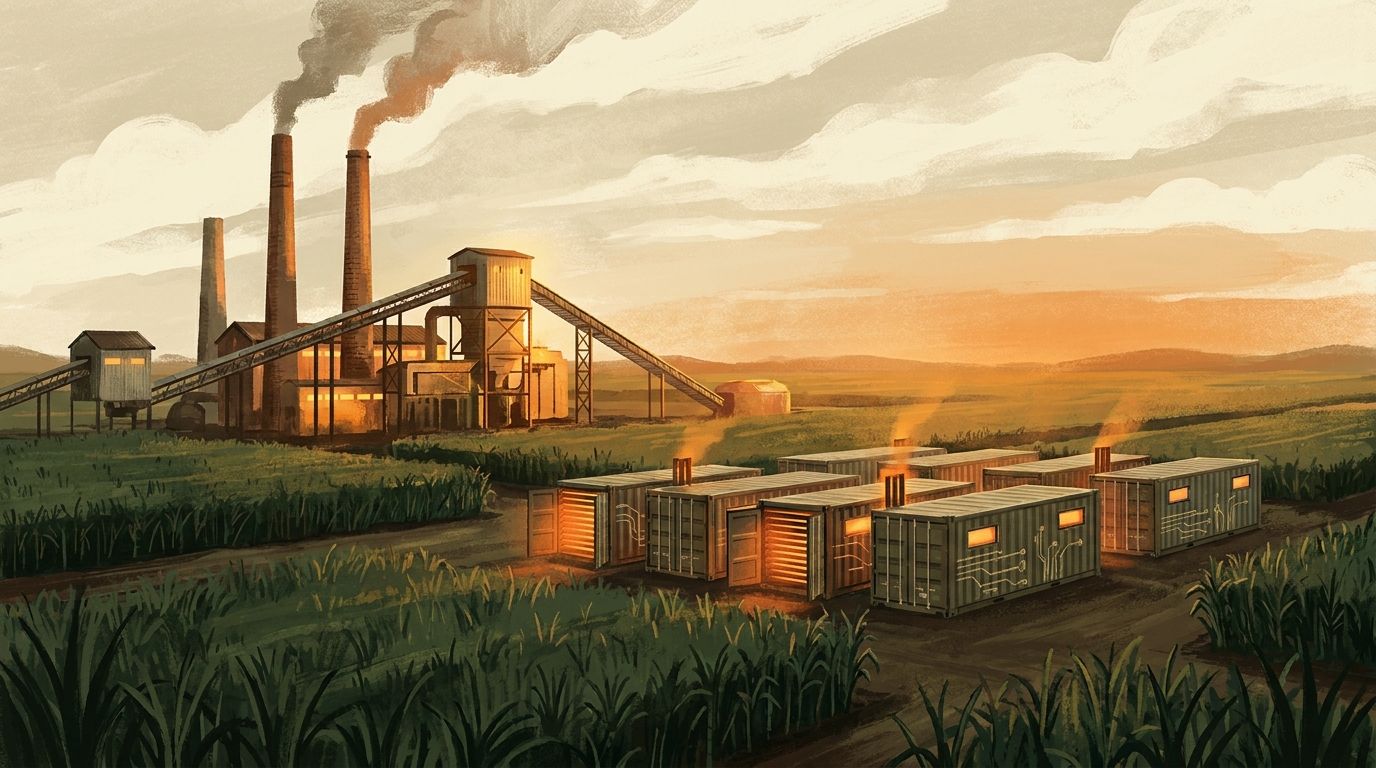
At a sugar-and-ethanol mill in the interior of São Paulo state, the fibrous pulp that's left after sugarcane is crushed — a material called bagasse — used to be mostly a disposal problem. This month it started doing something new: powering rows of bitcoin miners. Adecoagro, one of South America's largest agribusinesses, has begun energizing an on-site mining operation of roughly 10 megawatts and about 1,280 machines, with Tether — the company behind the world's largest stablecoin — a major shareholder in the venture.
It is a small deployment by industrial standards. But what it represents is not small at all: the marriage of agricultural waste, cheap stranded energy, and a globally liquid monetary network — in a part of the world that Western bitcoin coverage almost never looks at.
Cane mills already burn bagasse to generate their own electricity and steam; it's one of the reasons Brazilian sugar-ethanol is among the more energy-self-sufficient crops on earth. The catch is timing and scale. Bagasse energy is seasonal, lumpy, and often produced in excess of what a mill needs or can profitably sell back to a distant, congested grid. That surplus is classic stranded energy — real power with no economical buyer.
Bitcoin miners are the buyer of last resort for exactly that kind of power. An ASIC doesn't care where it sits; it only needs electricity and a network connection, and it will convert otherwise-wasted joules into a settlement-final, globally salable asset. For a mill, that turns a disposal cost into a revenue line — and does it without competing with anyone for grid capacity.
Stranded energy is bitcoin's quiet superpower: it turns what a grid can't use into something the whole world will buy.
Tether's presence is the tell. Flush with reserve income, the company has spent the past two years vertically integrating into bitcoin's physical layer — energy and mining — across Latin America, from El Salvador to Uruguay and now Brazil's cane belt. The logic is strategic rather than sentimental: owning hashrate diversifies Tether beyond its treasuries, hardens its bitcoin position, and plants an industrial footprint in fast-growing, energy-rich economies where regulators are increasingly friendly.
For Adecoagro, the appeal is simpler still. It already produces the power. Mining lets it monetize the megawatts it can't sell, in a currency that doesn't depend on the Brazilian real holding its value.
For most of bitcoin's history, mining clustered wherever power was cheapest and capital was nearest — lately, heavily in the United States. Projects like this one nudge the map. Every mill-scale operation in Brazil, every hydro-powered rig in Bhutan or Ethiopia, every flare-gas site in the field spreads the network's security across more jurisdictions and more energy sources — and, not incidentally, ties it to renewable and waste power rather than fossil baseload.
There's an adoption angle too, and it's the one we care about most. Countries that mine bitcoin tend to build the domestic expertise, the jobs, and the political constituency that make them more likely to use and hold it. Hashrate is a gateway drug for policy. A sugar mill in São Paulo isn't just earning sats; it's quietly giving Brazil a stake in the network's future.
A 10-megawatt mine in a cane field won't move the hashrate needle by itself. But it's a clean template — waste biomass, willing host, patient capital — that replicates across the world's sugar belts, from Brazil to India to Thailand. Watch whether Adecoagro scales past the pilot, and whether other mills follow. That's how the Global South becomes a mining power without anyone announcing it.
Editor's note: capacity (~10 MW), machine count (~1,280) and timing figures are per company statements and early reporting; we're confirming specifics and will update. Figures current as of publication.
Free. Five minutes. No hype.
Subscribe free